Aloha Kai

Screen Shot 2020-04-04 at 6.35.42 AM

ALOHA KAI

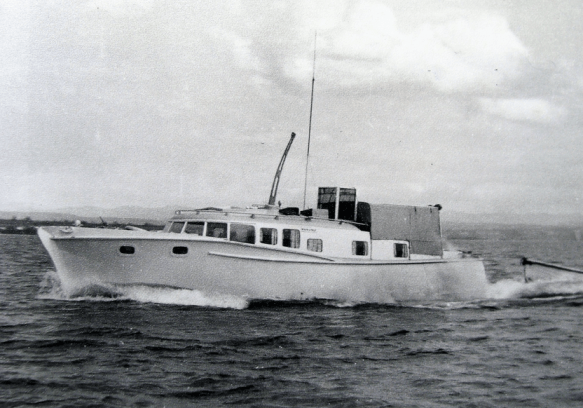
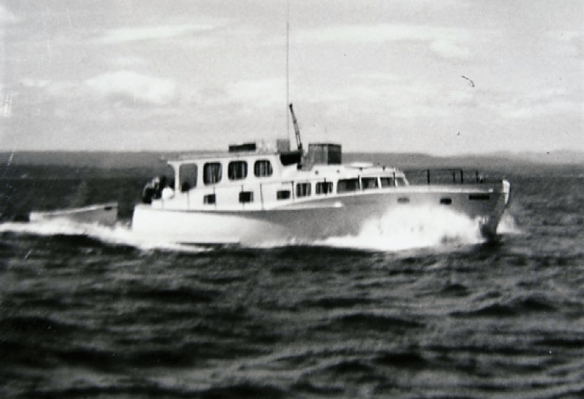
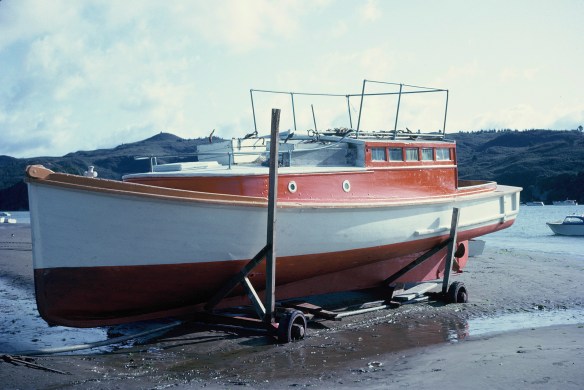
Today’s woody is the game boat Aloha Kai, seen above in a 1968 photo from Russell in the Bay of Islands.
On Lew Redwood’s fb, Charlie Baker commented that at the time she was owned by John Chibnell and that she was the fastest boat in the bay thanks to a Chev 454 V8 (petrol) engine. Her top speed was 35 knots, a step up from the norm of around 8.5 knots from the rest of the game fleet.
Douglas Burnage also commented that she may have been owned in 1980’s by Vic Otto and operated out of Houhora as a long-liner.
Can anyone tells us more about Aloha Kai eg design / builder and provide an update on what became of her?
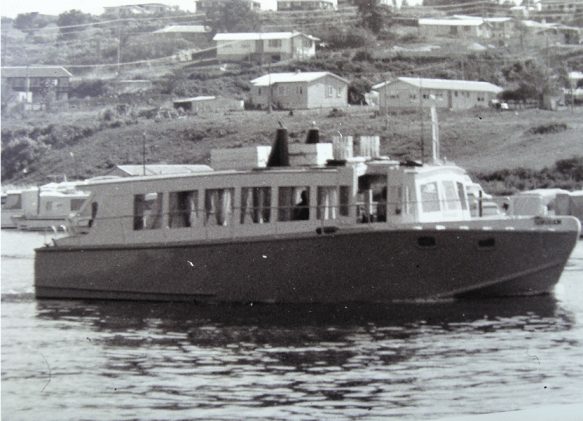
Update 24-05-2020 Photo below of Aloha Kai in Raio Creek Houhora – January 1994. Sent in by Craig Ogle.
IMG_0793

Tradition

Tradition @ Mahurangi Regatta 2016

Tradition at the Mahurangi Regatta 2017
Screen Shot 2020-05-16 at 9.18.55 PM

The 'Bar'

The Bar

TRADITION

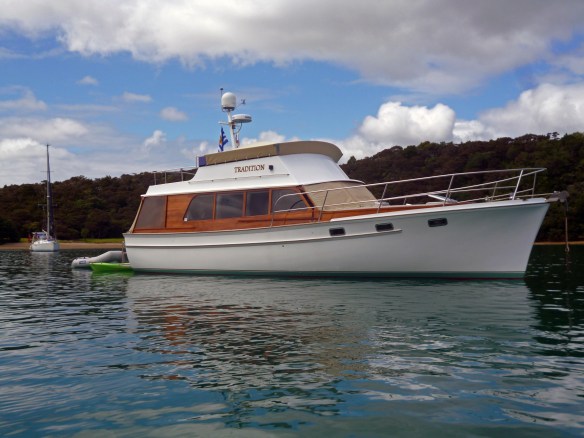
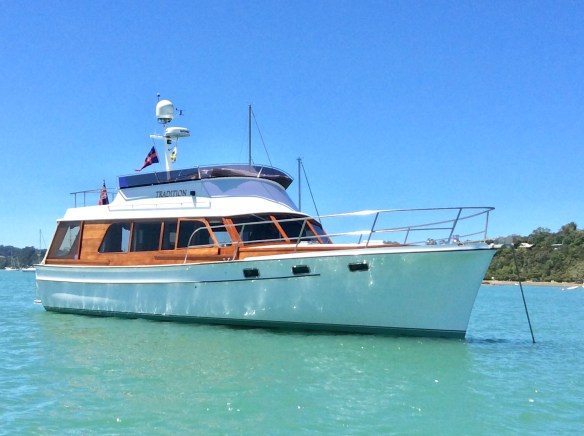
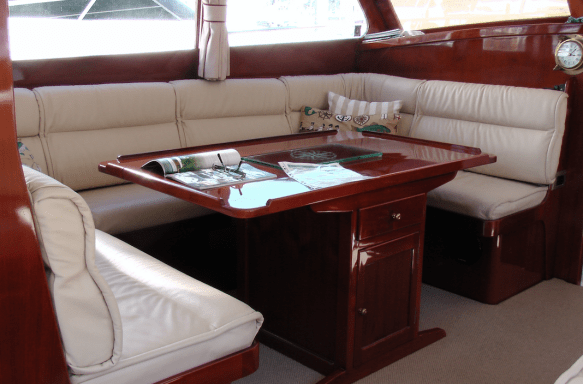
The 44’ launch Tradition slips comfortably into the woody ’Spirit of Tradition’ (excuse the pun) category – designed by Bo Birdsail and built by Geoff Bagnall, she was launched in 1990 for Rhys & Dick Boyd. Today’s WW story is a first for WW in that the format is an interview by Keith Busch (a former owner) with Rhys and Dick. Make yourself a cup of something and find a comfortable chair – its a cracker read and really showcases what a talented boat builder Geoff Bagnall is. Special thanks to Keith for pulling this story together – simply brilliant.  Full specs and ownership summary on the vessel at the end.

Keith : What do ‘Tradition’ and the Auckland pilot boat – Akarana, (designed by A. J. Collings & built by W. G. Lowe in 1960) have in common?*

Dick : I went into the fishing industry in the seventies. By 1985 I had a quota of my own and a purpose built long-liner – Kerama. Then the new owners of the company I worked for (Polar Seafood Co.) wanted me to come ashore and be fleet manager for all their trawlers.

Rhys : Anyway, one day he had just unloaded a catch and we were on our way home to our place near the Tamaki Bridge and he told me just how much he’d got per kilo for the fish he’d landed, and it was astronomical! Then he slipped in that he wanted to build a launch.

 Keith : So what year was this?

Dick : I would say it was 1985.

Rhys: So I said, ‘We’re not building a launch!’, and he said, ‘But I’ve got everything for it’, and I said,  ‘I don’t care, we’re going to buy another fishing boat, with prices like that we’re going to be loaded!’ So next day I go to work and on the way home I thought, ‘Oh that was a bit mean’. So he comes home that night and I said, ‘We need to have a talk’, and he said, ‘I’m going first. I’m building a launch!’, and I said, ‘I was just going to say that!’ So that was the beginning, it was like, ‘Oh I can’t do that to him, he wants it too much’. So we didn’t get rich, but we did get Tradition.

Keith : So where did you start, did you go for a builder or a designer first?

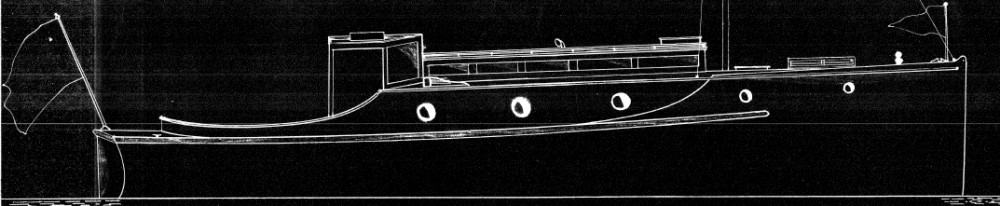
Dick : Well the designer was Bo Birdsall. I went to see John Lidgard first and I asked him to draw me a boat, but after a few sketches I wasn’t getting what I wanted. Then somebody, oh Roy Rimmer, said to me try Birdsall. So we met with Bo and he drew it up. We were real happy with his hull, it was great. But I still had a few questions about his topsides. Anyway, when we got Geoff onboard we thought we could start from Bo’s drawings and go from there, so that was the beginning of it. Bo was a real nice guy and extremely clever. He was good to work with.

Keith : So you were happy with the hull, how’d you end up with that beautiful topside?

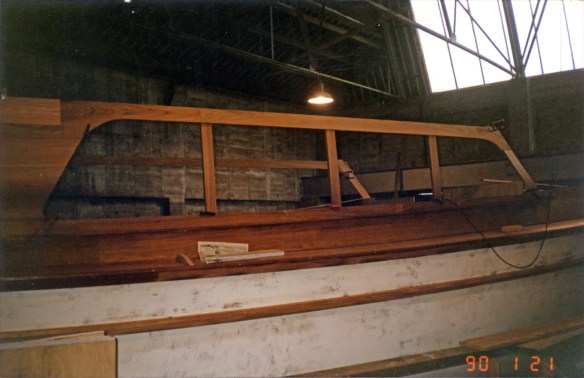
Dick : Well what happened was, Bo drew it up and he didn’t include the sedan roof on the fore deck, so it was just the main cabin sitting on the deck. But when Geoff was building the boat the radius that had to go into the forward area to give head room, well it just didn’t work. Anyway Geoff came up with the idea to put a sedan roof on the forward deck and just that small addition balanced out the main cabin nicely. It’s one of those things with a good builder, he just put up some false frames, then let us have a look at it and it worked. He’s got a great eye for those things you know, always looking as he goes.

Rhys : We didn’t get a drawing of it and say, ‘Yes that all works’. All of us looked at her as we went.

Dick : Of course Geoff would have put a little more sheer on it, because that’s just Geoff, but I liked Bo’s idea of the hull. It’s very hard during a build, a lot of the time you don’t know what you’re going to end up with. We had ladders all over the show. You’d be climbing up and down and looking along the boat and trying to imagine what it was going to look like in the water. Later we were down the side of Waiheke and this guy passes and yells out ‘Geez someone made a great job of that!’, so I think it in the end she works.

Keith : So going back a bit, how did you get Geoff Bagnall as your boat builder?

Dick : Well okay, first we started talking with Brin Wilson’s boys Richard and Bob Wilson, because Bo’s wife was related to the Wilson’s. Bo said ‘it would be good if you got the Wilson’s to build it. I’d had nothing to do with them so I got a price from them and I though ‘Well we’ve struck a bit of a wall here!’. So I talked to Bo and he said ‘Okay, then try young Bagnall’. So I contacted him and he was interested at a price we could manage and we went from there.

Keith : ‘Young’ Bagnall! He’s just retired! How old was Geoff at this time?

Dick : Just around forty or something about that, because he had built – Nazareth and the yacht. He’d already built several boats, oh and he’d built the one that hit the bricks going over to Barrier (Onetunga?), oh and Katoa. He would have built about 8 or 9 boats by then and he designed some as well, I think he designed Katoa. His boats are a little hard edged to my eye. More ‘solid’ compared to Bo’s lines I think.

Keith : So where was she built then. Was Geoff off on his own?

Dick :  When he did Tradition he built it in the old Harbour Board timber mill. The Harbour Board had just been privatised and they weren’t using their mill building at Westhaven, so Jack Fagan organised for us to use an area in the mill shed. That was real handy because all the woodworking equipment was in there so we could use it to deal with the timbers. All her timber work was done there in that mill building, except we sent the kauri out to a joker who did timber dressing in Rosedale Road and he did the whole lot. So it went out in flitches and it came back in nice dressed planks ready to go on the boat. The planks for the hull are inch and three-quarter by inch and a quarter heart kauri.
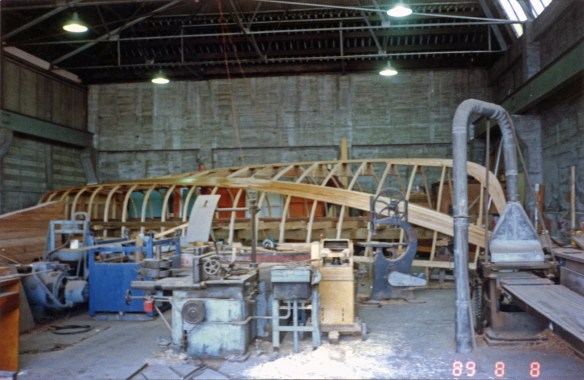
'Tradition' Construction-2

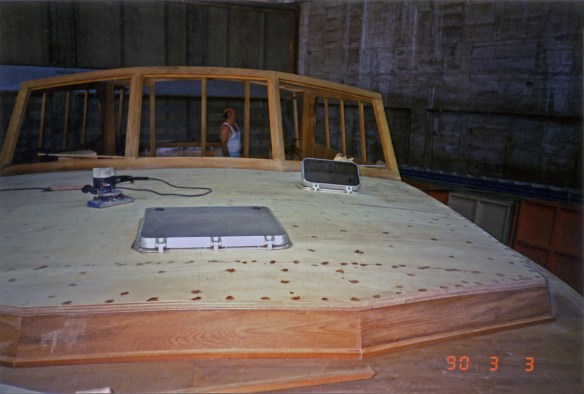
Work on Tradition commences in the Auckland Harbour Board Timber Mill building 1989

Keith : So where did the wood come from?

Dick : It came from Noel Mitchell who was the foreman at the Ports of Auckland slipway. When Akarana*, which was Auckland’s biggest pilot boat in those days, was being built, Noel had decided that a pilot boat could get smashed up real easy, so he bought enough kauri and teak for extensive repairs and put that aside to repair Akarana if she got crunched. There was talk of them selling this timber for houses but Noel said ‘No, it’s for boat building so we’re selling it for that. So that’s where we got the timber. We got all her heart kauri and the teak there.

Keith : So where exactly was the Harbour Board timber mill located?

Dick : Well, to the best of my memory, it was just past where ‘Sailors Corner’ is nowadays. On the left hand side of the road, well that was all Harbour Board land. Its where McMullen and Wing’s haul-out is now. The Harbour Board had three or four slipways there and they used to do all the work for us on the trawlers. They were close by so the company could keep the trawler crews employed by doing all the cleaning and paint-work and chip rust off the boats instead of spending all their time in the pub. So I knew Noel and it worked out pretty well.

Keith : So you got hold of Geoff and he was keen to take it on?

Dick : Oh yes. He had this old mate called Bert who used to sweep the floor and mix the glue and make the tea. Of course Bert has passed away now but he was a hell of a nice old guy and he worked on her as well.

Keith : Who else was involved in the build?

Dick : The wiring was Peter Galley, the painting was Mark Binney, plumbing was Alan Kemp, who was a Harbour Board guy. There was a lot of input from the slipway workers off and on and in their own time. Of course, I supplied them with fish non-stop so it was give and take, a bit of barter. The engineering was, oh well we did most of that stuff ourselves.

Keith : And the Ford engine was from Lees?

Dick : No, the engine was from Don Bernand,  Don is Mr Ford, he’s brilliant. I think we bought the engine in Tradition from Newlove in Whangarei and Don did the marinisation. He served his time with the Lane Motorboat Co. on the Tamaki River and when Lees got out of Ford he bought everything off them, all the patterns, moulds, that sort of stuff and set himself up at home. Don bought the new engine for me. It has a Newage Coventry 2:1 gearbox and the ‘get-home’ kit in it. At the time it was hard to find the gearbox we wanted but Don eventually found it and we fitted it. I can’t think who did the hydraulics, but it was all fitted by us.

Tradition Engine Room

Keith : So you gathered all her bits and pieces together. When did the build start?

Dick : It took me 6 years to put everything together before I got to the point where I could say, okay I’ve got enough to go and do it. During that time I had all the timber stored at home. At my son’s 21st we had the filches on sawhorses under the marquee so all the guests were sitting around on the kauri filches. They hung around for years reminding me to keep collecting stuff. The brass portholes in the cabin doors come from an old fish ‘n chip shop in Howick, while the ship’s bell is from the ill-fated ferro fishing vessel the – Trident.

Rhys : We’ll he’d been collecting things for a long time. He had some things ready to go. He’d probably told me he’d bought stuff for a boat but I hadn’t listened or realised it was enough to build a complete boat.
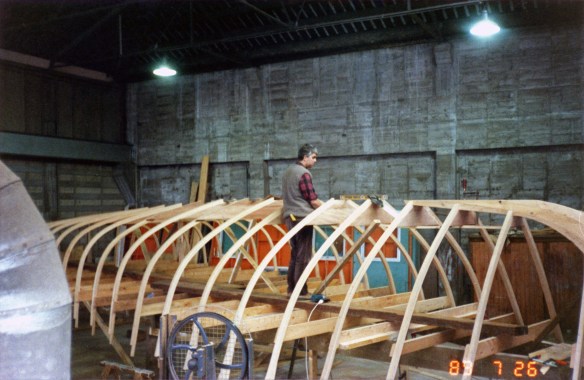
'Tradition' Construction-1

Boat builder Geoff Bagnall begins work, July 1989

Dick : The photo above is the laying out of the frames internally. You’ve got them all standing up there. That’s Geoff in his younger days. Geez he looks different there doesn’t he!

Keith : So the date on that photo is July 26th 1989, is that about the date she was started?

Dick : Would’ve been pretty close to it. Maybe a month before perhaps.

Rhys : Lucky the cameras had the dates on them in those days.

Keith : So tell us about all the effort of the construction.

Dick : Well we could lay 8 planks per day. So all the frames were stood up and we had the steam box ready for the planks there at the mill.
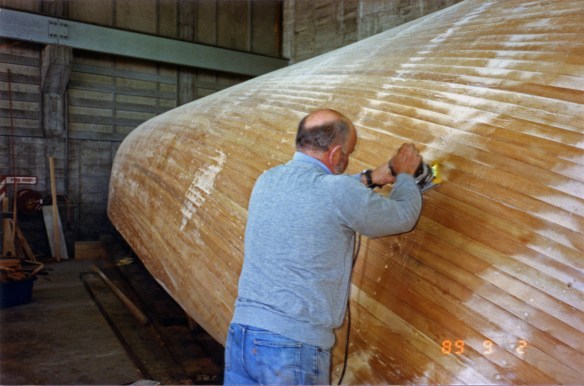
'Tradition' Construction-3

Original owner Dick Boyd sanding plugs on the hull, 1989

Keith : So you were coming down each day and helping Geoff?

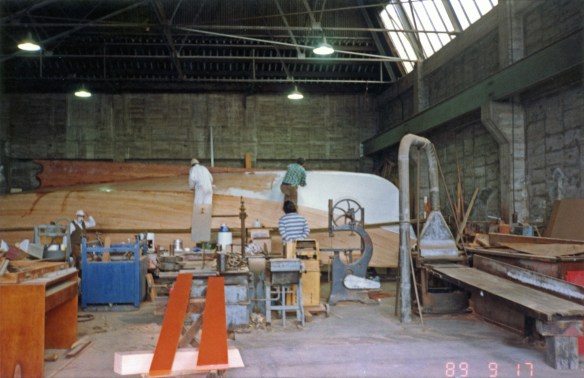
Dick : I used to come in at night after work and do all the plugging. So Bert, cuppa tea maker and floor sweeper, he used to help Geoff during the day. They used to put the timber in the steamer and the following morning they’d come in and put those 8 planks up and then put another 8 in the steam box. So it was pretty slow going. I’d come in after work and do the plugs. But they were always in front of me because you couldn’t work on the planks that they had just put up that day because you’re driving the plugs in, so I was always a bit behind them plugging and sanding.

Rhys : Don’t forget you had to make all those plugs yourself too.

Keith : So how many were there? Did you count?

Rhys : He wouldn’t be brave enough to count, that would have been tear-jerking.

Dick : No, it was slow work. But the reason I plugged it was that sometimes you wake-up in the morning and you’re able to see every bit of bog that’s gone into a boat and you shouldn’t be able to see that with proper plugging.
'Tradition' Construction-4

Geoff Bagnall and assistant Bert working on the hull, 1989

Dick : Roy Rimmer used to pop in to make sure we were doing everything right. There was a lot of interest in the boat, because it was very handy to everybody in the harbour area.

Rhys : A lot of people would pop in after work and see how we were getting on.

Keith : So why did you choose to build her in wood?

Dick : Well you’re right, wooden boats were not being built at the beginning of the 90’s and a lot of people said ‘What are you bloody well building a launch that big in wood for?’ But, you know, it was what we both wanted. If I go back to the days of the old ‘Golden Kiwi’ tickets, my nom-de-plume was always 44’x14’, that’s because I was determined I was going to build a wooden launch that was 44’ long with a beam of 14’. Ha ha, I never won the Golden Kiwi did I! But even way back then I was thinking of her, I suppose it was my dream. And I’d always said I’d love a boat with proper teak coamings, teak decks and a hull of kauri.

Rhys : With a wife to varnish and look after it!

Dick : Yeah, I was lucky I had one of those!
'Tradition' Construction-5

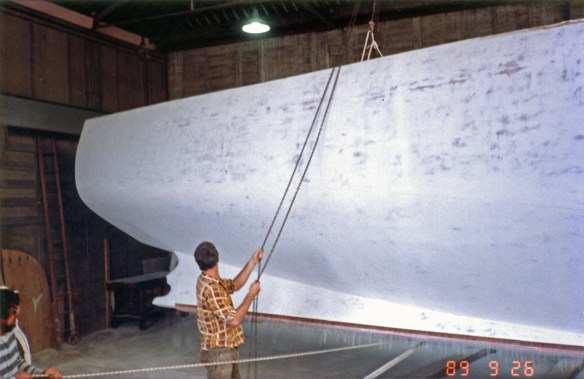
Geoff Bagnall turns the hull, September 1989

Keith : What were some of the comments you got when you were building her.

Dick : Well it was the materials of the build that attracted people. It’s a kauri strip planked boat, but the availability of kauri was getting very tight, even in those days. You just couldn’t go out and buy it. If you did happen to find some stacked up somewhere, it was really expensive. But because we knew the blokes at the Harbour Board and had feed them a lot of fish over the years, we got lucky with the source of the kauri we used. They gave it to us at a reasonable cost and there was also teak there that was meant to repair the old pilot boats, but they were being retired and the new ones were steel.  Colin Clare might know how old the wood itself was. I can’t honestly say, but it was already old when we bought it. I think it was milled on Great Barrier. Anyway, they were happy to see it go to build a boat and not end up in a kitchen cupboard.
'Tradition' Construction-6

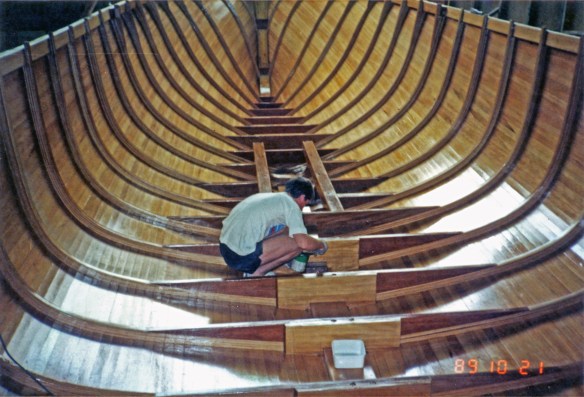
‘Bagnall’s work of art’.  Dick’s son Adam finishing the inside of the hull, October 1989

When I took Geoff in to have a look at the timber, there were stacks and stacks of 3’’x 2’’ kauri, but the sap wood was all full of borer. So we set those bits aside and all the stuff we bought were filches of heart kauri. The teak there was all 3’’, so Geoff split them and I think the cabin is inch and three-eights. Anyway, there’s a lot of teak in her topsides and a hell of a lot of kauri in the hull! What else? Well, there’s some totara in the keel, that came from the Salvation Army place down at Rotoroa Island. The guy who ran the ‘Kahino’ was a mate of Geoff’s and he provided that for us. Most of the keel and the engine bearers are Australian brushbox which is quite a hard, heavy, red coloured wood, but you have to watch it because it will get worm, that’s why it’s glassed over.
'Tradition' Construction-8

Topsides taking shape, March 1990

'Tradition' Construction-9

Dick Boyd checking proportions.

Keith : So how long was the build time.

Dick : Well what did we say, from mid1989 and it was launched at the end of 1990.

Keith : So all your mates and friends came and gave you a hand at some stage?

Rhys : Only Mary Smith came to help, the others came to drink! But Jack Fagan did some work on it, he was good.

Dick : It’s amazing how hard helpers are to find. The minute you mention sandpaper, they’re off, outta here! But Jack was one of the supporters of the whole project, he helped make things happen sometimes when we hit a wall.

Rhys : By the time we had the launching we were so exhausted from months and months of work we didn’t want her! We launched it and then everybody got so full of wine and drink that the next morning we had a shocking hang-over. We dragged ourselves out of bed and went round for breakfast at Westhaven and I said to Tich, ‘Do you want the boat’ and he said ‘Na’. Of course we didn’t really mean that, but oh it had just been such a big job and she wasn’t finished by a long shot. We didn’t have a stove or a fridge. We didn’t have squabs. We had a toilet and a shower, that was it! To top it all off we’d run out of money!

Dick : We had to follow Chris and Mary Smith around, because they had a launch called ‘Hukarere’ and they had a nice cooker onboard, so we used to follow them.
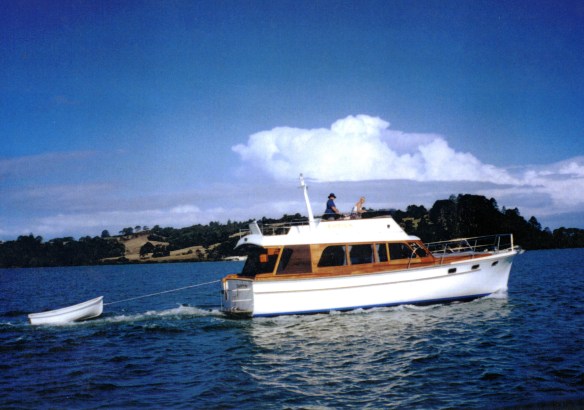
'Tradition' Construction-10

‘Looking for the Smiths’ – maiden voyage to Rangitoto, November 1990. Dick and Rhys Boyd on the flybridge.

Rhys : They also had a fridge so we kept our cold stuff in there.

Dick : Paul Nolan had a big Salthouse 53’ ‘Blitzen’ and he had a whole lot of squabs because he was replacing his so I said ‘don’t throw them out, we’ll be round to pick them up’.

Rhys : So we slept on those squabs and wherever Chris and Mary were, we were there. We couldn’t even make a cup of coffee! So they spent their time trying to lose us and we spent our time trying to find them. ‘Would you two like to come over?’ they would say, and we’d already be in the dingy heading towards them. And then after a while it was like, ‘gosh, can we even afford to finish her?’.

Dick : Anyway, over a few years we slowly pieced the rest of her together.

Rhys : Yes, there was still a lot to do. All the sanding inside is mine, every single inch!! You know I was a kindergarten teacher, so every school holidays, for two weeks in May and three weeks in August, and most weekends, we were on the boat doing something. I’d row out, hop on the boat outside our place in the Tamaki River and I’d get going on something. Lots of sanding, lots of varnishing.

Keith : So where did you take her on the first trips.

Dick : Well I liked the bottom end of Waiheke and over at Coromandel, Te Kuma.

Rhys : And we never managed to get to the Bay of Islands because we were working too much.

Dick : Also Waiheke. Oneroa was always popular because the Smiths were there. They still tell us when Tradition is in the bay. We have our spies! And she’s a notable boat anywhere you go, people respond to her and row over to have a yarn. Yeah, Geoff did a great job on her. One of his best.

Rhys & Dick Boyd on Tradition

Original owners – Dick & Rhys Boyd, Mahurangi Regatta, January 2017.

Owners of M.V. Tradition since Dick and Rhys Boyd 

1990-1996 > Dick and Rhys Boyd  – Moored in Tamaki River

1996-?        > Dave ? [clue – owned a pub in Mangere?]

19?? – 1998  > ?? Two guys bought it from Dave via a broker [information from Rod Middleton (Sailors Corner) They wished to take her south by truck to Mana Marina but after talking with Geoff they sailed her down the coast.

1998-2006 > Sold to Peter and Jenny Standish from Wellington and berthed at Mana. Cruised in the Marlborough Sounds.

2006-2007 > Sold to a Picton local. Moved to Waikawa Marina, Picton

2007-2011 > Sold back to Peter and Jenny Standish. Berthed in Waikawa Marina. Had a major refit at Frankins Boat Yard, Waikawa in 2009.

• Varnish stripped inside and two pot urethane used.

• New navigation electronics, TVs, sound system, stove, leather upholstery, carpets, covers and bow thrusters added.

• Bunks in forward V-berth removed, double bed built in.

2011-2019 > Sold to Keith Busch & Wiesje Geldof of Wellington. 3 years berthed at Waikawa Marina. Vessel trucked north to Tauranga from Mana Marina 2013. 3 years berthed at Bridge Marina, Tauranga. Hutchinson’s Boat Yard, Tauranga work :

• Stripped outside varnish and replaced with 16 coats of ‘All-wood’ urethane

• New teak plank deck installed. Boot topping strip repainted in light green.

• Fly-bridge helm station repainted. Holding tank and generator added.

3 years berthed at Hobsonville Marina, Auckland

Accepted into Classic Yacht Association in 2016 as ‘modern classic’.

2020 > Sold to Chris and Rae Collins of the RNZYS
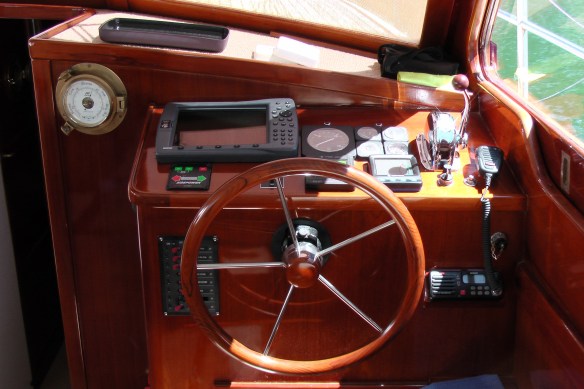
Lower Helm Station

Lower helm station

'Tradition'. BOI 2016

Bay of Islands 2014

Specifications of M.V. Tradition

Type : Saloon Launch

Designer : Bowden ‘Bo’ Birdsall

Builder :Geoff Bagnall, built at Auckland Harbour Board mill building, Westhaven

Launched : November 1990

Commissioned : Dick and Rhys Boyd of Tamaki, Auckland

Dimensions : LOA 44 feet, beam 14’ 3”, draft 4’6”, displacement 11.5 t

Engine : 1990 Ford 145hp ‘Marko’, cruises at 9 kts, max speed 11kts

Gearbox : Newage Coventry 2:1 gearbox

Construction : Kauri planked hull (inch and three-quarter by one inch, glassed-over), strip-teak deck, teak topsides, white hull with light green boot-topping, polished wooden topsides, white fly-deck.

Mechanical : Side-Power bow thrusters, Pugaro diesel generator, anchor winch

Electrical : 12V and 240V systems, auto-helm, radar, Garmin gps chart plotter, TV, stereo system, VHF (x2), 3 x house batteries, 2x start batteries, inverter

Accommodation : 2 cabins, Master (double) and Guest (2 single)

Galley : 4 burner gas stove, microwave, gas hot water system, fridge, freezer

Tanks : Diesel – 1 x 650 litres; water 2x 350 litres (700 litres) both stainless steel. Black water holding tank 300 litres in welded plastic

NOTE: Boat builder Geoff Bagnall is not retired, just no longer has the shed in Milford Creek.


SS Duke of Marlborough

Duke of Marlborough copy

SS DUKE of MARLBOROUGH

I recently stumbled across the above photo of the steam ship – Duke of Marlborough and knowing nothing about her put a call into Russell Ward aka Mr Steam. The man is never embarrassed to speak so – take it away Russell, WW is all yours…..

“Once, 30+ years ago, I built up a steamboat called “Gypsy”. So pull up a chair, warm yourselves by the fire and I’ll tell you a story which isn’t about “Gypsy” at all, it’s about the “James Torrey” which became the “Duke of Marlborough”.

But, through “Gypsy”, I met one Lloyd Lewis of Lake Tarawera. He was an ardent enthusiast for steamy things (who wouldn’t be – living on Lake Tarawera.) Lloyd had made a steamer up out of a hull I had sold him a year or so previously and really had the steamboat bug badly. As the late Pete Culler (he wrote a lot about boats and he was a wise man) said “It’s awful, don’t go near it or you are hooked.” And you can’t argue with facts like that, folks. Suffice to say Lloyd got steam enginitis in a big way.

He had Wellington naval architect Bruce Askew design a hull for a 36’ steam vessel following the style of the early 1900 steam boats The steel hull was built in 1987 by Gordon Clark and Brian Starrock in New Plymouth and shipped to Rotorua for Lloyd to complete. He did a fine aesthetic job. She was launched as “James Torrey” and he used her to take fishing tours on the lake. The lads appreciated the warmth from the boiler at times.

Lloyd built the engine – an English design by A.A. Leake and a dashed good looker it is -a traditional open compound, driving a 28” by 42” propeller giving a service speed of 6 knots. A piston valve is fitted to the high pressure cylinder and a balanced slide valve on the low pressure one. It has cross-head driven twin feed pumps and air pump. Exhaust is through a feed-water heater to a keel condenser. There you feel a lot better for knowing that.

But to sum up, working on salt water, you have to condense the exhaust steam or you run out of feedwater real quick. Besides, condensing gives you a useful addition to the power through the vacuum created which, in essence, sucks the piston while the steam pushes.

The steam is provided by a Kingdon type boiler (1900’s Simpson Strickland design) built by Langley Engineering in the U.K and, since you didn’t really want to know, It is a vertical fire-tube type, 34 inches high by 30 inches diameter over lagging, has 3.4 square feet of grate area and has 84 square feet of heating surface. She burns coal and there is nothing better.

Lloyd had quite job actually getting Ed Langley to dispatch the finished boiler although it had been long since paid for. Ed had had his delivery problems over the years…. Legend has it that, in frustration (remember communication was all letters and phone calls that had to be booked well ahead in those prehistoric times); Lloyd flew over to the UK and turned up at the works just ahead of the receiver. Seeing the likelihood of his investment coming to nothing, he took matters into his own hands and loaded the boiler up himself. Lloyd just wasn’t the sort of man to argue with and got his boiler. It is a very handsome job.

Anyway after a number of years, Lloyd tired of his steamboat and Roger Frazer took her to Picton. He renamed her “Duke of Marlborough” and did a lot of restoration which is a credit to him. He has been taking passengers out of Picton for some time. I’m sure the passengers appreciate the boiler’s warmth even more that the Lake Tarawera types.”

I understand she may be for sale………

WoodenBoat Magazine Interview #3 

This week WB editor Matt Murphy interviews Harold Burnham in a live discussion of how, for nearly three decades, he has been instrumental in revitalizing the shipbuilding and maritime culture of his region by designing, building, and rehabilitating traditional vessels for cultural tourism. Harold is an 11th-generation shipwright, and has, at various times, also been a sawyer, mariner, model maker, and sail maker.

Seriously Cool Steam Boat

Screen Shot 2020-05-07 at 5.42.41 PM

Screen Shot 2020-05-07 at 5.42.52 PM

Seriously Cool Steam Boat

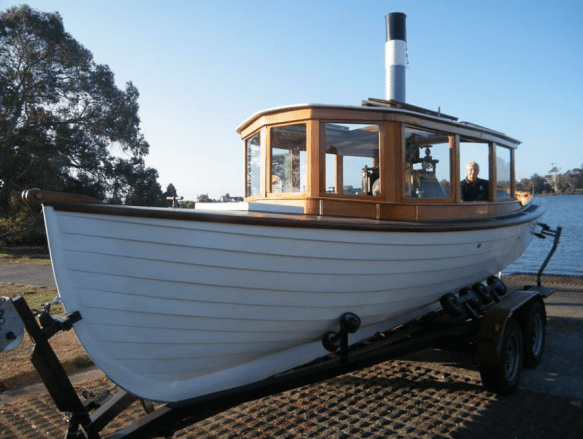
The above steam boat, owned by Hamilton engineer, Chris Cooper recently popped up on a fb post of Geoff Lewis’s.
All I know, but I can hear Russell Ward duping as you read this, is that Chris rebuilt the boat from a wreck. It has a tripe-expansion engine, in my ignorance I hope it is coal or wood fired and not diesel – I would love this as a retirement boat on a lake…………..
Hopefully we will find out more about her.
AND WOODYS WE CAN GO BOATING AGAIN – NO PRIZE FOR GUESSING WHAT I WILL BE DOING THIS AFTERNOON
Screen Shot 2020-05-13 at 5.58.27 PM

HDML Manga > Haimoana

HAIMONA EX MANGA - 1

HDML MANGA > HAIMOANA

In the interests of saving you from getting a sore neck from shaking your head – this boat ended up with a beehive restoration i.e. was put on the bonfire.

The HDML Manga was built by Madden & Lewis in Sausalito, California, USA during WWII and was sold by the NZ Navy in 1980. Her first owner post the Navy was Steve Hansen of Herne Bay, Auckland. When Hansen purchased her she had no engines. During his period of ownership she was kept on the outer side of the Auckland’s Viaduct Basin.
Hansen sold her to his friend Hans Van Duyn of Helensville in the early 1980’s, still with no engines. (Hansen also owned the HDML Black Watch).
Van Duyn stripped the coamings off her whilst she was at the Viaduct Basin and took her bare hull to Helensville on the West Coast, where they spent the next 2+ years rebuilding the vessel – including 16 single berths and 2 staterooms. In the mid 1980’s she was renamed Haimona after the owners late son.
The vessel was fitted with two Ruston Hornsby, 200hp diesel engines, with hydraulic gearboxes. Top speed was claimed to be 18 knots. The engines were ex the A.H.B. tug Manukau. Also fitted with a funnel & dry exhausts with silencers.
Van Duyn used her extensively, from the mid 1980s to c.1999. She was the largest pleasure boat in the Helensville Cruising Club fleet and was frequently mark boat and involved in many regattas and other club activities,  
She fell in to disuse around 1999 when Van Duyn sold his waters edge property, on the Kaipara Harbour. As there was nowhere else on the Kaipara that had a suitable facility to slip her, she deteriorated through lack of ability to maintain her and lack of use. Ultimately, she got  to the point, where her pumps were running 24/7 and despite attempts to provide her with better moorings, the end was near and they brought her ashore, stripped her engines out of her and saved what they could e.g. portholes and other useable fittings. In c.2006 they put a match to her.
Note: during this period Hans Van Duyn also owned HDML Kupara, which is now owned and restored Scott Perry, Whangarei. The story of Kupara has appeared on WW – link here   https://waitematawoodys.com/2018/10/04/hmnzs-kuparu-hdml/
Story assembled by Ken Ricketts with input from Steve Hansen, Rene Van Duyn and Bob Siegel. Edited extensively by Alan H.
Manga Navy Service ex Greg Philpott

HMNZS Manga (Q1185) was one of 16 Harbour Defence Motor Launches (HDML) to be delivered to the RNZN in 1943. She was commissioned on 6 April 1943 and joined the 124th. ML Flotilla at Auckland. She was used in anti-submarine patrols in the port approaches and the Hauraki Gulf northwards to Cape Brett. On 11 October 1945 she paid off in Auckland and was placed in reserve. In early 1946 she was converted for army use, fitted with a towing bitt and transferred ‘on loan’ to the Army. She was renamed Bombardier and used by the RNZ Artillery for target towing and general transport duties for over 10 years. In 1948 she was reclassified as a Seaward Defence Motor Launch (SDML) and renumbered P3567. In November 1959 she was transferred back to the RNZN. In 1960 she was commissioned as HMNZS Manga (call sign ZMBJ) and joined the fishery squadron where she served until 1967. After a refit she was assigned to Wellington RNZNVR until 1973, and then re-joined the fishery squadron briefly, returning to Wellington in 1974. In 1977 Manga was restricted to sheltered waters and returned to Auckland in 1977. During the period from 1977 to 1981 she was attached to HMNZS Ngapona. She was withdrawn from service and sold in 1982 to Takapuna Contractors Ltd., and was later sold again and transported to Helensville for rebuilding.


Great story tomorrow (Monday) – I’ll make good for today’s work-boat / military OTT story 🙂
Don’t Be Embarrassed If You Emailed Yesterday Asking For Chris McMullen’s Berthing Tips – 178 people did 🙂
Something For The Yachties – photo below sent in be Nathan Herbert – looking to ID to the two yachts seen here berthed at Whangarei.
Mystery Yachts Whangrei

A Gift From WoodenBoat Magazine

Screen Shot 2020-04-08 at 6.01.10 AM

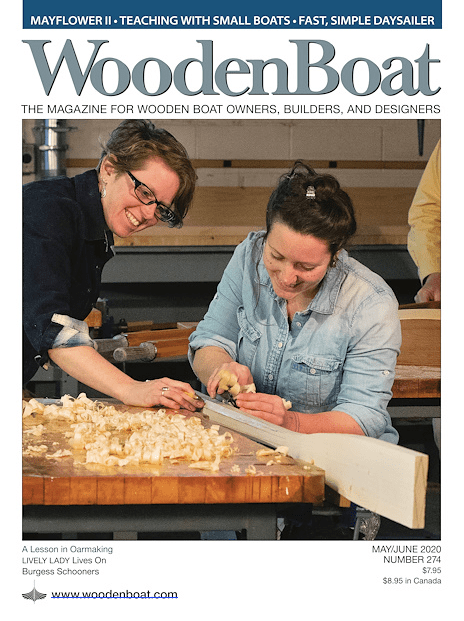
YOUR OWN COPY OF WOODENBOAT MAGAZINE

In response to the COVID-19 worldwide pandemic, and to help ease your time while practicing social distancing, the publishers of WoodenBoat have very generously decided to make the digital edition of WoodenBoat No. 274 (May/June 2020) free for all to read and enjoy. Please share this digital edition with all friends and family you think might enjoy, or need, a fun distraction. With the forecast for long overdue rain for most of NZ later today – this is perfect timing for a lazy afternoon on the couch 🙂 Enjoy

Link Below

https://woodenboat.advanced-pub.com/Vizion5/viewer.aspx?shareKey=rOFucb


Screen Shot 2020-04-08 at 6.10.25 AM

The Restoration Of Melodeon

034

melodeon 001

melodeon 015

melodeon 1.4.20 005

The Restoration Of Melodeon

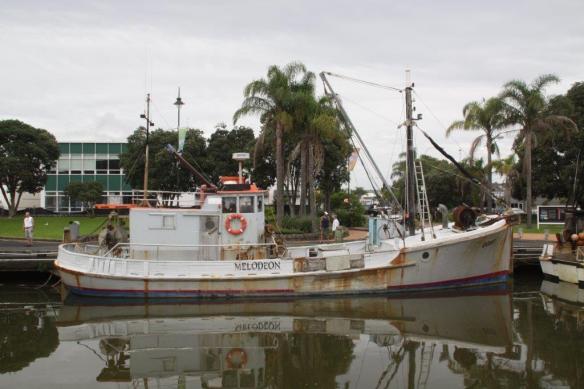
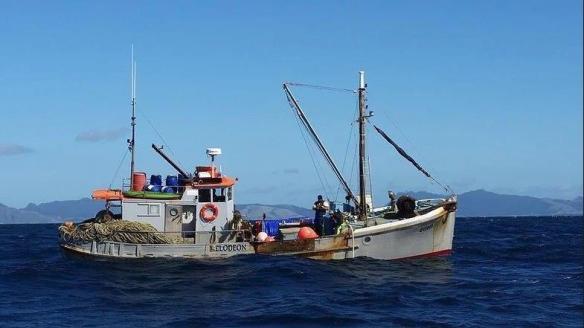
Now woodys if you know Dick Fisher you  will know that Dick likes BIG things – big classic boats, big projects, big (zoom zoom) cars. Chatting with Dick recently he informed me he had a project on the go, his words “something to keep me out of trouble” so of course I said ’send me some details – givens Dicks other two boats – Akarana, the 60’ 1960 AJ Collings designed and built by WG Lowe, ex Auckland Harbour Board pilot boat and Hamal, the 1975 purpose built exploration ship – I suspected the project would be a doozy. Photos of Akarana & Hamal below.
Dick and Colleen have a stunning track record of converting ex work boats into the most amazing classic cruisers so WW looks forward to following this project, we will be giving Dick a friendly nudge for updates.
.
I’ll let Dick tell us what he is up to, remember click in photos to enlarge 😉

 
“The story so far goes a bit like this……
We purchased Melodeon from Greg Hayes in April 2018. Greg had owned & fished with her for the past 25 years. 
One of the photos above shows her at her semi-permanent berth at the Whangarei Town Basin prior to our buying her.
After the successful negotiation of price with Greg, who had expressed the wish for Melodeon to only be purchased by someone prepared to restore her.
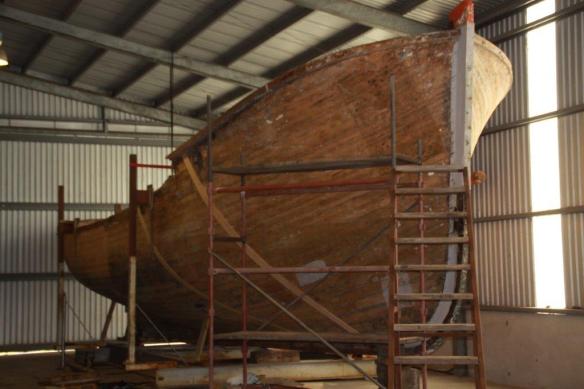
We lifted her out at Dockland 5 in Whangarei, her estimated weight at this point was in excess of 50 ton. We removed as much equipment as were able which included 9 ton of lead balast. This would explain why when blasting the paint from the hull we uncovered seven (7) waterlines this made her draft aft at 7 ft. 
 
With the assistance of Boat Haulage Ltd we moved her to our workshop at Kamo & then commenced dismantling decks, bulwarks, wheelhouse & removed the engine & fuel tanks etc. She was then high pressure water blasted & garnet blasted all of the paint off inside & out.  She was then moved inside the same shed where Akarana had been for 5 years during her restoration.
 
The hull was copper fastened of 3 skin construction.. unfortunately the 2 inch Kauri decks were iron fastened & unable to be saved.
 
To date we have treated with preservatives the inside of the hull & currently has a holding undercoat.
 
The last few month I have been focused  on restoring the T8 Kelvin engine which was in reasonable condition. Main items needing replacing were a set of 8 exhaust valves , a complete gasket set plus other small items. I was able to purchase these from  Kelvin Diesels in Glasgow, a subsidiary of British Polar Engines. We have found this company & their staff most helpful in procuring parts. The engine is now complete & running very nicely. 
 
Up to date the work has been carried out mostly by myself & my son Richard when he had time. The engineering side of the restoration we can manage ourselves.  We now realise we need a skilled boat builder to assist us with the woodworking aspect.
It is our intention not to alter the overall design, with the exception being the wheelhouse which needs to be a little bigger.  
 
We are fortunate in that Greg Hayes has passed on to me the Marine Dept files dating back to October 1934.
Some salient points for you:
Plans, specs & building was carried out for Melodeon by Chas Bailey & Son in Auckland.
Original engine was a German Deutz/110BHP / 2 cycle diesel/ @ 450RPM this was replaced by the current T8 Kelvin.
Propeller:  4 blades /59 inch dia x 48 inch pitch – 3.3 to 1 reduction
Dimensions: Overall 57ft Beam 15ft6in draft 7ft
The existing T8 Kelvin was installed new in 1960 & the estimate from info we have, is that she has run well in excess of 100,000 hours.
Melodeon fished using different methods all around NZ, during the 1939/45 war the US Navy commandeered her for service in the Pacific.
  
This is an ongoing project for me in my dotage & its keeping me out of trouble.. in fact it’s a pretty big job….as the TV Ad goes…”
 
A Heads Up
Two cool things you may have overlooked in the last week
1. Do check out the link that Hylton Edmonds posted in the WW comments section. Its to a National Film Unit movie that features the then police launch Lady Shirley going about its duties on the Waitemata Harbour – fast forward to the 5:10 mark to catch the start, its a great watch and lots of our woodys make appearances – https://www.youtube.com/watch?v=8mlqfwtybXE
2. Put your hand in your pocket and spend NZ$5 to subscribe for two months to the very informative and entertaining Vblog – OFF CENTER HARBOR. The guys at OCH have offered up this deal to WW readers so you can get your classic boating fix during the lockdown – details here  OCH $5 Deal
Akarana (L) – Hamal (R)

Manunui

Screen Shot 2020-03-28 at 12.05.11 PM

Screen Shot 2020-03-28 at 12.05.28 PM

Screen Shot 2020-03-28 at 12.05.48 PM

MANUNUI

Todays’ story on Manunui comes to us from the ‘desk’ of Paul Drake – as always, well written so I’ll pass over to Paul.

 “Arriving at Taupo for our annual holiday one January in the late 1950’s, my brothers and I were intrigued to see a very unusual looking new commercial boat on the scene.   Before we knew her name, we kids called her ‘The Ugly Boat’.  She turned out to have a proper name – MANUNUI – after the saw milling town just out of Taumarunui.   It was there that she was built by the manager of said sawmill, Basil Maude.

Basil’s hobby was building boats, but he rarely got more than about three-quarters of the way through before losing interest.  MANUNUI was the exception.  He wished to see how big a boat he could build out of plywood.  He had the plywood made at his mill from selected timber.   Her bottom had two sheets of ply each twenty feet long , six feet wide, and one and a quarter inches thick. She measured 36 feet by 12 feet.

She had to be chunky and strong because Basil had two Allison Kittyhawk 12-cylinder aeroplane engines which he wanted to fit.   He designed and built the double gearbox himself.  It measured eight feet by three feet by two feet deep.   At the last minute the plan changed and the two gallons per minute Allisons were wisely ditched in favour of Ford V8s. But the gear box remained – larger than the two engines.   This most fascinating gearbox was mounted forward of the engines with the propeller shafts running back under the engines.   Chains were involved, and each propeller was operated independently of the other in the normal way.  MANUNUI was the first diesel powered launch on the lake (so it is said) and also the first commercial plywood boat to operate on the lake.

In the good old days when fishermen would club together and charter a launch for five day expeditions to Taupo’s Western Bay, MANUNUI was a very successful and busy charter launch under her very capable skipper Ron Houghton.

The original canvas arrangement over the aft end was eventually replaced with the rather functional effort shown in the second photo. In about 1970 a whole new cabin appeared.   Shortly afterwards MANUNUI was sold to New Plymouth.   I wonder if she survives?   Somehow I doubt it.

Much of this information is contained in ’Boats of Taupo’ by Charles Cox.


Taranui (Gailene > Masquerade > Taranui) 

Unknown-2

TARANUI (Gaylene > Masquerade > Taranui) 
 
Today’s woody story comes to us via the collective input of many people – Harold Kidd, Grant Faber, Barry and Christine Johnston, Grant Richards – under the guiding hand of Ken Ricketts and edited (a lot) by Alan H.
Some basic facts – 
Taranui is 30’ in length with a beam of 9’ 7”. 
She was built in 1948 as an internally ballasted 350 sq. ft. sail area Bermudan ketch (D28). There is speculation that Taranui was built either on the Hobsonville Air Force Base, or nearby, of kauri.
Her current owner is Grant Richards, who supplied all the above photos, and she is kept at Gulf Harbour marina.
 
Her provenance (with a few holes) goes like this – 
 
She was built by G Neville in 1948, her first registered  owner is D.H. McMillan of Ellerslie, Auckland – she was kept at St Heliers Bay.
Her second registered (15-09-1951) owner was W. (Bill?) Ridley of Pakuranga who kept her at Panmure.
She passed to D Wintle in 1961 & then Ron Faber on 13-10-67.
Grant Faber (son of Ron) has commented that when she was owned by Don Wintle, she was kept at Northcote Point, where she was moored when Faber Snr. bought her. Faber Snr. continued to keep off Northcote but later secured a mooring for her in Westhaven. 
By the 1960’s one mast had been removed and later both masts & rigging were removed by the owner from whom Barry Johnston bought her off. That owner still had them & offered them to Johnston, but he declined, as it was his intention to retain her in launch mode. Barry Johnston made her present mast during her major 1996 -2000 refit.
Johnston bought her off a private advertisement in trademe in the 1990’s and cannot recall who from. He owned her for about 15 years and kept her at Westhaven.
When Johnston bought her, she was called Gaylene (changed by an unknown previous owner) and in a very sad state, with lots of rot in the coamings and decks, and other much deferred maintenance, which he spent the next 4 years getting her up to pristine condition.The work all being done, on a family member’s private slip, in the Whau River. In view of all the work he undertook, Johnson changed her name to Masquerade.
One day when Johnston was on a cruise, Grant Faber rowed over to Masquerade and asked Johnston if he could have a look aboard, as he believed his father Commander Ron Faber RNZVR OBE VRD, may have owned her in the period c.1964 -79. After an inspection, he confirmed it was indeed his father’s old boat. After being informed that her original name was Taranui, during her 4 year re-fit, Johnston changed her name back to her original name, which she still has today.
According to the APYMBA records (ex Harold Kidd) – her original engine was a 28 hp petrol engine, with a 17 x 10, 3 blade prop. 
Grant Faber has commented that when his father bought her, she had a marine converted, 6 cyl. petrol Chev car engine, most probably her original engine, this engine gave a lot of trouble so Faber Snr. replaced it with a brand new, 6 cyl Holden petrol car engine.
By the time  she arrived in the hands of Johnston, she had acquired an old 4 cyl. slanting Ford diesel c.60hp, which during his 4 year refurbish, he replaced with a Moon Engines converted Isuzu 4 cyl. diesel c.60hp – which she still has today.
 
Recently, Grant Faber sent Ken Ricketts the note below:
 “Of nautical interest, the ensign staff shown in one of the photos, and the ensign, was passed to Dad, from my grandfather (Roy Drummond). It came from his launch Te Whara. He purchased it and fitted it to Te Whara in 1921 specifically for the visit of the Governor General visiting Whangarei in his ship Tutanikai. The launches of the day formed a guard of honour in the harbour. This ensign which is of real bunting made by Le Roy’s (the noted marine canvas makers) flew on Te Whara until Pa sold her, then on Taranui, then on my launch Te Whara 11). It is currently framed and hanging in my library showing remarkably little wear for an ensign coming up to 100 years old.” (edited)
 

WBB0003_Banner-980x160

Marlin

Marlin a

Marlin c

Marlin b

MARLIN
Woody Baden Pascoe recently sent in the above photos of Marlin seen here in the top photo at Whitianga c.1968 after being re-powered with a Caterpillar 320. 
At this time she was owned by Alf Clow (photos are courtesy of the Clow family). Alf bought Marlin off Rolly Smith who used her for game fishing. It is believed that prior to Rolly Smith she was owned by the Thames Harbour Board (who went bust).
 
The thinking is Marlin was build by Sam Ford, but there is know knowledge as to the launching date.
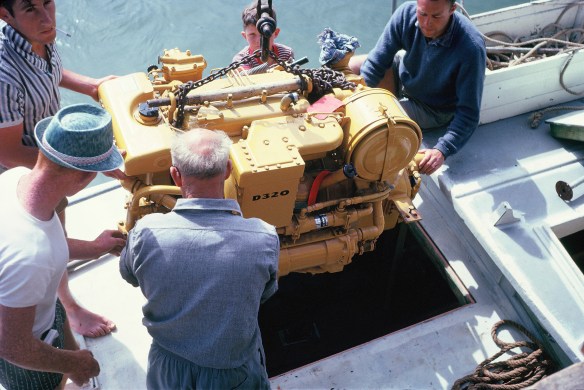
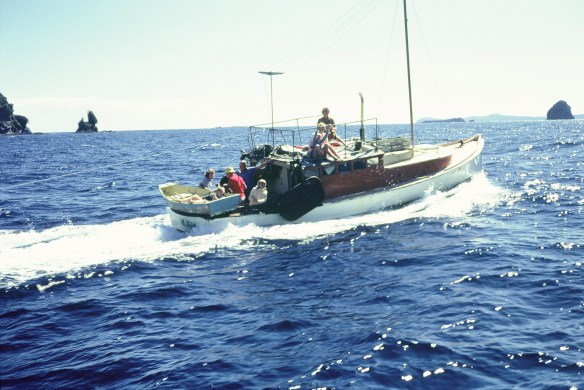
The second photo shows the new Cat 320 being lowered into Marlin, seems a rather large donk for the size of the boat. Thence the last photo of her flying along with Clow family on board.
The dinghy on the stern is from the hands of Howard Pascoe 🙂
Any woodys able to shed more light on the history of Marlin?
Input from Barbara Cooke – Rolly Smith was my uncle. He purchased Marlin during the early years of WW11 for the purpose of deep sea fishing but due to government fuel restrictions this wasn’t permitted. He and his young family farmed at Fletchers Bay, top of Coromandel. After the war they returned to Whitianga where Rolly operated Marlin for chartering and game fishing. In later years his son Bruce skippered Tuatea, another game fishing vessel in Whitianga.

 
Input from Ross Dawson – Papers Past, Thames Star 11.3.1926 tells us…”the Harbour Board’s new launch Marlin, was brought down from Auckland on Tuesday by the Dredgemaster,..Mr Roche” and in the same newspaper 31 March 1926 says…”…the launch passed government inspection on 10.3.1926….fit to ply with 8 passengers within extended river limits when not towing and with suitable canvas over the cockpit, or with 16 passengers within river limits proper….length 31.75 feet, breadth 8.25 feet, depth 2.87 feet, horsepower 30-35, crew 2. Registered as “Marlin” …” So, no builder but it shouldn’t be too hard to find a reference to the launching about Jan – Feb 1926, in the Auckland newspapers.

The Thames newspaper notes Marlin being in Whitianga in 1933.

 
Input from Harold Kidd – Can’t say I was confident about my last posting. Did some more digging and found that the Thames Harbour Board commissioned this launch from Sam Ford as a towboat, largely used for their dredge. She was unnamed but was completed in early 1926. Her dimensions were 31’6″ loa, 8’3″ beam and 2’6″ draft and 2.87tons displ. Things can’t have worked out as she was up for tender in August 1928 (again unnamed). The Secretary of the Harbour Board was later charged with embezzling a large sum from the Board and it folded shortly afterwards.
So the memories of all concerned were absolutely spot on!
Now we have to sort out what her name was before it was changed to MARLIN. Lovely boat! How nice it’s Sam Ford. 
I’m just in the process of preparing a series of Boating NZ articles on him. This boat just shows the breadth of his skills at much the same time as WHAKAARI and before his Art Deco cruisers.
WBB0003_Banner-980x160