Mystery Launch + Romance II Relaunch

Mystery Launch

photo ex Peter Louglin ex papers past

Todays photo is from the NZ Herald 09-10-1928, appears to be a very manual process, note the tin of tallow on hand to grease the rails. Who can ID her?

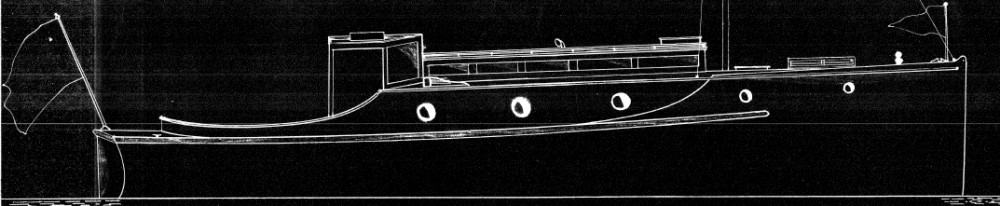
One of the reasons I published this photo is that today a very similar motor boat, Pauline & Harold Kidd’s Bailey & Lowe – Romance II is re-launching after a refit at Marco Scuderi’s yard that has seen R2 returned to very close to her original configuration. Still a few last minute jobs to finish so unfortunately R2 will not be at Patio Bay this weekend. ww will feature R2 when complete.
View a gallery of the refit here http://www.mcnshipwrights.com/romance-ii.html

CYA Classic Journal – Issue #97 + a bonus boat

CYA Classic Journal – Issue #97 + a bonus boat

Two parts to todays post – firstly click the blue link to read the latest edition (Dec 2014) of the Classic Yacht Association – ‘Classic Journal’. Feature stories are a great day out for the launch division at the Whangateau boat yard & the relaunch of Innismara. CYADEC2014
And a few shots below of a wee wooden run-about I saw in Avondale, hopefully about to get some TLC.

A Day At One Of My Favorite Boating Spots – Whangateau – Sailing Sunday

RETALIATION RELAUNCHED

START THEM YOUNG

And a visit to Whangateau would not be completer without a Laughing Lady work-in-process photo

A Day At One Of My Favorite Boating Spots – Whangateau

Yesterday (Saturday 29/11/2014) saw an informal (is there ever a formal one) gathering of young & old salts at the Whangateau Traditional Boat Yard. The objective being to launch as many of the classic yachts as possible & hold a race. Unfortunately Hughie had other plans & the wind was just too much for the old bodies & boats. Saying that, the brave did go out & had a blast, our hostess had a wee swim & a tow back……….., relax Pam the photos are safe with me 😉

One of my reasons for rocking up today was to see Harold Kidd’s just restored ‘Retaliation’, fresh from a Pam & George restoration. Retaliation was built by Rex Rix in 1933 to beat the Idle Alongs in Wellingtron, but didn’t. She carrys the same rig. Today she looked stunning & Pauline and Harold Kidd + Hugh Gladwell braved the conditions & had a very quick blast up & down the harbour.

To quote Russell Ward – you know it is blowing when a Zeddie takes a reef in! refer photo of Hugh Gladwell  in Olive (Z9).
Russell took the youngest woody boaters out for a lap of the harbour, things started a little ‘loud’ but the arrival of mum helped & as you’ll see from the photos from in the creek, bliss and happiness was achieved on board.

As always it was a great family day & to a foodie like me , the lunch was a big bonus –  the fresh hot smoked snapper just perfect.

The day had a sad element – we were buzzed by the Westpac Rescue chopper & advised that they were searching for a missing fisherman. It a appears he & a friend were fishing in a small RIB in the entrance to the harbour (actually tied off the channel marker) when an oar was lost overboard & one of the fisherman dived in (fully clothed & sans a life jacket) to attempt to retrieve the oar. The current can be very savage in the area & he disappeared below the surface.
Not long after, I left the boat yard to visit Shane Anderson & the chopper was doing repeat sweeps of the coastline in front of his place. It appears the fisherman has drowned, so lets not let this life be wasted i.e. lets use this incident to remind us to wear our vests, particularly when we are in small boats.

As always a special thank you to Pam & George 🙂


CYA Launch Group Road Trip

CYA Launch Group Road Trip

While the CYA yachties were having their 1st race of the season on Sunday, the launch group hit the road & headed north to Whangateau for a shed visit to check on the progress of ‘Laughing Lady’ at the Whangateau Traditional Boat yard. Good planning ensured we were there at high-tide, so we got to see all the old girls afloat. Regular readers of ww will have seen photos of the yard from my previous posts but today was special to share Pam & George’s magic space with a bunch of serious wooden boat nuts.

James Dreyer gave a brief talk on the the history of LL & how the restoration was coming along. Probably the best question of the day & best answer was – “Are you taking her back to the USA” – “No, she is here to stay, the Waitemata & greater Hauraki Gulf is her new home”.

Post the shed visit we headed up the hill to Carolyn & Shane Anderson’s (MV Waimiga) stunning property for a a tasting of locals wines & their own estate olive oil. A BBQ followed & then a coastal walk.
There are plans to make this trip a regular on the launch calendar.

A big thank you to Pam & George from Whangateau Traditional Boats + Carolyn & Shane. And James Dreyer for letting us all crawl over Laughing Lady 🙂

Enjoy the photos – click any to enlarge – I took so many, this is just a random selection, I’ll post more over time.

Sailing Sunday – Innismara

Sailing Sunday – Innismara
This week the classic yachting fleet saw the return of the magnificent ex Bernie Schmidt built, 67′ racer Innismara, aka ‘war canoe’. She has been restored by Blanche & Ian Cooke with the team at YDL.

Innismere sold on trademe in 2011 for just over $3010, but was in very poor shape after being stored in a shed since 2002 & sustaining fire damage to the forward sections. Her keel was missing having no doubt been sold for lead. Refer below Steve Horsley photo at the time of sale & my photo of her in the YDL shed awaiting restoration.
Once again the Cookes have returned one of our classic fleet to better than new condition.

The above photos (click to enlarge) were taken by Tony Stevenson dockside as she was being prepped for the mast being re-stepped. CYA member Steve Horsley commented “that’s a party cockpit if I ever saw one”.

Given that Blanche & Ian already own the 1937, 60′ Ranger, who sails what is going to be very interesting.

Now I’m off to one of my favourite wooden boat haunts today so Mondays post should be a cracker 😉

Mystery boats at Lake Taupo

MYSTERY BOATS AT LAKE TAUPO
photo ex Ken Ricketts

Ok, one for the train spotters today – Ken sent me the photo above but has know idea the location or date. His guess on the date is late 1930>1940. He also believes that Lady Ava is 3rd from the right on the hard stand.
What say the rest of you on where & which boats?

Update from Paul (& Nigel) Drake

In consultation with brother Nigel, here are some more details. Starting from the left, we have ROTHESAY – previously discussed on WW. This is Don McLeod’s “new” ROTHESAY. Behind her is MOANA (Sam Ford). Don’t know the next one. Then we have DESTINY (Coulthard) – then MOANA ROA, locally built of totara and now in Whangarei. On the slip is ARCADIA, still at Taupo. Then WAIHAHA now AVALON, now at Rotoiti as previously discussed.
Across the river we have VICTORY, built locally by Jack Taylor during WW2 without power tools, and still at Taupo (Kinloch Marina). Astern of her the 1907 Logan double ender PONUI, On the hard behind Jack Taylor’s house is EL ALEMAIN, now RANUI, built at Rotorua for a rehab hospital for returned servicemen and still at Taupo. Astern of her is ROMANCE (Bailey and Lowe 1914). In the water, second from the right, is NOMAD, now thought to be at Rotorua. Further upstream, above ARCADIA, is CHAMPION, ex IONA,, now in Brown’s Bay, Paremata, Wellington, under another name.
A remarkable photo – thank you Ken!

A Day at Lowell’s Boat Shop

A Day at Lowell’s Boat Shop

A friend of mine & ace photographer – John Burland snapped the photos below last week at the Lowell Boat Shop in Amesbury, Massachusetts, USA.

The shop was established in 1793 & Lowell’s is the oldest continuously operating boat shop in America and is cited as the birthplace of the legendary fishing dory. Located on the North bank of the Merrimack River, Lowell’s Boat Shop is now a non profit working museum dedicated to building classic wooden dories and skiffs.

They use a lot of yellow & green paint on their boats, its not that they bought a container load – yellow and green are traditional colours with the highest contrast for visibility in fog.

For more info – link the link below
http://www.lowellsboatshop.com/pages/lbshistory.html

click photos to enlarge 😉

Lake Taupo c.1950’s

Lake Taupo c.1950’s.

photo ex Paul Drake

This photo appeared on a postcard & shows two boats that have recently featured on ww – Lady Pat & Moana.

Also in the picture, on moorings, in line astern are  – Kotare (steel), Arcadia and Kahurangi.

Arcadia is still on Lake Taupo – with new cabin. Kahurangi was last seen at Mana, Paremata, also with new cabin. KOTARE is still at Lake Taupo.

The vessel poking out of the boat shed is Water Nymph now restored and at Lake Rotioti.

Chris McMullen Herreshoff Steam Launch – Part 2 (the engine)

The building of a replica 1898 Nathanael Herreshoff triple expansion steam engine – as told by Chris McMullen.
CMcM SteamLaunch AH6

The Herreshoff engine is a triple expansion type with cylinders 3-1/2” x 5”x 8” with a 4-1/2” stroke. It is a smaller version of that depicted in the L Francis Herreshoff book ‘The Wizard Of Bristol’ page 228.

The engine is very different to what the textbooks on the subject show. Everything designed by Nathanael Herreshoff seems to be that way. He certainly never copied traditional thinking but worked it out for him self.

Those interested may notice the two crankshafts gear driven one to one. The right hand one drives the piston valves. Going astern is effected by sliding bush or sleeve within the driven gear activated by a lever, this rotates the valve C/S to a new position. The bush, gear and shaft required machining male and female three start threads, left and right hand 8” pitch!  Not easy. The threads have / had to be cut on a planer using a dividing head coupled to the motion. Modern cars use a camshaft driven by a timing belt, similar to Herreshoff but remember this engine was designed in 1898!  The engine is very short to allow the crankshaft to be supported by two bearings and also to prevent loss of heat as the exhaust steam travels from one cylinder to the next, thus trying to reduce pressure loss.

If you look at the image of the crankshaft casting (below) you will notice the overhung balance weights. Notice the lack of material in the web between the second and third journal. The crank can’t be ground and there is no easy way to machine the metal designed to be eliminated by casting.  Casting this crank was a mission in SG iron. To cast it in steel (with 1/4” to the foot possible contraction) is going to be more difficult to achieve the correct length.

H.M.C.O had an outside foundry cast their steel but I notice in reading a recent article on Herreshoff Anchors they did have problems with their steel castings.

The base of the engine is a bronze casting to hold oil. The engine max revs are about 700 so the engine will have to be enclosed or throw oil everywhere.

There are good drawings available for this engine but no tolerances are given. I guess the fitters knew what was required. The original drawings were coloured to show the different materials, as was normal drafting practice.  The prints I got were black and white and difficult to read. No layers as in CAD drawing.

The Boiler is a three-drum type with curved tubes. It is similar to a Yarrow Type boiler. All the circulation is achieved in the tubes, the outer tubes being cooler than the inner. Once the circulation starts it continues. This was proven by Yarrows experiment in the early 1900’s. So Herreshoff and Yarrow, an ocean apart, came to similar conclusions. The upper drum of the boiler is 8“ OD, the lower drums 4-1/2” all with 5/16” wall. The 1/2“ tubes are expanded. Not easy to do up a tube just over 4” ID.

The boiler was built under survey. The working pressure is 250 PSI.

There are no pumps on the engine. The boiler is fed and the cooled exhaust condensate is removed for reuse by an independent steam driven combined feed and air pump. These pumps were the only item on the launch not made in house by H.M.C.O.  There were no drawings of these Marsh Pumps made by The American Steam Pump Co., Battle Creek Mitch. I copied mine from ‘Vapo’, an incredibly clever but simple pump with two moving parts but very difficult to manufacture.

I should add there has been no fabrication. Everything has been cast in iron or bronze.

Again this interesting project has been done for no other reason than for my own personal satisfaction.  I guess Prof. Evers Burtner’s comments (see copy of magazine article below), I quote “It is too bad that this engine is so complicated that amateurs would not be tempted to build one of their own”, was red rag to a bull.

To view part one i.e. the boat click here https://waitematawoodys.com/2014/07/07/chris-mcmullens-herreshoff-steam-launch/

Click Any Image / Photo Below To Enlarge


Chris McMullen’s Herreshoff Steam Launch – Part 1

Chris McMullen’s  Herreshoff Steam Launch

I visited a rather special boat shed the other day, shed is a bit of an understatement – I have a shed, Chris McMullen’s one is more like an aircraft hanger.
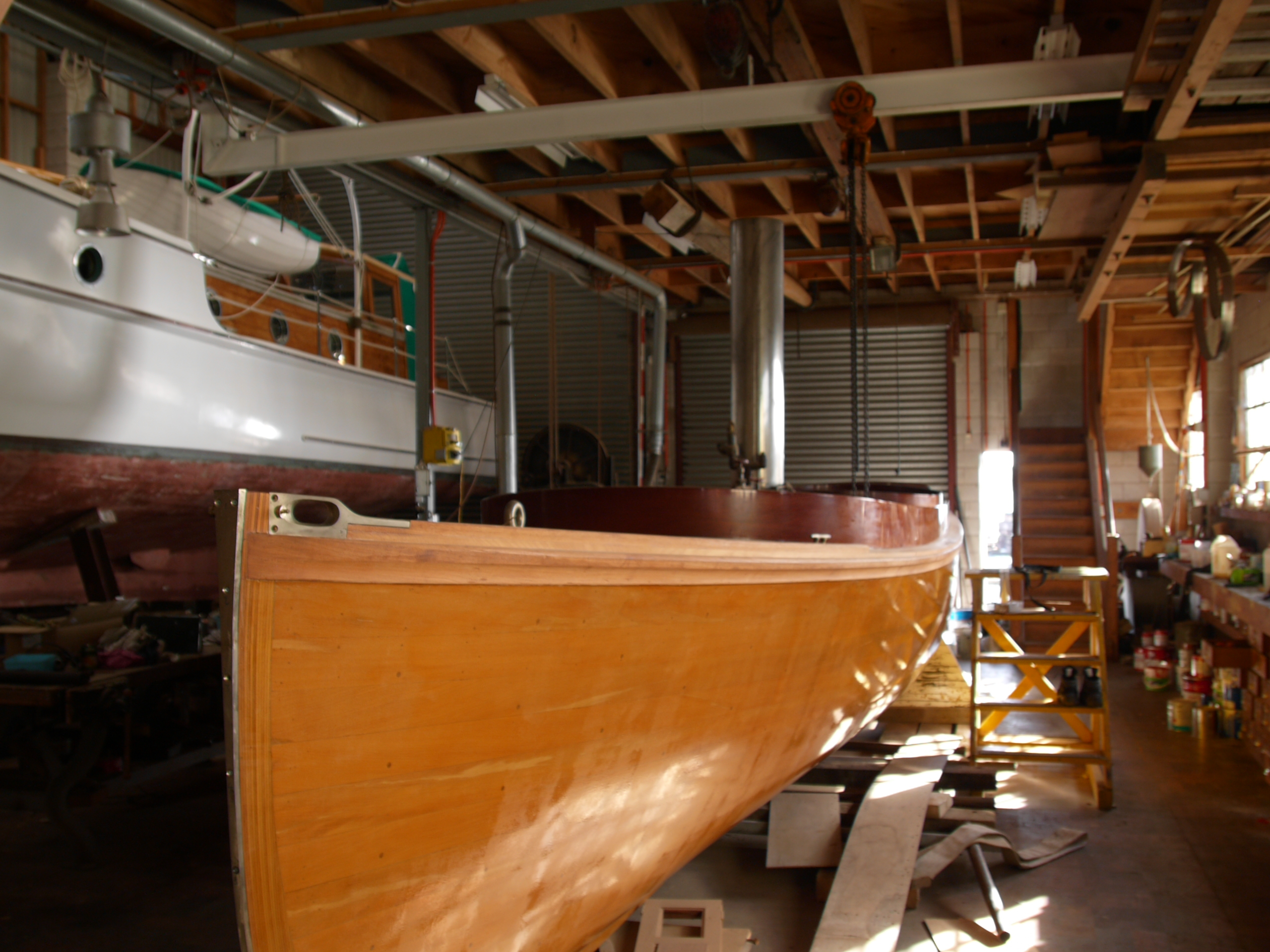
The reason for the invite was to have a look at the 1933 Colin Wild built launch Wirihana out of the water, but what really made me accept the invite in a flash was the chance to view the 34′ Herreshoff steam launch that Chris has been creating for nearly 30 years.
I use the term creating because every piece of this boat (including the steam engine) has been crafted by Chris’s own hands. Its a little way off launch day but already its a piece of art.

Why would someone undertake a project of this magnitude ? Chris’s view is “the whole project is an engineering exercise and an interesting challenge to recreate what was done 100 plus years ago.  Further, traveling on a fast steam launch is a great experience and there is something about generating your own power from fire and water”.

Click any of the above photos to enlarge 😉

I’ll let Chris tell the story – read on

“I have been building this (lets say) machinery and boat on and off for would you believe 27 years!  I started the project in 1987 –88 the year I sold McMullen & Wing Ltd.  Unlike some of my steam friends in the USA and the UK who are single minded,this has not been my only interest, during the time I have owned or had the use of other boats and done many other things.
The long winded project, is an embarrassment for me being a professional boat builder. It must be explained that I am not a trained Engineers Pattern Maker,  Foundry Moulder, Fitter and Turner, Coppersmith or a Boilermaker. I have had to learn these skills. Believe me, the Herreshoff’s draftsmen certainly did not compromised his design to make it easy for manufacture.  The castings for the engine are complex and thin walled. Several foundry’s kindly allowed me to do my own sand moulding on their premises. It would never have been possible without their cooperation.  I have had four attempts at casting the crankshaft. The only good casting (currently installed in the Engine) is of material not up to spec.  This has been a major blow and I guess my knowing this has set back the job.
The 3 throw crank has been drawn in “Solid Works” with the idea of machining it from a solid 9 inch diameter bar of steel on a NC lathe and Mill. A huge job and still can not be completely finished on these remarkable machines. At this stage there is no way to change the design. Crazy, the original was cast and machined in steel over one hundred years ago!
I went on and built the 34’ x 6’ 3” x’ 1’10”hull exactly the Herreshoff way (with a mould for every White Oak steamed frame) The hull double planked carvel style and glued with epoxy rather than set in shellac (as was the original) The planking was two skins of 5/16 NZ Kauri. So thin it could not be edge set. On the bilge the planks were made from thicker stock as they had to be backed out (hollowed and rounded) Very easy to loose control of thickness doing this and I believe Herreshoff Manufacturing (some how) steamed the round into the planks. I have a steam box, experimented but could not make it form the planks. I could have built the same boat double diagonal in a fraction of the time but the design scantlings would have had to be changed. At the time I wanted an exact replica! To what end? Now, I am not sure. (See below Vapor)
Anyway, the hull is basically finished with the boiler engine and water tank installed ready for the plumbing.
For those interested the design is HMCO design # 263 it was built 1908 as the Starboard launch for the Beautiful Twin Screw Steam Yacht “Cassandra”  Cassandra was built for an American owner by Scott’s at Greenock. Scotland in 1908 .She was 238 f.t O.A.L and could travel at just over 15 knots. Her tender was designed and built in the USA would have been “State of the Art” at the time and most likely the fastest launch available.  It would seem to me there were excellent Steam Launch builders in the UK. Simpson Strickland and Liquid Fuel Engineering (Lifu) and others but the owner chose the Herreshoff design / build. I have a copy of a letter written by Francis Herreshoff (the designers son) stating these launches could do 14 knots. To many, that seems unlikely but I have been on two Steam launches on Lake Windermere that can do  13 knots, so lets say we do not know.  These launches are proportioned closer to a rowing eight than a normal hull. On design #263 The boiler pressure is 250 PSI  The propeller is four bladed 22 x 30 inch pitch. the Hull and machinery is light. The shaft is low angle and the weights well forward.  The speed and shape of “Vapor” a similar steam launch has been discussed at length on Wooden Boat Forum  I have never got involved in the discussion but I am very familiar with “Vapor” and know the owner. Ed Louchard a boat builder from Port Townsend has done a wonderful job of building a replacement hull.  Vapor is the only surviving Herreshoff Steam Launch. The hull had been re planked at some time but the machinery is all original. Regarding “Vapor”, when I started my project I thought there were no Herreshoff Steam Launches in existence. I tracked down” Vapor” and her friendly owner in California about 12 years ago. Now she has been rebuilt it sort of makes my replica surplus.  In some ways procrastination has helped as more information about these remarkable launches comes to light from all over the world. I have enjoyed the research but now I am looking forward to finishing my project but it does get harder as one gets older”

Part 2 – The building of a replica 1898 Nathanael Herreshoff triple expansion steam engine –  https://waitematawoodys.com/2014/07/11/chris-mcmullen-herreshoff-steam-launch-part-2-the-engine/

Update on Vapor on the WoodenBoat Forum 24/07/2014

Vapor photos & kind words about Chris McMullen

http://forum.woodenboat.com/showthread.php?179519-Herreshoff-Steam-Launch-In-Auckland-New-Zealand&p=4235461#post4235461

And more Vapor – 25/07/2014

http://forum.woodenboat.com/showthread.php?179519-Herreshoff-Steam-Launch-In-Auckland-New-Zealand&p=4236325#post4236325