Venture – Sailing Sunday

Bucklands Beach – c.1968

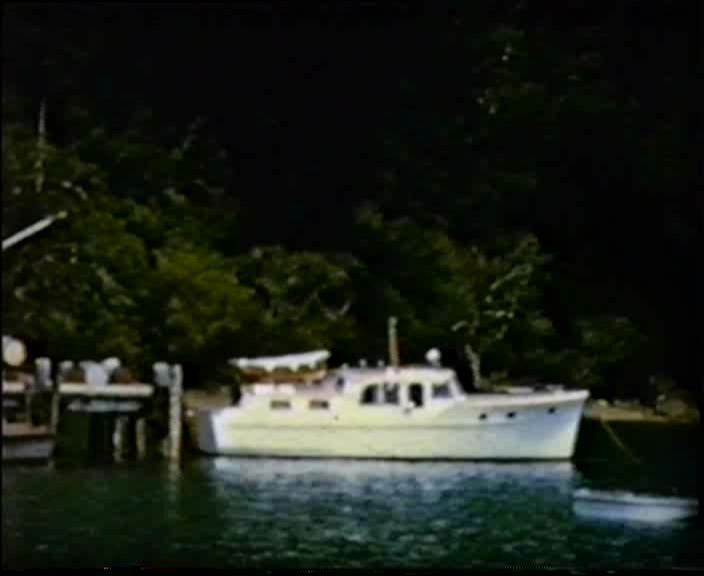
VENTURE – Sailing Sunday photos & detail ex Don Ross ex Merv Stockley. With lots of input from Harold Kidd The history of Venture (E38) goes something like this – she started life as a carvel lifeboat built on the Northern Wairoa by Barbour then was converted to a keel yacht by Bob Shakespear. Alan Coates (later a Magistrate) owned her about 1931 and sold her to Dick Bakewell in 1936. Harold imagines Dick sold her on when he bought JEANETTE from Ted Le Huquet in 1948. Don Ross purchased her from Dick Bakewell about 1939-40 (dates a bit out, but you get that), Don thinks she was built of island kauri and thought she had been built in the islands and sailed to NZ, this contradicts Harold’s records but Don’s version is only ‘dock chat’. She was only 18ft and a carvel double-ender. Don later swapped Venture’ for the launch Ngaroma from Snow Harris who Don believes was a well known yachtie in Mullety circles from Auckland. At the time Snow lived at Hansen’s Island (after Charlie Hansen had passed on) and wanted a yacht instead of a launch. Don lived for most of his younger years in Auckland and sailed all round the Gulf. One of his favourite trips was to sail up to Hansen’s Island for the weekend. He has a number of letters from Charlie Hansen. In 1949 Don,his wife and daughter Lyn headed off to Whitianga in Ngaroma where he used her for game fishing until 1962. Merv Stockley believes they saw Venture up on Bucklands Beach in Auckland around 1968 and took the above photos. Some of her original keel had been removed then. Merv has commented that of all Don’s boats Venture was closest to his heart as he & his late wife, Joan,  did a lot of sailing in Venture & he would love to know if she is still around. Harold Kidd Input Merv is undoubtedly right that Don bought her from Dick Bakewell c1939. My date of 1948 was the most recent limit date, logically. The first mention of her I can find (amongst a scrum of other VENTUREs) is in 1933 when she took part in an Otahuhu Sailing Club race to Bucklands Beach, so she was obviously up the Tamaki at that time. Dick Bakewell told me she was built by Barbour as a lifeboat for ARATAPU which he built in 1878, a sister-ship to HUIA. ARATAPU was sold overseas in 1932, so that kind of works. Did I say Alan Coates owned her in 1931? All I know about his ownership is that he sold her to Dick Bakewell in 1936. Alan was a keen yachtsman in his earlier days and was associated with the Richmond, Otahuhu and Manukau clubs.Lovely bloke. It’s possible that he bought her when ARATAPU was sold, and had Bob Shakespear convert her to a deadwood keeler, but that’s conjecture. She was registered as E38 when it became necessary to wear sail numbers during WW2. Update from Russell Ward – 12-05-2015 1987 photo below of Venture moored at Okahu Bay, off the slipway over towards Pooh Pt. Russell had just launched SL Gypsy and admired Venture’s style. In typical Mr Ward style he warns us to not get sidetracked by the elegant steamer centre frame 🙂

Okareka (Fergy)

OKAREKA (formally FERGY)
photos & details Kent Dadson & Ken Ricketts. Edited by Alan H

Looking for lots of clarification today. Today’s launch was built by Colin Wild & reportedly launched c1940’s (but her owner, Kent Dadson, has been told 1952). She started life named Fergy & is approx. 35′ long.
She was built for Don Brown of D. D. Brown Ltd & had 2 x Graymarine flat head 6 cyl 90 hp petrol engines. Ken Ricketts commented that she was one of the very first boats that had mufflers fitted to petrol engines with above water exhausts – most boats popped or roared along in those days, but Wanda II, Connie V & Fergie were all virtually silent,  from idle up to cruising speed. The petrol engines were later replaced (c.1965?) with twin Ford 2701Es diesels (Lees conversion). Her varnished coamings went white, very early in the peace, pre 1953.
1954 photo of her below in Mansion House Bay, Kawau Island.

Any help in confirming the above & filling in her past would be appreciated.

FERGY 1954 DENNIS BROWN BY C WILD - IN MANSION HOUSE BAY

Update from John Blundell – Ted Copsey and his son Peter were the Fergusson tractor agents based in Pukekohe and they rented some space at the back of Fisher and Blundell Ltd in Newmarket around 1960 – thence the name Fergy 😉

August 2015 Photo at Gulf Harbour

12-02-2025 INPUT ex KARYN KLARWILL – In September 2024 work began on Okareka by Tim Beck who purchased her to share with his young family.   Tim has had the guidance of his father-in-law who has just finished helping restore the 1959 bridge-decker Kotuku. So far Okareka has been surveyed, cleaned, new front windows, engines serviced, the hull caulked, puttied, primer and antifouled applied, topsides, decks and cabin tops painted while on the hardstand at Northcote Point.  She will eventually need more work including new carpet, the squabs recovered and perhaps even a name change.
Okareka was relaunched on 22 December 2024 in time for her new family to enjoy the summer. Okareka will be moored on piles in the Wairoa River in Clevedon.

Port Ligar

PORT LIGAR
photos & details ex Peter Mence

Todays post is a wee bit of a hybrid – her previous owner, Paul Hastings, purchased a 1940 hull of approx. 22′ length & commissioned Bruce Askew, the well know Wellington base yacht & launch designer,  to design a new topsides. The work was undertaken by Evans Bay Boatbuilders in Wellington. The combination of Askew’s eye & the craft of the builders have produced a very salty craft.

She is powered by a Isuzu diesel which pushes her along at a comfortable 10 knots. The interior features blue squabs  set of with red piping. Launch day was marked in style with the ‘Duke of Wellington’ doing the honours 🙂

Interested to know more about her & the where-abouts of Port Ligar now, she has the makings of a perfect lake boat & I get the feeling that one day she will join the fleet on Lake Rotoiti.

Esperanza II

ESPERANZA II
details ex ken Ricketts, edited by Alan H. photos ex B Worthington

The story of how Esperanza II, an American Chris Craft arrived in NZ started in about 1948 when the Fuller family of the Bay of Islands had an American couple, fly over here, to go game fishing on one of their charter boats.

They (probably Snooks Fuller) met the couple personally & instantly hit it off & became instant friends. As a result of this, the extremely wealthily Americans invited them back to America, to stay as their guests, at their waterfront mansion. They accepted & in due course fulfilled the invitation & were amazed at everything the saw. Their hosts had numerous cars, mostly Cadillacs & several boats, one of which was a fabulous virtually brand new 36 foot Chris Craft launch, which was tied up at the bottom of their garden.

They went out & about in the hosts cars & one day the hosts asked the Fullers if they liked the car they were in that day & of course they said they did & their hosts said words to the effect, “well you better take it home with you.” The Fullers naturally thought the hosts  were just joking & passed it over.

In the next day or two they went out in the Chris Craft & of course that was out of this world for them, the like of which they probably had never seen in NZ. Once again they were asked if they liked it & of course they said – they loved it, so once again, the hosts said to the effect, “well you better take it home with you.”

Very shortly after they returned home, they got official documents telling them that the car & the boat were on their way to NZ. The Fullers must have been blown away with the Americans generosity.

Esperanza II became the ultimate luxury game boat of her era in “The Bay,” with many dignitaries & prominent guests aboard. She was originally a fairly fast boat, powered by 2 very large Chris Craft V8 petrol engines, when she arrived, these were eventually replaced with Ford diesels.

From the photos above, taken over the years,  it appears that she is still alive & well & Ken understands she was in Whangamata fairly recently for a period & is possibly in Auckland these days.

The details of the above ‘story’ were told to Kens family in the 1950’s by friends of the Fullers. Can any one confirm & add more details from her past?

Mosquito Craft Dinghy

Mosquito Craft Dinghy
details ex Geoff Brebner

OK woodys, who has one of these under the house?
Geoff found the old advertisement below & wondered how many of us remember the little 9ft Mosquito Craft moulded ply dinghy popular as a tender from the late ’40’s through to the mid ’60s. Geoff’s late brother-in-law Hector George was sent by his father Geoff to Davison’s in Vancouver to learn the method of of pressure-moulding with veneer and marine glue. This was in about 1948.The same technique was used during WW2 with the Mosquito bomber, hence the name.

The George family started building them at their home at Tamaki Drive Kohimarama before moving to a factory at Ellerslie. The design of the 9 footer was the prize winner of a RNZYS competition for a yacht tender “way back when”. Geoff was led to believe Bill Couldrey was the winning designer, but is prepared to be corrected on that. Incidently, the George and Couldrey families were related by marriage.

The boats were laminated up over a very heavy solid wooden mould out of four layers of 1/16th veneer, with the apron and kelson integral, then put in a large rubber bag which was pulled down to 30 inches of vacuum until the Aerodux glue cured. Seats, gunwhales and tuck were fitted to the finished shell. Later on a 12 ft and a 10’6″ model were also built.They were produced up until 1965 when the cheaper glass-fibre boats found favour.
Geoff can’t recall the figure, but over 900 of the 9 footers were built. Geoff worked there for eleven years & his sister sister’s family still own the first and the last of the 9ft line.
Geoff thinks the 2nd one built was the tender on Harold George’s VICTORY A8.

There must be a few out there tucked away at the back of the shed.

Harold Kidd Input

The Mosquito dinghies were built in quite a different manner from the “cold-moulded” veneer dinghies. As Geoff describes above the Mosquitos were much more elaborately manufactured than the Lidgard type. There were a lot of the latter built. All that was needed was a good sturdy mould, a supply of straight-grained veneer (often pinus radiata), some Aerodux resorcinol raspberry jam adhesive and a staple gun.
Jack Logan produced heaps of them and many backyard builders whacked them out. I used to help my mate Barry Brickell’s father, Maurice, build them at Tui Street Devonport and went on to use the same technology with John Chapple to build several racing 12 footers and that became almost the standard construction technique for one-off and volume centreboarders, especially Des Townson’s famous Zephyrs and Mistrals.
But the Mosquito craft were the pioneers and arguably the best.
The fuselage of the de Havilland Mosquito (DH98) was originally built of a birch/balsa sandwich using CASEIN glue which was all they had when it was designed in 1938. It caused problems in hot humid conditions by unpeeling. However de Havilland developed urea formaldehyde glues, later available commercially as Aerolite, which aced that issue. The Mosquito wasn’t the first plane to use that construction. I used to fly and part-own a de Havilland Moth Minor (DH94) ZK AKM, which was cold-moulded with casein. She’s still flying happily with no fuselage issues after 77 years.

21/02/2015 Photo ex Darren Arthur


Darren commented that the oil on the transom was the result of running a “Seamaster 400”. A rather odd ball outboard that used an air cooled Tecumseh lawnmower engine. Noisy, heavy, smelly and leaky were some of the more polite adjectives Darren recalls his father using to describe it 🙂

24/02/2015 – story & photos from Roger Lacey

My father bought a 12′ Mosquito craft in about 1969. It was a couple of years old and had a 7.5hp Archimedes Electrolux motor that used to eat spark plugs for breakfast. We used it for fishing in the Waitemata and also at Lake Rotoiti where I learned to row. When my parents bought a bach in Turangi we moved the boat down there but not before sanding back the outside and giving it a coat of epoxy resin, which in hindsight probably saved it. The boat caught many times its weight in trout and made both an ideal fly fishing platform and a stealthy trolling vessel over the shallow weed beds near Tokkanu and at the other smaller lakes nearby. The unreliable Electrolux was replaced by an infernal 2.5hp air-cooled Tas outboard which provided just enough power to motor up the lower reaches of the Tongariro River but was useless for trolling so we rowed it most of the time. In the late ’90s my dad sold the boat with the bach without consulting me so I tracked down the new owner and bought it off him, took it home and restored it. As I didn’t have room for yet another boat I ended up selling it to a friend who has it still. He recently found some rot in it, got it professionally repaired and fitted an new foredeck. It is currently awaiting paint.


Mechanics Bay 1945

Mechanics Bay April 1945

photo ex James Dreyer ex ‘Old Auckland’ facebook

I thought it was time for an old b/w photo & a who can tell us more about the motor boats featured.

Updated ex Harold Kidd

My pennyworth is the the left hand launch is one of the Hubert Scott-Paine designed control tenders, built by his company, British Power Boat Co, in 1939 for Tasman Empire Airways Ltd for the flying boat base at Mechanics Bay and later copied here. They floated around between RNZAF and TEAL operated by the Civil Aviation Board so it’s hard to be precise, at this distance, on which one she was. The first Hythe-built one arrived on EMPIRE STAR in June 1939 and was 37ft 6ins x 8ft 6ins and had twin 100hp petrol engines (Meadows I think, as fitted to Invicta and Lagonda sports cars and those Bren Gun carriers which didn’t have Ford V8s). They were guaranteed to do 18 knots but could touch 25.
I think the middle launch is TASMANAIR, built for TEAL by Colin Wild in July 1941 with a very similar spec to the Scott-Paine boats, but had a large passenger capacity.
The right hand boat is possibly the Scott-Paine 23 foot aircraft tug brought out on the EMPIRE STAR in 1939, fitted with a single Meadows.
My Standard 5 and 6 classrooms at Devonport School, high up on Mount Victoria, had splendid views of proceedings at Mechanics Bay. We had one student teacher who would stop the class and let us see all departures and landings. There were some hairy ones, especially Catalinas in a strong westerly.

PS the little launch coming in at left is probably one of the locally-built runabouts used at Mechanics Bay for general purposes, often in charge of Flight Sergeant Johnny Wray of NGATAKI fame. Dave Jackson will probably be more precise on that one as his father was in the RNZAF Motorboat Section. It could even be the Collings & Bell 28 footer PIRI PONO which got rather modified by the Air Force and had a Chrysler Crown installed in place of its “orphan” 150hp Niagara..

Additional photo added ex Pam Cundy

Harold Kidd input

It’s a pity we can’t see if the Scott-Paine launch in the foreground of Pam’s pic has a W number on the bows, which would identify it precisely. My guess is that she’s W6 which was returned to Auckland in May 1944 from Lauthala Bay, Fiji. The plane in that image is an RNZAF Short Sunderland.
The planes in the top pic are the Short Empire class civilian flying boat ZK AMC “AWARUA” in the foreground, 3 RNZAF Sunderlands and an RNZAF Consolidated PBY5 Catalina at the rear. As a child, I thought it strange that AWARUA had been named after the Auckland Meat Company.

Pacific at the 100th Auckland Anniversary Day Regatta

Pacific at the 100th Auckland Anniversary Day Regatta

photo ex Nathan Herbert

Given that tomorrow is the 175th running of the regatta, I felt it was a perfect opportunity to post the above stunning photo of the launch Pacific & her crew watching the A-Class fleet compete in the regatta.
From L>R – A18 Tawera / A16 Little Jim / A2 Rawhiti / A14 ? / A15 Prize / A5 Rawene / A9 Moana

Tonight there is a big on-the-water fireworks display in the inner harbour so if you are in & around the city – check it out. Details at the regatta website (link below)

I would encourage you tomorrow to make the effort to find a good viewing point as the regatta is one of Auckland’s truly special days.
More details here http://www.regatta.org.nz/

Felisa

FELISA

photo & details ex Harold Kidd ex John Blundell

Stan Blundell, of Fisher and Blundell, got his cousin Gerry Lane to design a 32’ x 9’6” motor-sailer for him in 1949. Gerry was then a school teacher but had served his time with Bailey & Lowe who had no job available for him when he came out of his apprenticeship at the beginning of the Depression. He never lost his skills and his love of boat building, however. Harold has heard a claim that the boat was designed by Garth Lane of the Lane Motor Boat Co, but says that’s incorrect.
Stan had her built by Phil Barton in St. Mary’s Bay. She was fitted with a 4 cylinder Ford diesel and, although lightly rigged, the Blundells used her sails to good effect in making passage and could get 8-10 knots under sail alone on a broad reach. Her coamings were teak and kept varnished. Stan named her Felisa as it is the Spanish equivalent of Phyllis, Stan’s wife’s name. Phyllis spent much of her early childhood in Guatemala and grew up bilingual.
The Blundells lived at Lynch Street in Point Chevalier. Felisa was moored off the property and took the mud at low tide.
Stan sold Felisa to Tairua, his son John thinks, around 1959, and she was later stationed at the Barrier. Harold had a report of her in 2000, owned by Callahan.
In one of the photos, she is on the mud off Lynch Street near a 20ft open cockpit hard chine launch designed by Ron Oliver, a design which won a Sea Spray competition. Several were built. The structure in the background is the old quarry on Meola Reef.
John Blundell would very much like to have Felisa’s recent history filled in.

Where is she now?

Update 27/01/2015 – CYA member Mark McLaughlin snapped the photos below of Felisa on her Tamaki Estuary mooring. The motor-sailer rig has been chopped ‘a little’.


Raema

RAEMA

Raema a 1940 Collings & Bell bridgedecker, has just changed hands & is now berthed at Port Motueka. She is 34′ LOA, 9’2″ Beam, 4’3″ Draft & powered by a 120hp 6cyl. Ford diesel.
On board there is a plaque saying ‘Raema RNZYS’ & she is rumored to have been once own by a past rnzys commodore.
Her owner would love to know more details on her past & see some early photos if they exist.

This slideshow requires JavaScript.

Harold Kidd Update

RAEMA was built in late 1923, not 1940. Her first owner was Gordon Bartleet, who had REHIA built by Colin Wild in 1939. I can find no contemporary reference to her builder, but Collings & Bell is almost certainly correct because she had a 4 cylinder Doman engine for which they were agents.
In March 1924 Bartleet sold her to Moller who was then Commodore of the Takapuna Boating Club and bought her back from him in September 1928. In October 1930 Percy McGill of Rotorua bought her, keeping her until the winter of 1933 when Horsley bought her. She then appears on the Kaipara in 1938-9 owned by Bo Bogle and then R. Smith (unless that’s another RAEMA). Then nothing in Auckland. She does not appear in the RNZYS records up to the mid 1960’s (which is where I’ve got to in transcribing them).

PS The only photograph I know of is at the Matakohe Museum and numbered PAHI 88. It shows her at the 1938 Pahi Regatta.

Zoe


ZOE (MYSTERY LAUNCH ON THE KAIPARA)
photo from Russell Ward

Russell was recently mud plugging and gunk holing over on the West Coast – Kaipara, skippering the steam boat Romany when he came across the nice bridgdecker above, tied up  at Helensville. Russell noted that the styling of the windows was very ‘individual’.
Russell was told by a local that it was built in 1948 & was also told her (the launches) name, but forgot it 😦  .

An unusual boat in an equally unusual location – someone most be able to ID her ?

As always – click photos to enlarge 😉

1937-1938-ford-5

18-10-2015 Update from Cherry Bishop

This boat was built by my father Francis Bishop and a boat builder friend who’s name may have been Gladden. It was built from one of the last kauri logs to have been milled in the North island and yes 1948 is the year it was built. He dearly loved the boat and named it after my Mother “Zoe”. During my childhood we often took her out on the Kaipara fishing and netting for flounder and stayed overnight,sometimes for up to several weeks at a time depending on the demands of home and work. We often attended the Kaipara cruising club regattas and other events.We also sometimes moored at the lagoon at the end of the South Head Peninsula and I have fond memories of falling asleep in the bow of the boat listening to ship to shore radio and the sound of lapping waves and peacocks meowing ashore.As children we all fished and swam “with the sharks”.
Since my Father was born in 1910 he was familiar with boats sailing the Kaipara harbour and I once found a series of drawings he had done as a child of “boats” which were very detailed. I think he was really a frustrated boat designer. He left school age twelve during the depression as labour was needed on the farm and he was a farmer all his life. Boats were his hobby and a great love.He died in 1999 aged 89.