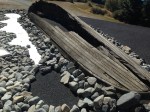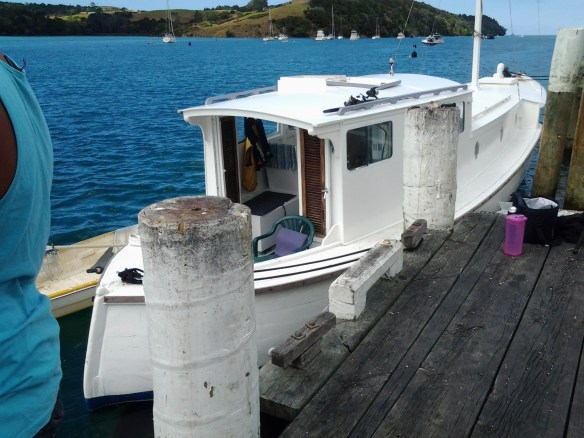
RENUHOU details ex Ken Ricketts, John O’Meara Jnr., John Bennett, Bob Roach & Dave Stephens. edited by Alan H Now this is a great tale, its believed that she was built c.1904 as a single skin double-ender, with single mast. In the b/w photo above, Renuhou was moored in Mansion House Bay, Kawau Island. Now like so many of these old girls there are big holes in her past but this old girl has lived an ‘interesting’ life. She had been in Tauranga & was sailed by her owner, Pat O’Malley, back to Auckland in the early 1970s, who refurbished her & later sold her to John O’Meara. We understand that O’Mera owned her approx. 43 years ago (from the mid 1970’s). When he bought her she had a 40hp Ford diesel & bilge keels. She also had had a fire aboard & was badly burnt prior to O’Meara owning her. O’Meara sold her to a Michael Kirkwood, who had her moored in Okahu Bay, for quite some time. During his ownership Kirkwood fitted a permanent wheel house hatch and another mast, to her cabin top. This new aluminum mast was fitted along with a replacement for the original by a John Bennett (secretary treasurer of the PYBC). O’Meara later bought her back off Kirkwood while she was moored in the Tamaki river for 8 > 10years. O’Meara sold her to an out-of-town owner who lived in the Raglan area. They did not look after her & during his ownership she was hauled out on the Panmure Yacht Club hardstand and stayed there for quite some time. John Bennett has advised that she was more or less abandoned & as the hard stand fees were not paid she was eventually sold by the P.Y.B.C. (under the terms of their haulage agreements, to defray costs). The club sold her to Dave Stephens on 2.2.2011. Now this is where the story of Renuhou makes a big U-turn. Ken Rickets had heard that she might now be a child’s plaything in a kindergarten, so Ken did a bit of detective work & jackpot – turns out Dave Stephens had transported her (permanently) to his lifestyle property at Albany & spent the last 4+ years restoring, refurbishing & altering her to suit his needs i.e. a permanent sleep-out / accommodation that is part of his lifestyle property that features all sorts of artifacts & bits & pieces. Whilst the Ford diesel engine has been removed & sold, the well made bronze strut, shoe, rudder, & stainless steel shaft, are all intact. Whilst she is presently not seaworthy it would only require a small amount of time & money to do the essentials to get her back in the water. The photos below show Renuhou during her relocation / restoration – its a better option than what Colin Pawson calls a Beehive* restoration *for the overseas readers Beehive is a brand of matches/fire lighters 😦
Category Archives: 1900’s
Kumi
KUMI
KUMI
I received an email a few weeks ago from someone that talked about the launch Kumi – problem was it was not from the owner & I had no idea who they were. They did talk as if they had an interest (past / present) in the boat. I even rang Harold Kidd & asked him if he knew of xxxx xxxxxx, the name drew a blank with Harold also.
So I call Kumi’s owner Haydon Afford & ask him if he knows someone called xxxx xxxxxx – the answer “thats me, I get sick of having to spell my name so for years I have used xxxx xxxxxx for the unimportant things in life e.g. ordering a pizza etc. xxxx even has his own email address…….. which is more than Haydon does, no mobile phone either 🙂
Hayden then realizes that on the email to me he did not say it was from him. I have re-printed the email below.
” Dear Alan. Quiet at work so found all these fantastic pictures on your extremely good website . if you wanted to include Kumi in the Bailey and Lowe chapter I wouldn’t mind. brief history? Launched aug 1905 as ‘Eliza’ for Henry Adams as a lorry to take produce to and from his island Moturoa in the bay of islands. Raced in 1908 rudder cup ;failed to win . The annoyed mr Adams challenged any body [mainly aimed at line honours winner James Reid with Seabird] to a race for 50 guineas to Russel wharf and back . Kumi beat Seabird more by good luck than boat speed , since in the rerun of the rudder cup it was very obvious that Seabird is a faster hull! Adams had some bank trouble in 1913 and Eliza vanished never to be seen again , but fortuitously at exactly that moment ‘Kumi’ appeared built by the same builder to the same design and launched on the same date as ‘Eliza’ .whew. She was sold to other people and in 1928 sold to Whangarei harbour board as a pilot boat and used as such till 1955 .She then went to Whangaroa harbour as a crayfish boat for mr Russ and did this till 1975. It was during this time that an oyster barge made a mistake in berthing, crushing Kumi against the wharf and sinking her in apparently three minutes. In 1975 she went to a Whangarei back yard till 1985 where she was modernised. Mr pont of Whangarei sold her to mr Tercel and she came back to Auckland where her modernisation rapidly deteriorated through several owners until 1999 when the present owners purchased her in spite of the surveyors comment of “not even any use as firewood, too rotten and wet”. The Affords took her back to their place and rebuilt her to close to 1905ish ; which was lucky because she ended up the same as her launching day photo in the maritime museum which Harold Kidd told us about after her relaunch. Kumi has had several engines but mr Pont in Whangarei installed a 1963 six cylinder Ford rated at 80 horse power and this engine still gives perfect service .Kumi is a fun boat, fast enough [if not a line honours winner] but sea kindly and comfortable and ready for the next 100 years.”
A little more about Kumi – in the summer of 2012/13 Kumi completed a circumnavigation of New Zealand, I have covered this previously on ww but if you missed it, click the link below to read Haydon’s tale. Post the trip Haydon gave a talk to CYA members at the RNZYS, it was one of most entertaining evening I have been to. Haydon & Kumi’s vovage was acknowledged in 2013 with the presentation to Haydon of the ‘CYA Outstanding Achievement Award In Seamanship’ (photo above)
The story of Haydon Afford’s 3 month circumnavigation aboard Kumi his 1905 Bailey & Lowe launch
Recognition – Kumi also features in the CYA Classic Register 2014-15 edition – the link below takes you to the section.
http://classicyacht.org.nz/demosite/wp-content/uploads/Classicreg2014/flipbook.html#p=26
A.H.B. / KELVIN
A.H.B. / KELVIN
A.H.B. is 1907 Chas Bailey Jnr, 3 skin Kauri and 39ft., she was built for the Auckland Harbour Board hence her name A.H.B….Once she was sold out of their ownership she was renamed Kelvin and spent most of her life called that, her current owners, the Pollard brothers, we put her back to her original name.
Paperspast says she’s worked alongside Ferro in the early days, even receiving Ferro’s old engine at one stage. Also that she was leased to the police during night time hours for patrolling the harbour in 1911.
She was transferred to the Manukau and used by their harbour board for quite some time there before being sold off eventually.
The old stern on photo (supplied by Harold Kidd) is thought to be before or after the shot of the other old photo (ex Paperspast ) which caption says she was being returned to the Waitemata to be used in cray fishing industry 1933. Refer b/w photo/caption below.
Some info supplied by CYA member Baden Pascoe even has her fitted with two engines in the late 1940’s. Both shaft logs are still installed but plugged off.
She was also owned for a time by by boat builder Dave Jackson.
For a while she languished amongst the derelict boats down in Waikawa, then she was sold and steamed to Mana where she was forgotten and almost met her end via chainsaw before the Pollards rescued her, got her running / floating and bought her back to Auckland.
She’s powered by a D series Ford with a hydraulic box and is berthed at Panmure. She is mobile but she is a project boat requiring plenty of work and a loving owner to take her to the next step.
The Pollards boys – Andrew & Cameron have rescued more classic motor vessels than anyone I know, I have heard Harold Kidd say on numerous occasions “the their blood is with worth bottling”.
Like all of us, there are only so many toys you can fit in the box so A.H.B. is looking for a new owner / home – initially contact me on waitematawoodys@gmail.com
as always – click on any photo to enlarge 😉
Miss Kathleen
Image

MISS KATHLEEN
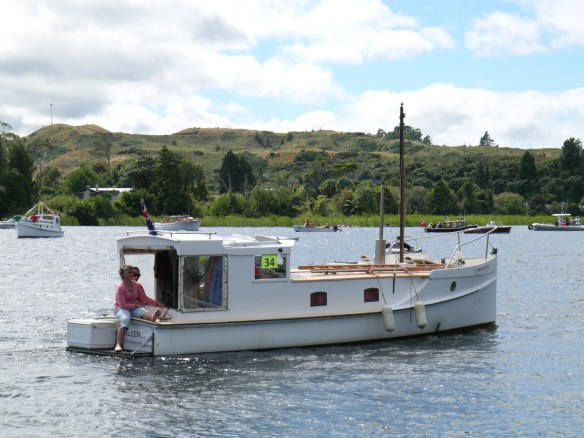
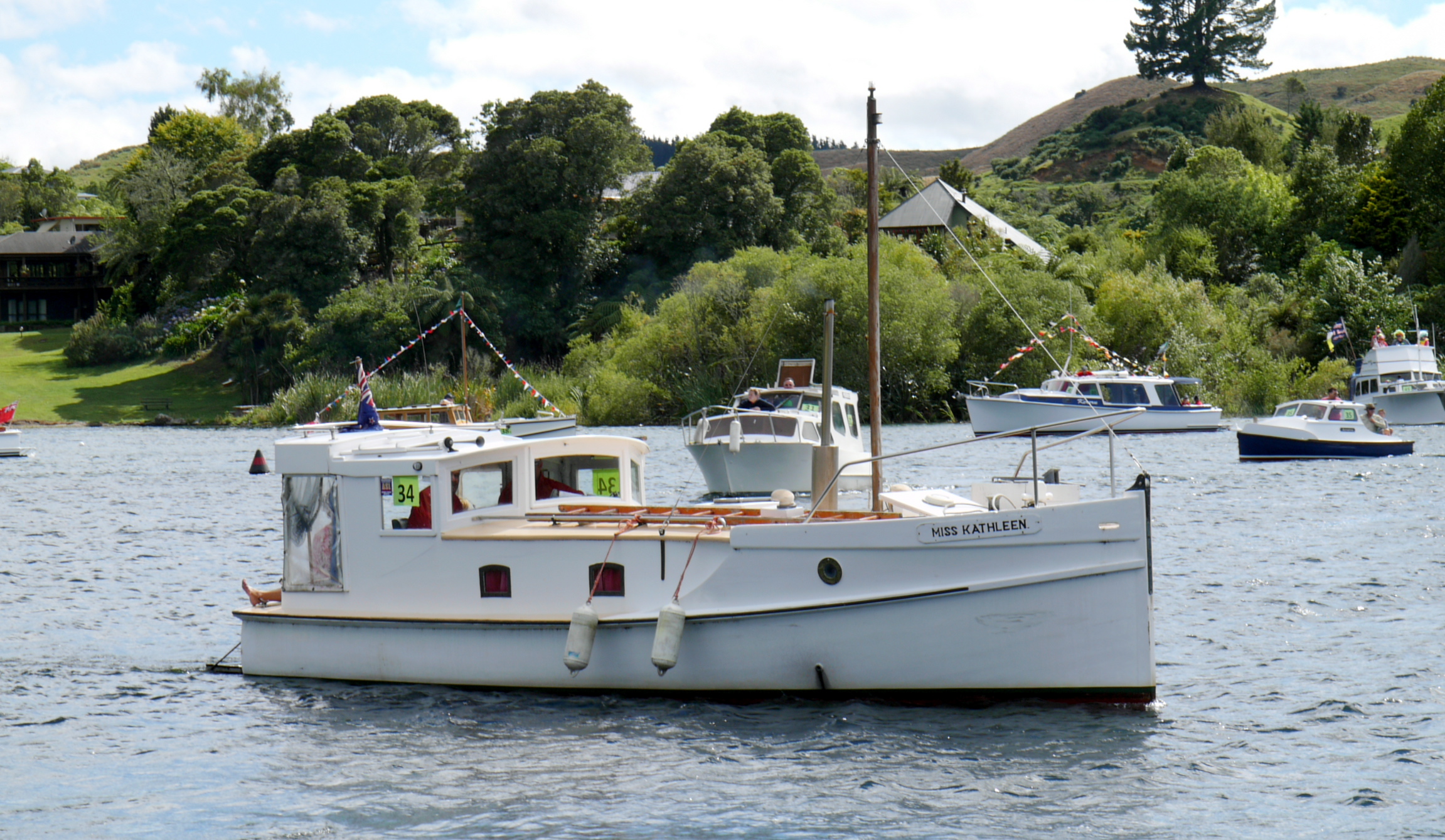
A 1902 Logan, 27’6″, kauri planked. Built by Logans for a wealthy Whangarei family. She was used as a please boat & spent most of her life in the Bay of Islands. Subsequently used for long-line fishing. She resides on Lake Rotoiti.
Powered by a 50 year old David Brown 50h.p.
Miss Kathleen was rebuilt in 1989 & purchased by her current owner, Barry Green, in 1997 from Captain Richens, an old sea captain.
Harold Kidd Update
Yet another mythological “Logan”. Looking at her hull, she’s obviously neither Logan nor 1902. A 1992 “Northern Advocate” article on her provenance talks about her 1989 rebuild by Colin Richens and infers her original build date at around 1925, which is more like it.
However, I suspect she’s a bit earlier than that and possibly one of several launches of her type built for Whangarei by David Reid of Drake Street, Auckland, around 1914-16.
Thelma / Vera
Image

THELMA / VERA
photos & details supplied by Bruce Yarnton. (Russell Ward added)
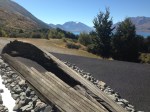
From the story below you will learn that Thelma has had a fascinating life & now her ‘bones’ sadly reside on the roof of the Lake Ohau Lodge, for protection after numerous backpackers decided kauri made good firewood 🙂 The lodge owners are interested if anyone has any old photos or tales for her past.
The tale of Jock Edgar & his gambling adventures are worth the read alone.
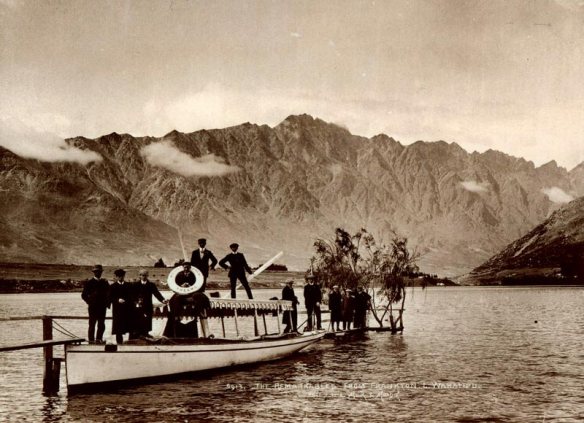
In the b/w photo above Thelma is berthed at Lake Wakatipu (Frankton) with the Remarkables in the background. There is no date to the photograph but sources have confirmed its pre 1920’s.
The History of Thelma (Vera)
The Thelma was built in Auckland in 1903 by Mr C Bailey, and engined by Messrs W A Ryan & Co, also of Auckland. Thirty five feet long with a six foot four inch beam, she was fitted with a 5 horse-power Union oil engine, and could accommodate thirty passengers. She was brought new to Dunedin by Messrs Hayward & Garratt to demonstrate the Union oil engine. She was not christened Thelma but was the Vera for the first few months of her life. The Vera’s maiden voyage was on the Otago Harbour in September 1903, and she was then bought by Mr Searle of Queenstown and by October 1903 was providing tours on Lake Wakatipu.
Six weeks later Vera had been overhauled by Ryan & Co after her bearings gave trouble, and was re-named Thelma at the same time.
Subsequent owners were Jno C McBride who took her over in 1906, and then Jock Edgar.
Quoted from “The Mount Cook Way” by Harry Wigley, first published 1979.
Jock Edgar was one of the characters of the district. A confirmed batchelor, an inveterate gambler, he had no family ties and not many other responsibilities, and would periodically go on a bender for two or three days. Jock who was never known to hurry, had a Southland drawl, and when he told one of his innumerable yarns, often against himself, his eyes and florid face would light up.
In his youth he was once lined up before the local magistrate – who happened to be his father – on a charge of being drunk and disorderly, and in due course he was fined 7s 6d. After listening to the magistrate make his pronouncement, Jock said in a loud voice: ‘You’ll have to pay it, Dad.’ He went off to the South African War and gambled his way round that country with varying degrees of success, finally arriving on board the ship which was to take the contingent home with not a penny in his pocket, and only the clothes he stood up in. He claimed that when he stepped ashore in New Zealand he owned nearly all the loose cash on the ship, as well as a wide range of saddles and bridles, watches and other gear.
Returning to his hometown of Queenstown, he bought a graceful old launch – the Thelma, with a yacht-type counter stern and a slow-revving single-banger engine – and with this he ran trips to the many parts of the lake not serviced by road. The old Thelma was later used on Lake Ohau for a number of years until she went ashore and was damaged beyond repair, and as far as I know she is still lying on the beach below the Lodge.
To cope with the expanding traffic Jock had built a modern passenger launch, the Kelvin, and he also developed walking trips up the Routeburn Valley and down the Greenstone, using a series of mountain huts and packhorses to carry in supplies. He ran the business from a small building on a piece of land he owned on the waterfront across the road from Eichardts, and it was this building which was moved to the Crown Range and later on to Coronet Peat to establish skiing there.
In the mid 1920s the Company bought the whole of Jock Edgar’s business, including the launches, the land on the waterfront, and his huts and horses. A modern building to replace Jock’s hut was erected on the waterfront site to house the branch office and staff. Once a year Dooley Coxhead, who was then Company secretary, did a round of the Routeburn and Greenstone Valleys to check the huts and count the horses, but it was not until some years later we found that the ones that Jock had sold to us actually belonged to the Tourist Department!
In a book called “All Aboard” by RJ Meyer which was about the old cargo boats, firstly yachts then latterly steam, it mentions the Thelma in the winter of 1933 being roped in to help with the mail and service run to Glenorchy. While the Earnslaw was having boiler repairs the Ben Lomond also developed boiler trouble and the Thelma was called on to serve the lakeside stations. The Thelma then had engine trouble and the Kelvin and the Muritai had to carry on the service.
Tamahere
Image

TAMAHERE
photo & details ex ken ricketts
Tamahere is seen above tied up at the Sandspit wharf. She is currently owned by Chris Metcalf who has had her for about 12 months & bought her off a Mr Rose. She has a small Isuzu engine, which replaced a 135 hp 6 cyl Ford, which had been right in the bow, & he has put the Isuzu more amidships.
The designer / builder is un-know & while there is no concrete proof the talk is she was launched in 1904. She appears to have been low wooded in the bow & has had the bow raised & combings added to, altered, or replaced, through the years, but not for a very long time as Ken recalls her more or less looking like she does now back in the 1950s/60s.
In her past life she was used for years by a number of Kawau Island residents & trades people (builders etc) to tow barges & be a work boat & workers transport, Also for a while was used to tow the fuel barge with big tanks on it, to the KIYC, from Sandspit. She was moored for quite a period in the 1970s & 1980’s in Smelting House Bay.
Currently kept up the Matakana River at Sandspit & is in the process of being, in the owners words, ‘tidied up’. Any help in ID’ing her & her past would be appreciated.
Bondi Belle
BONDI BELLE
story & photos by Baden Pascoe
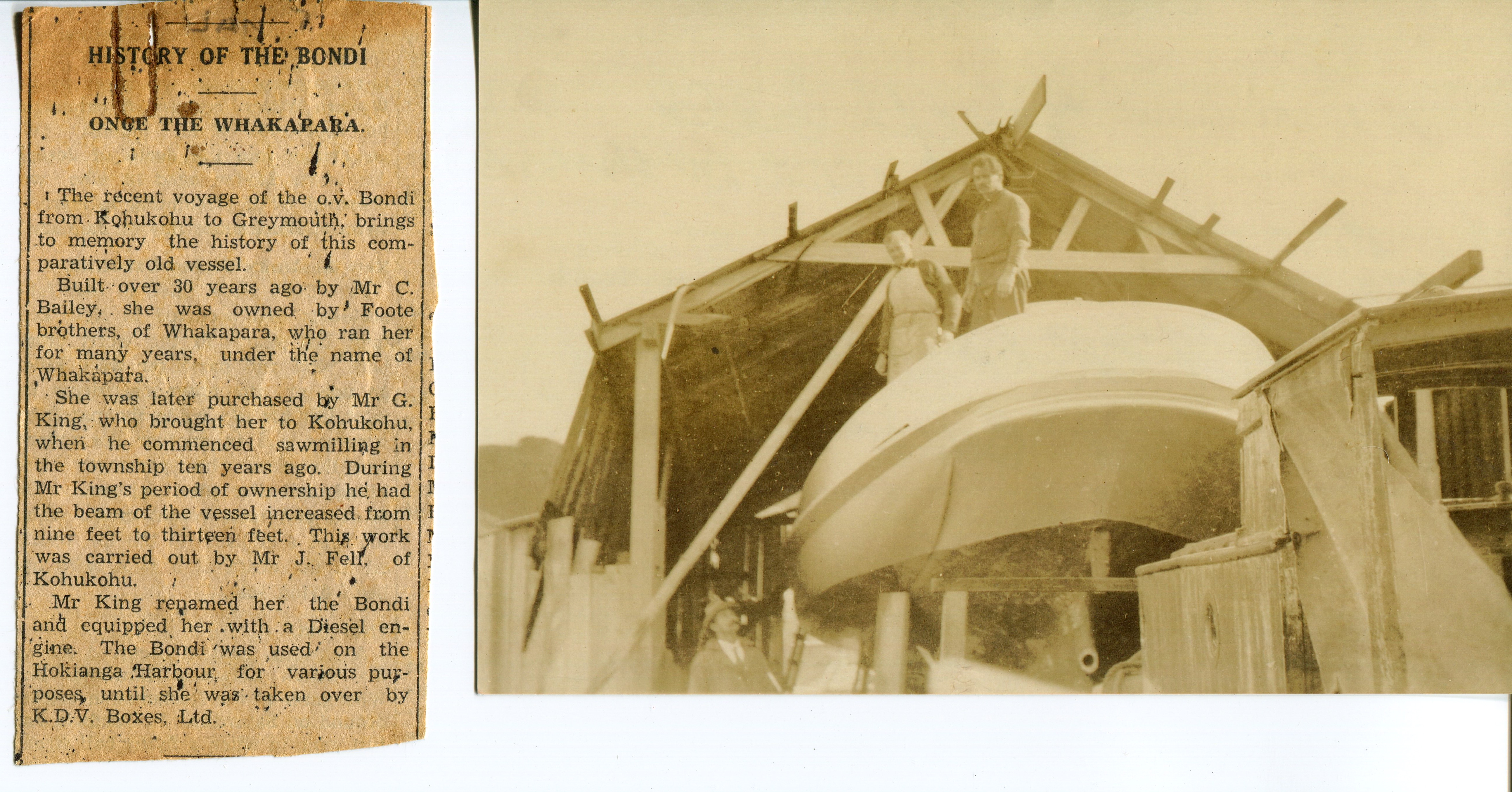
Bondi Bell was built as S.S.Whakapara, at Whakapara (North of Whangarei) by Charles Bailey Jr. for the Foote family who were saw millers at several Northland locations . Launched in 1901, initially she was a steamer and converted to diesel in the 1920’s. This vessel is steeped in history and her owner ,Ted Carter needs to find a new owner for her. He is asking $85,000 and is open to negotiations. For details call Ted on 0274-485976.
(b/w photo c.1901-02. Whangarei, Hatea River, were the town basin is now)
Link the (blue) link below to read the brilliant story of the history of Bondi Belle & her 80 year circumnavigation of New Zealand.
BONDI BELLE – Around NZ in 80 Years
The press clipping from the Hokianga Newspaper c1929, was saved by Arch Fell & given to Baden Pascoe. Arch is most likely in the photo. Click to enlarge
The Rudder Cup
Image

The article below was penned by Harold Kidd with the intention of creating interest among the classic launch community to re-run the 1908 race in 2008 to celebrate the centenary of the event. As tends to happen with most things HDK puts his name to, the 2008 race happened.
Pauline & Harold Kidd donated a cup, the Rudder Cup Centennial Trophy for the race & now each year CYA launches race to Patio Bay for the cup. Today is that day so it seems appropriate to feature the 1908 race. I very proud to have Raindances name on the cup (2012 winner).
Enjoy the read & thank you Pauline & Harold. Alan H
THE GREAT LAUNCH RACE OF 1908 – The Rudder Cup race around Sail Rock
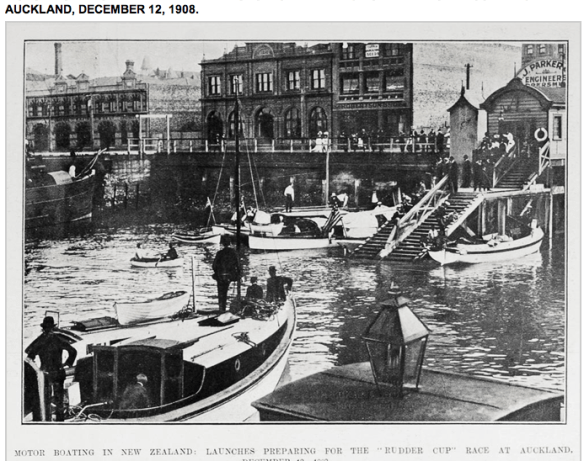
The Rudder Cup launch race around Sail Rock and back, a distance of 108 nautical miles, was set to start off Queen Street Wharf at 10 pm on Saturday 12th December 1908. All week the weather in the Gulf had been heavy, all day a stiff southerly blew, but at sunset this died to a flat calm. Shortly before the start, a light westerly breeze came up and that quarter prevailed throughout the race. The Squadron race committee made a serious mistake. Despite the fact that the weather was clearly settling, it decided to apply the heavy weather handicaps, handicaps that made the larger, more powerful launches give big time allowances to the smaller fry. Happily, for the moment, and for the peace of mind of the faster contestants, the handicaps were sealed.
Of the 14 entrants, only 12 made it to the start. The brand new 42 footer Alleyne, owned by Arthur Brett, Commodore of the New Zealand Power Boat Association, scratched for some undisclosed reason and so did Leo Walsh’s Kelvin, with a slight engine problem.
The massed flying start was a pretty sight as eleven of the twelve launches throbbed their way, “with the cyclonic whirring of gas engines”, said the Star, down the Waitemata, around North Head and into a calm but very dark night. Floral had been first over the line but James Reid in Seabird took the lead by North Head. Eliza had a problem restarting her engine and was trailing behind. The moon rose in the East as the launches approached Tiri and droned on into the night, the little fleet now becoming strung out with only their nearest competitors in sight. There was a beam swell and sea off Kawau but it moderated, then got up again when a fresh westerly kicked in as they entered Bream Bay.
At 0414 on Sunday morning Seabird was the first to round Sail Rock and turn for home. She was followed by Matareka, 26 minutes behind, then Alice leading the main bunch a few minutes later. The Herald reported the rest of the race,
The run home was uneventful, the westerly wind off Waipu beach being left behind and a southerly with a bumpy sea being run into at Whangaparaoa Passage. Seabird gained on all the launches and Matareka also improved her position, but neither of the leading boats had sufficient in hand to secure a win.
But, until it was all over, and the handicaps opened, neither skipper knew that.
Alleyne met Seabird as she rounded North Head, out on her own, and she came tearing up the harbour to finish at 1030, cheered by a very few of the NZPBA faithful on the wharf that Sunday morning. Seabird was 53 minutes ahead of Matareka which was 28 minutes ahead of Alice. All the remaining boats had finished by just after 1300 in the following order, Wanderer, Maroro, Kotiro, Eliza, Vanora, Floral, Winsome, Waipa and Petrel. Seabird averaged well over 8 knots for the run, a great turn of speed for the time, point to point in the open sea.
When the handicaps were opened it was found that Seabird had to concede a time allowance of 3hrs 23 min to Maroro, something that was impossible in the conditions. The handicap results were Maroro 1st, Winsome 2nd, Petrel 3rd and Alice 4th. So the Rudder Cup went to the Matheson brothers of Maroro.
Not surprisingly, there was much criticism of the outcome. Some said that Seabird was the moral victor, some said that Chas Bailey’s Alice had performed best in comparison with the others having regard to her size and horsepower and should have won with proper handicapping, all said that the handicappers had done a bad job. A protest was lodged with the Squadron but failed. The real winner was the reputation of the motor launch and of the marine engines of the day. The Herald said,
The race is considered by motor launch owners as a triumph for the reliability of the motor boat. Twelve boats went round the course, and not one engine is reported to have stopped throughout the long run of from 12½ to 15 hours.
But the fun was not yet over. Immediately after the race, Harry Adams issued a challenge to Maroro, “or any other competitor” to a race from Queen Street Wharf around a buoy off Russell Wharf and back, non-stop, 240 nautical miles, for ₤50 a side, a preposterous sum at the time. Adams was taking a shot at James Reid and Seabird. Possibly he was driven by the need to dispel doubts about the Auckland-built Adams Kiwi engine in Eliza which had played up at the start of the Rudder Cup race. James Reid accepted at once.
Arthur Brett was stakeholder, starter and judge. Eliza’s crew consisted of Capt. Ted McLeod, master of the Northern Steamship Co’s coaster Clansman as skipper, Bill Cook, later of the Whangamumu whaling station, navigator, Fred Reynolds, of Whangarei, engineer, and Charlie Mitchell as engineer’s mate. Harry Hopper stayed ashore. James Reid employed Capt. J. Quinn, master of the auxiliary schooner Endeavour, as pilot and had as crew K. and H. Boyd, A. Tyer, and E. Akersten.
There was nothing like a big wager to stir interest in the Colonial heart so there was considerable attention paid when the race started off Queen Street Wharf at 0750 on Saturday 30th January 1909, the day after the Auckland Anniversary Regatta.
James Reid told the Star,
“The boats got away to an even start, but one at once knew that something was wrong with the Seabird; there seemed no life in her. The Buffalo came alongside us, and beat us easily, showing that there was really something out of order. The Eliza was drawing right away from us, and we were sure now that we had seaweed on our propeller. We reversed the engines several times, and tried her again, but could not shake it off.”
Buffalo was a new launch built by Reid’s younger brother David and was much lower powered than Seabird. Seabird carried on until Takatu Point when Reid stopped the engine. Ken Boyd went overboard and cleared the totally fouled prop with a boathook. By then Eliza was out of sight, but they gradually hauled her in. Off Bream Head the weather rolled in thick. Seabird felt her way up the coast, rounded the buoy off Russell Wharf at 2340 and then Capt. Quinn stood her out to sea till daylight when they briefly picked up the Poor Knights. Through lifting mist they raised Sail Rock in clear weather and steamed straight home from there at full revolutions. She did the 54 nautical miles in 6 hours 15 minutes, averaging a cracking 8.64 knots and crossed the finish line at 1638 on the Sunday.
On board Eliza, the Kiwi engine never missed a beat. She rounded the Russell buoy at 2250, 50 minutes ahead of Seabird. Her report made much of a rough trip home in a rising easterly,
Aboard the Eliza, one lurch threw two five-gallon drums of oil across the engine-room floor, and another threw the engineer right across his engine. The launch went under the Hen to get smooth water, to enable her to fill her oil tanks, and owing to the rough sea she went outside Piercy Island to get calmer water.
Eliza finished at 1425, 2 hours 13 minutes ahead of Seabird to win the wager.
James Reid pooh-poohed Eliza’s rough weather talk.
“I must contradict the report that both boats were knocked about in the sea. …we did not get a drop of water on the decks.”
And that was that. The reliability of the modern internal combustion marine engine had been further enhanced, there had been some heroics to suit the taste of the time, and honour was satisfied all round. But the story doesn’t end there.
It will come as no surprise to readers of Vintage Viewpoint and our books that, almost a hundred years after the Rudder Cup race, the main protagonists of 12th and 13th December 1908 are still soldiering on.
Eliza was run by Harry Hopper for some years and was bought by brothers J.T. and J.W. Mason of Whangarei in 1920, renamed Kumi, Maori for a fabulous monster, like a taniwha. They sold her to the Whangarei Harbour Board in 1929 and she stayed on strength as a tug and pilot boat, skippered by Archie McKenzie, for many years. Recently vet Haydon Afford of Taupaki bought her and rebuilt her.
James Reid sold Seabird in 1910. She stayed in Auckland in various hands until the cyclone of 1917 when she came ashore in St Mary’s Bay and was badly chafed. Charles Collings bought her and rebuilt her, then sold her to Turnbull of Lyttelton. From Lyttelton, where she spent many years as a harbour ferry, she gravitated to Nelson. She has recently been bought by Steve Thomas, a Nelson marine broker who first sailed in her in Golden Bay as a boy 25 years ago and fell in love with her.
Maroro remained with the Mathesons until 1920. She then went through a series of owners, reading like a Who’s Who of launchies of the time; W.J. Quelch, Sam Leyland, Wilkie Wilkinson, T. Macindoe; but she eventually went fishing and is currently owned by David Owen of Okupu, Great Barrier. She is hauled out directly opposite the wharf, needing a new owner desperately. She is highly restorable and highly original, the only changes from her 1908 configuration being a sensible and neat dodger put on by Lanes in 1920, beltings put on to work as a long-liner and the inevitable mechanical updates.
Of the remaining entrants, Matareka is sound and loved by the Fenelon family in Auckland. We saw a photograph recently of a launch in a shed up North that is Petrel or her twin. Wanderer is very like the Wanderer owned by Terry Curel on the Kaipara in the 1960s and may still exist. Fred Cooper sold Winsome to engineer and wheeler-dealer Peter A. Smith in 1914 and she disappears, probably with a name change, because Bailey & Lowe built a tuck stern Winsome for J.H. Foster in 1918, the boat that has been owned by the Pickmere family of Whangarei continuously since 1923.
Bailey & Lowe sold Floral in 1909 to Capt. J.S. Clark for use as a passenger and cargo launch on the Whitford run. Again, she probably still exists under a different name. We have a candidate to follow up, last seen on the hard at Coromandel. The big Vanora was sold by Lindsay Cooke to Maurice O’Connor of the Thistle Hotel in 1912. He fitted a 30hp Auckland-built Twigg engine and sold her to the Government in late 1913. We do not know her subsequent fate.
Alleyne became Daisy in the hands of W. de Renzy of Ponsonby in 1916 then went to E.J. Kelly, a stalwart of the Ponsonby Cruising Club in 1918. By then the Lozier had been replaced by a 30hp Twigg. Kelly sold her to Sanfords in 1927, so we suppose she finished her days as a long-liner. Waipa was a mystery, even at the time of the race, but we are pretty sure that she is the pretty little double-ender in a recent Boating NZ trade ad.
W.J. Harper sold Kotiro to Frank Chapman in 1919 and she became Ahuareka. We lose track of her in 1937. Bailey sold Alice to Tonga in March 1910. Kelvin carried the name on when Walsh sold her to Reg Shepherd. By then there were so many launches with the name Kelvin throughout the country that following her history is impossible.
Of the 14 entrants in the Rudder Cup, 4 definitely exist, Waipa is a probable, at least 2 more are likely and we think there’s a fair chance half the others may lurk under a new name on a mooring, up some tidal creek or in someone’s backyard.
Buffalo Bill
BUFFALO BILL
Now when a lady in her 70’s asks for some help, there is only one answer – & it starts with Y.
So waitematawoodys lets see if we can help out here.
Back in her teens (1942-52), her father, Reginald Morven Ellis, owned the Lanes built launch ‘Buffalo Bill’. The Buffalo Bill was the family boat & she would love to know if its still around & whats happened to her over the years. The photos shared with us are a little ‘ropey’ but with a name like Buffalo Bill someone must know more about the boat.
Harold Kidd Update
See what I mean when I say that “Lanes” is the default position for launch builders?
BUFFALO BILL was built in December 1909 by David Reid of Drake St., Freeman’s Bay for himself to advertise the fact that he was the agent for US-built Buffalo marine engines. She was 32′ x 7’8″ x 2’6″. David Reid also built WAIATA (below). He built BUFFALO in 1908 and BUFFALET in 1911.
Soon after she (he?) was built, Chas Chambers of Birkenhead bought her (him?). Jack Finlayson of Northcote bought the launch pre-1939 and changed the name, but it appears to have reverted to BUFFALO BILL in the 40s when Ellis owned her. Sorry I have no word of her after the 50s, probably a name change.
Update 16/12/2013 – photo (b/w) ex Harold Kidd of Buffalo Bill (nearer the camera) & Waiata. Note the boy on the cabin top of Buffalo Bill with a .22 to ward off orcs (or seagulls).
Maroro

Maroro (leading)

Maroro

Susie

Susie
MARORO
photos & details ex Harold Kidd & Alan H
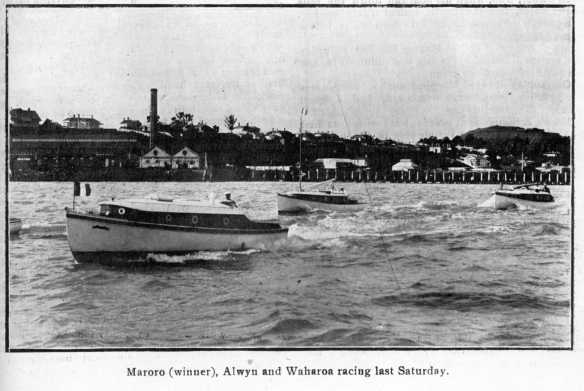
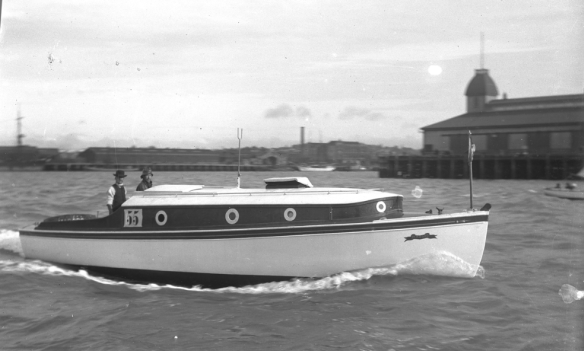
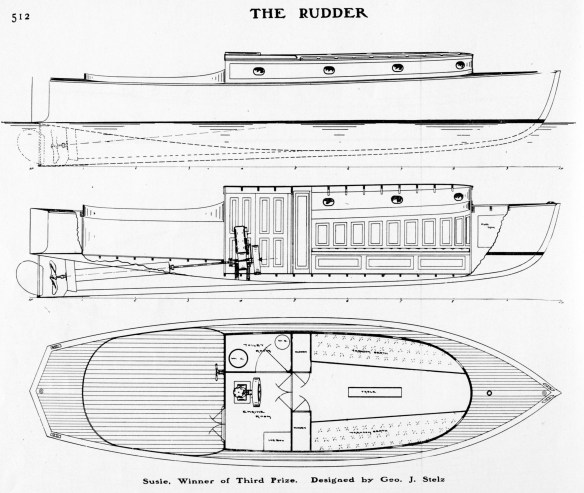
This story starts in 1907 when an Auckland family (Matheson brothers) built in St Marys Bay on Aucklands waterfront a 32 ft launch MARORO (flying fish in Maori). Her plans came from the USA Rudder Magazine and she was therefore rather unusual in design in the local New Zealand context. Maroro has a great history but her claim to fame was she won the Rudder Cup, a night race around Sail Rock & back, held on the 12th December 1908.
Fast forward 100+ years (August 2009) & Harold Kidd, Colin Pawson & myself flew to Great Barrier Island to check out Maroro where she was ‘resting’ at Okupa in Blind Bay, you can view photos from that trip on this link http://classicyacht.org.nz/forum/viewtopic.php?f=4&t=652&hilit=Maroro
Maroro was subsequently transported back to Auckland & is now resting again at Marco Scuderi’s yard in Helensville, while her fate is decided. You will see in the Great Barrier photos she was / is as they say in the real estate game – a little distressed. There are lots of posting on the Classic Yacht Association NZ forum on Maroro if you are interested http://classicyacht.org.nz/forum
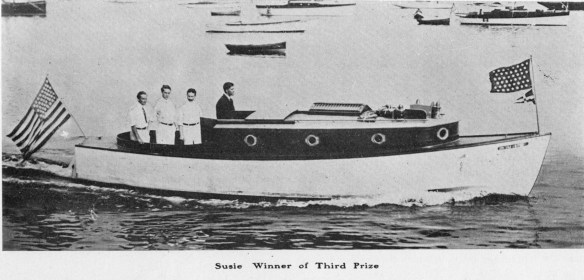
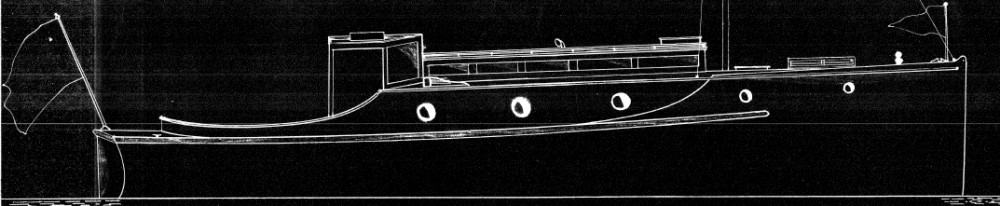
The purpose of this waitematawoodys posting is to reveal that at long last the original plans for Maroro have been tracked down by super sleuth Harold Kidd, who obtained a copy of the August 1906 edition of the Rudder magazine off Ebay. Featured were the basic layout /plans of a motor launch named Susie. She was 3rd in the Knickerbocker YC long distance power boat ocean race in June 1906, the 2boats that finished ahead of her were much bigger & more powerful. When you compare the photos of Maroro & Susie , disregard the cabin top & focus on the bow & stern, they are almost identical. It would appear that the Matheson brothers were impressed with Susie’s performance in the Knickerbocker race & built a clone.
The above photos include a shot of Susie , the plans, a photo of Maroro winning a race on the Waitemata Harbour & a rather spectacular close up shot of Maroro. What do you think – peas in a pod? (you can freeze the slideshow by clicking on a photo)
Note: the discovery of these layout / plans could help decide the future of Maroro.