RONOMOR
Todays post is a complete mystery to me. When looking thru the ww photo files I discovered a folder tagged ‘Ronomor????’ . At some stage I must have ear-marked it for future reference / follow-up. If someone out there sent these photos to me, I apologize for the void.
Now folks – anyone able to supply more info on her or ID the people in the photo, that would be good 🙂
Update – Slightly embarrassed – I have posted Ronomor before. But todays post has prompted Baden Pascoe to send me the great story below – enjoy the read.
RONOMOR & HER KEEPERS
One of my favourite pastimes is to roam around commercial wharves and docks and look at the old and the new workboats. I get a real kick out of seeing a well set up work boat that is well maintained and ready to deal with the many challenges she encounters when at sea.
Every time I see a boat that meets these standards my mind goes back 40 years to the days when Bert and Neil Chaney owned and operated the immaculately kept 36” fishing boat “Ronomor”. To this day I would still award them first prize if this activity were some sort of competition. Some people maintain that work boats cannot be maintained to a high standard when operating them in a commercial environment. The Chaney’s however managed to do this year in and year out with a wooden vessel that was not purpose built for commercial use and was 50 plus years old. They worked “Ronomor” very hard in all weathers, but they always put back what they took out of their boat. They were very successful commercial fishermen in all aspects of their profession.
A few years ago I did some research to try and find “Ronomor” and after a few months, a friend of mine spotted an old launch that matched her description. Sure enough this was the boat I had been searching for and remarkably she was still in reasonable shape. She is so typical of the many old pleasure launches that were converted to harbour and coastal fishing boats. Unfortunately due to their mainly light construction not many of them have survived.
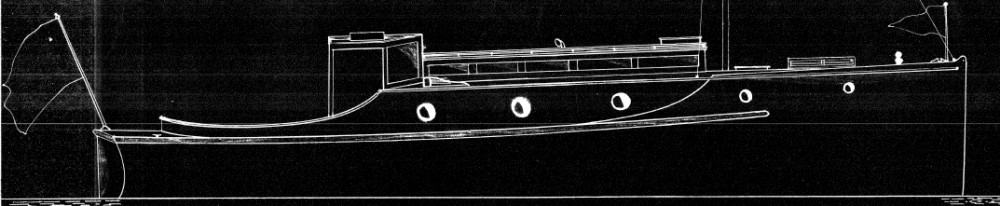
“Ronomor”was built at Stanley Bay by Wattie or Davy Darroch in 1908. Some time before 1920 she was lengthened and a canoe stern was added to give her a total overall length of some 36’. Before she was built the Darrochs used a dinghy to row from Devonport to the city and to any other destinations on the Auckland harbour . When they built this launch they knew their rowing days were over and so the new boat was appropriately named “Ronomor”. I’m sure that the builders had many adventures in this lovely little launch and there must be many stories about their life and times with the boat.
The name of the next owner of the boat is unknown at the stage but she was based in Napier, and it may have been at this time that she was converted to a fishing vessel.
Bert Chaney purchased her in 1939 and steamed her to Tauranga. At this stage she still had a Scripps, which was possibly the first engine to be installed in the boat. These well proven marine petrol motors were imported by T.M. Lane & Sons (Later Lane Motor Boat Company). The engine was fitted with battery ignition. On one occasion Bert was picking up his long lines by dinghy (a technique he used by himself) when on returning to the boat he found a flat battery. “Ronomor” was anchored in the lee of the Alderman Islands, and he had no option but to row to Whangamata and buy a charged battery. He set off again and returned to the Alderman’s arriving late in the evening. The battery was fitted and the Scripps fired up. On his return to Tauranga he had a magneto fitted!
In 1944 the Chaney family moved to Whitianga, and “Ronomor” was used to transport the entire contents of their home. Neil recalls that the later part of the voyage was hard going because the weather had turned bad. At this stage the vessel had a JP 2.21 Lister as power and progress towards Whitianga in heavy weather , with a huge load on board was hard going. Once the Chaney family were relocated in Whitianga, Bert set up his fishing business and concentrated on cray fishing and long lining. From time to time he would undertake charter work, when the big game fishing season was in full swing. He was a very popular skipper with overseas fishermen who came to Whitianga for the International competitions. He was well known for his double strikes of yellow fin Tuna on light tackle, and Hank Newman from the New South Wales Fishing Club was one of his regular clients. In 1947 Bill Clark, another well known Whitianga fishing identity, fishing from the “Ronomor” landed what has been considered the largest marlin caught in New Zealand waters. At the weigh in the antiquated scales, which only registered to 900lbs, flicked fully around, but the estimated weight of the fish was in excess of 1000 lbs. The fish was played for 12 hours and 10 minutes. A marathon that would match the stories of Hemmingway ‘s “The Old Man of the sea “
In the mid 1940’s she was steamed to Auckland and the JP 2 was removed and a new JP 3 fitted. This gave her a top speed of 8-8.5 knots. Bert continued his charter work and was a very active member of both the Mercury Bay Game Fishing Club and the Mercury Bay Boating Club. “Ronomor” featured in most of the launch races at the Mercury Bay Regatta.
As I stated Bert and Neil maintained the boat in a meticulous manner. Every year she was slipped at Whitianga and any repair that was required,carried out. She was sanded and repainted to a high standard. Every few years all paint was removed from her hull and super structure and she was taken back to bare wood. My Father was the only person Bert would allow to carry out any structural work. Whenever “Ronomor” was hauled out Dad would be working on her and I would make visits to the beach at the bottom of the road and inspect the day’s work. This always started with a cup of tea made with condensed milk and some of Mrs. Chaney’s home cooking. Bert and Neil would always make me welcome.
In the early 60’s the JP 3 picked up a liner during a cray fishing and long lining trip. Bert and Neil were at the Red Mercurys when this fatal mechanical incident occurred. Before they could reach the engine room the damage was done. Unfortunately the JP 3 was beyond repair and had to be replaced. A new Lees Marine (Fordson) 6 cylinder was fitted by Allen Watson (Marlin Motors) and my Father did the structural work. The Lister gearbox was retained and fitted to the bell housing on the new Fordson.
In the late 60’s early 70’s Bert retired and put “Ronomor” on the market. A young Whitianga man Ian Clow was about to start a career in commercial fishing and he immediately identified “Ronomor” as a “turn key” operation. He followed in Bert’s footsteps and in a very short time gained a reputation as a true professional out of the same mould as Bert Chaney. He worked the boat very hard and continued in the same way as Bert and Neil had done in maintaining the boat to the highest of standards. Ian told me of some very close calls he had while working his pots. One day he had a line around the prop shaft and lost all control over forward and reverse. He had to very quickly remove the inspection plate of the old Lister gearbox and hammer the brake band free to enable forward motion. All this was taking place while his boat and crew were about to grind themselves to death on a group of rocks only a few feet away. Another incident he recalls was lifting his pots at Devils Point and the echo sounder block was sheared off the hull by a large rock. ‘Ronomor” took on water rapidly through the bolt and transducer holes, and they had to make a dash to the closest sandy beach at a speed of 10 knots. My Dad had to come out and temporarily patch up the boat and she was steamed back to Whitianga for slipping and repair.
Ian did not have to do a lot of modifications to the boat in the time he owned her. He did replace the Lister gearbox after the rope around the prop incident and my Father replaced some of the Pohutukawa knees and fitted some stringers to the cockpit area to stiffen the hull. Ian also fitted an AWA double sideband radio that had been purchased with a donation given to him by two men who were rescued by a foreign freighter and transferred to “Ronomor” near the Southern end of Ohinau Island . One of the last things Ian did was to replace the Fordson with a later model. I must mention that Ian’s brother Graham designed and built one of the first “power blocks” ever to be used on small fishing vessels in New Zealand. This enabled them to work more pots and was a great advantage to them.
Ian had now been in the fishing industry for 35 years and after owning nine commercial fishing boats he rates “Ronomor” as one of his better boats , and says that she set him up for his future. I’m sure Bert would be proud to hear him say that and proud of the way he looked after the vessel. Ian sold her in the early 80’s to a fisherman from the Barrier.
The last time I saw “Ronomor” was about 15 years ago tied up at the viaduct. She was not in the mint condition that Bert and Ian had maintained her to. I felt a little sad when I saw her.
I am about to meet Ron Eastlake who now owns “Ronomor” to hand on to him the history I have collected of this remarkable old vessel. I look forward to seeing her again and I will be encouraging Ron to preserve what I call a historic boat. She would be one of the last surviving boats built by the Darrochs who were New Zealand’s most innovative and famous scow building family.



 waitematawoodys.com #1 for classic wooden boat stories, info, advice & news - updated daily - 15+ million views