Waiata & her builder

This slideshow requires JavaScript.

WAIATA & HER BUILDER

details & photos (b/w) by Harold Kidd, colour photo ex Rob Uivel

Waiata is featured else where on several ww posts but Harold’s below brings every together.

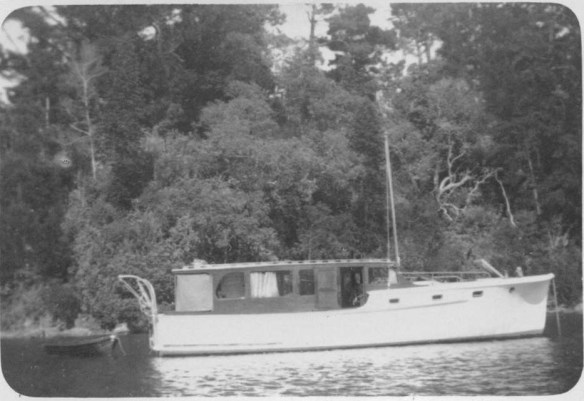
Rob Uivel owns the neat little launch WAIATA which is a remarkable survivor from the pre-WW1 period, 101 years old and going strong still. WAIATA was built by David Reid at his yard in Drake Street, Freeman’s Bay and launched in November 1913 for Devonport enthusiasts Edward Percy Earle and Alfred George Lunn who were keen competitors in the highly popular NZ Power Boat Association races in the “under 9 knots” category. Her first engine was a 14hp (rated) Britt engine but that was changed in 1921 for a 14hp Westman engine, for which W.R. Twigg was the local agent.

She held the NZPBA championship pennant several times during WW1. She also took part in the search for Count von Luckner when he and several other German prisoners of war escaped from Motuihe in the launch PEARL in December 1917. Earle dropped out of ownership in late 1919. Lunn became Commodore of the NZPBA in 1920 but sold WAIATA around 1922. She pretty much drops out of sight except for being recorded as being used as mark boat for Devonport Yacht Club and other clubs’ yacht races right through the 1930s. It would be interesting if WW people could fill in the gap between then and now.

David Reid was a very good boat builder indeed and had the agency for the very fine Buffalo marine engine. He had a prodigious output of launches culminating in the very fast Cascade in early 1916. David was the son of Robert Reid whose business he had taken over in 1904, and the brother of James Reid who was equally important as a launch builder. However, David suffered from asthma so badly that he sold his business, machinery and moulds to T.M. Lane & Sons and left for Queensland in late 1916.  It was a very great loss to this country.

photo below of 1st owner – Alfred Lunn

Screen Shot 2014-04-30 at 5.31.57 PM

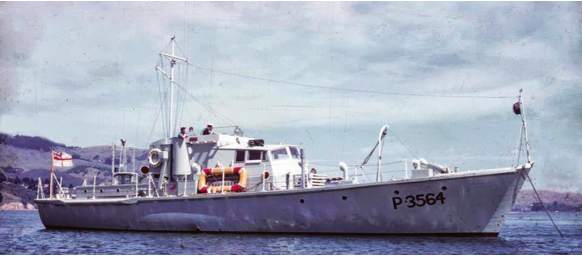
HMNZS KOURA

A clip from a chat between Russell Ward & Alan H
photo ex Basil Rutherford collection

Anywhere else in the world , these ladies would be being restored & proudly on display.
Instead another one is about to be slaughtered at Paeroa or Thames on 14 May or thereabouts.
It has reached the end of a sad trot of indifferent ownership and has been given her marching orders from the Maritime Park. It is a shame because when Paeroa were given her, she was one of the better ones the Navy had.
Tarapunga died a few weeks ago. Another whose name escapes me did some impact hydrography in Milford Sound last week.

Manga is making her last sacrifice at Helensville .
These eminently useable boats are vanishing at a rate.
Paea is going strong and may be the beneficiary of Koura’s parts.

The simply lesson here is that old boats have got to be kept working. If not they just rot away.

Interested in reading more on all things Motor Launch, be they serving in the Navy or in civvy hands. (over 250 photo’s and 50+ stories and tech data / links to other ML pages) Check out the link below
 

http://rednaz1958.blogspot.com/2016/03/composite-list-of-hdmls-still-active.html

A Modern Classic

A Modern Classic

If someone in Auckland does not nab this soon, I beat you it will be heading off to the lakes.

You rarely see the angles & proportions looking right on a sub 30′ boat. At 25′ this one is dam near spot on, but you would expect that given it was modelled on a William Garden dory design. A great picnic boat, she has explored harbours, lakes and rivers. With a double v berth forward , over-nighters are also on the agenda.

Built in 2005 from ply (I known, I’ll go & wash my mouth out) & glassed over (make that a double wash) she has a 2005 21h.p. Nanni diesel motor, done 400hrs from new & wait for it, she even has a bow thruster……….

On trademe for $30k, would be hard to find a better boat of that money.

Seagull

SEAGULL

Now this boat has some provenance, built in 1953 at the Devonport Navy dockyard, was originally on the starboard side of the HMNZ Monowai Survey ship.

29.8’ in length & powered by a 53hp diesel, new in 2004, now with     1850 hrs on the clock.

Seagull is a solid, reliable, economic, ex Navy survey launch converted to pleasure use & is perfect for cruising around the Hauraki Gulf.

Recent work over the winter of 2013 includes, full hull repaint, including anti foul, new cockpit, lockers, new toilet, new stern platform with stainless steel ladder. Full engine service, oil and filters, belts etc including new batteries.

Garmin GPS chart plotter/fish finder. New VHS radio. New 2 burner gas stove. Good sized electric fridge. Solar panels for battery backup.

Owned by a fellow DYC member, Seagull is currently for sale on trademe as her owner has a desire to return to the dark side (sail)…… Hopefully he will see the light & buy a motorsailer.

Is This Cutie A Seacraft?

Is This Cutie A Seacraft?

(click on the photos above to enlarge)

The crew at the Whangateau Traditional Boat yard would like some help ID’ing one of their boats. But before I go on, I have to say that this little motorboat has got my name all over it – perfect for Riverhead cruises, gunk-holing around Mahurangi & trailering to Lake Rotoiti.

The question for you all is :

Is the recent WTB purchase, a 12′ 6″ dinghy, a genuine Seacraft and if so, what year would she likely have been built? (there is no plaque on her).
She has a 3hp Normon marine engine, air cooled, which is believed to be her original motor.

Keith, the previous owner restored her and the motor & has her running superbly. He also has a couple more of the Normon motors running. He said she was painted green and cream and that he had striped the paint and carried out the varnishing.

Pam & George feel she has perhaps a little more sheer in her and perhaps not as broad and as flat a stern as the Seacraft boats they are familiar with & wondered if there was some variation in shape through the years?

Pam told me they had some lovely sea trials in her over the weekend & the boat is so user friendly she could manage her by herself.
They envision some tiki touring, sliping in the odd regatta along the way and shan’t be too deturbed if the pretty little thing is not a genuine Seacraft.

Tawhiti

Image


TAWHITI

Mill Bay photo ex Ken Rickett

Waitemata photo ex Harold Kidd

The above launch was recently sited moored in Mill Bay, Mangonui by Ken’s daughter.

Like a lot of Mill Bay boats she appears to be crying out for some TCL.

More info on her would be appreciated if anyone knows anything.

SEE HDK COMMENT BELOW – ME THINKS MR RICKETTS WILL BE OFF TO SPECSAVERS ON MONDAY MORNING 🙂 Spelling corrected in headline & categories for google searches.

HAROLD KIDD UPDATE

That’s TAWHITI not TAWHIRI as you can see clearly from Ken’s own image. Someone needs specs.
Recent owners have given me a bunch of information about her, some of which is clearly rubbish anecdote (as anecdote usually is).
The tale must however contain some truths.
It is roughly as follows;
1. TAWHITI was built by Logan Bros in 1908. Even though the bridgedeckerisation obviously occurred in the 30s at the earliest and her name may well have changed several times in her life, I put this down as a myth.
2. She was built as a passenger launch for the Kaipara. Maybe.
3. Known owners don’t go back very far but are George Twitchett, Bucklands Beach, 1955 to 1965 who sold to Stan Honeybun that year, to John Hunt to Jim Duckworth. I think another owner was Rex Norwood c2000.

Clear facts are that her dimensions are 36’x36’x9’3″x? and she was recently powered with a Ford 60hp 4 cylinder diesel. She is single skin and was a flushdecker originally of the period 1910 to 1918. A pity her name is lost.
My database contains several local TAWHITI entries but I have no way of knowing if there was only one or several TAWHITIS without corroborating evidence. There may have been several people who wanted to use the name TAWHITI which is charged with meaning in the Maori language and, with Hawaiki, equates with the spiritual homeland = TAHITI. But it is also the Maori name for Woolshed Bay at the entrance to Coromandel Harbour. She was never registered with the APYMBA.
My first TAWHITI is a launch on the Manukau in February 1919 with no further mention on that harbour. Conjecture, built by Les Coulthard and shipped across after trials?
The second (or the same) is recorded in A.H. Pickmere’s log as being in Bon Accord on 18/4/27. Then groups of people from TAWHITI visited the new LITTLE JIM on four occasions between December 1934 and February 1936. Unfortunately no owner was identified, but surnames involved were Curnow, Hoban, Keely, Barton, Sturtevant, Oborn, Wooley, Graham, Craig, Grant, Seabrook and Wilson. Some of those are well-known North Shore names of that period.
I guess it’s possible that the name was mispelt in LITTLE JIM’s log 4 times, and was in error for the Col. Wild yacht TAWHIRI, but none of the names concur with TAWHIRI’s owners.
I took some good images (see above) of her off Rocky Bay on 2/1/2002 when she was in good order. Those aboard said they had no real idea of her provenance. They kept her in the Tamaki River, just upstream from the Panmure Yacht Club. But I was interrupting their fishing and sheered off.
I saw her again several times later in the the season and the next doing some serious fishing around Rakino.

My conclusion is that she will be a known boat by a good builder whose origins have, as is so often the case, been obscured by successive alterations and (possibly) a name change.

PS My “built in Onehunga” theory may have some legs as Les Coulthard built a lot of boats for ports on the west coast as it eased transport issues mightily if they could get there on their own bottoms or, if small enough, by coastal steamer from Onehunga. For example Les built the 56ft schooner-rigged trawler HELENA for Westport in 1934 and the New Pllymouth Harbour Board’s pilot launch in 1935. So it’s entirely possible that the “passenger launch on the Kaipara” is the truth……………if a little long on assumptions!

Boat Designer – Sonny Levi

Boat Designer – Sonny Levi

photos & details supplied by Ken Ricketts

Levi designed at least 3 launches for the NZ market (refer below)

Designer Bio (straight from his website)

Born in Karachi 85 years ago, Sonny Levi was at school in Cannes when the war broke out.
His father, an interior designer and manufacturer, and an enthusiastic motor yachtsman, moved into Government contract boatbuilding at a shipyard in Bombay. From this early age the young Renato (‘Sonny’ was bestowed by an ayah who could not manage the letter ‘r’) designed boats, inspired by the multitude of local craft in that seafront city.
He joined the RAF and trained in England, studied aircraft design and demobilisation and returned to Bombay, where by 1950 he was chief designer in his father’s busy drawing office. In 1960 he moved to Italy to work for Navaltecnica in Anzio. “I have been very fortunate to have clients who are prepared to take risks” he says today.

“I always tried to be as honest with them as I could when we discussed their projects. And occasionally something didn’t work. This is the problem with original design.”
But for every failure there were a great many ground-breaking successes, and it seems typical of the man to ascribe these to luck and pass on credit to his customers – even if they were signing the cheques.
But when you look at some of the projects he involved them in you begin to see what he means: so many of the designs were at the cutting edge of naval architecture, where success was by no means certain. Like an artist with wealthy patrons, whenever he had an idea for a new work he could usually find someone to pay for it.

Rich playboy powerboat racers would find themselves enthusiastically funding outlandish and dramatic experimental prototypes. Commercial boatyards would be talked into daring new engineering solution on the promise of more speed and efficiency. If Sonny Lei is a problem solver at heart, he is one who has never seemed inclined to solve the same problem twice.

The Levi Boats

#1 Resolute


Built in the mid/later 1950’s, originally 38 ft., she was lengthened somewhere along the way, probably in the 1990’s, to about 42 feet, originally with twin 4-53 GM Detroit Diesels, until a 2012, which were still going fine, but were replaced with 2 larger Yanmars. Resolute belonged to a friend of Ken Ricketts, Ray Bailey, for a period in the mid 70s & is now moored at Westpark Marina.

#2 Ikikai
Little is known about Ikikai, she was circa 40 feet & originally also had twin Detroits.

Both of these first 2 boats, were designs based on boats he designed & were built in numbers, for the Indian Police, as Police Boats, in their era.

#3 Bacardi


Launch date unknown but powered by twin 427 cubic inch ‘Interceptor’ GM V8 petrol engines, circa 400 hp each, these were replaced with 2 x GM Fuel Pincher 4 cycle V8 diesels circa 200 hp each. Barcardi was owned in the 1990’s by another of Ken Ricketts friends, Rick Brown.

All 3 boats were all built for Arthur Jenkinson, who was in the musical instrument business, in Auckland, by Percy Vos, & /or Shipbuilders.
Levi was very radical in his designs, for his day, virtually all his launches were designed as high speed, high performance boats, many of them having a reverse shear, & in the case of Ikikia & Resolute a slanting out tuck that v’ed to a central point in the middle.
Bacardi had a “cathedral” type bow, but she was very quick with those 2 “Interceptor” GM V8s.


The 2014 Great Annual Waikato Seagull Regatta – Part2

The 2014 Great Annual Waikato Seagull Regatta – Part2 (+ new photos)


story by Adrian Pawson
photos ex Nina Wells (Working Edge Pictures)

(scroll down to the previous post to view Part1)

RACE DAY TWO
Day two greeted us with rain. The second leg of the race is a shorter but not insignificant 33Nm. We would need to pass through Meremere then Mercer and Tuakau before navigating the Mimi clad back creeks of Hoods Landing to find the finish line.  Apparently there were flags to show the correct finishing route through the willows, but we weren’t taking any chances. Out came the iPhones and on the back of some free café WiFi we soon had a selection of maps and a GPS plotter app to guide us home safe.

The second days start is a more straight forward process than the previous day at the dam. There’s only a single lane ramp at Rangariri and 40 boats to get on the river. With the whole place currently under development due to the new express way going in, the launching process was logistically challenging. Once on the water everything was as per normal. There was still a thick haze of smoke and usual noise, but today she was a straight time on distance affair, and that we thought we could manage.

Seagull starts aren’t conducted to quite the same degree of accuracy as we’re used to in the yacht racing scene. A green light comes on and stays on for a while, then an orange light flashes and when that one stops the race has started. Exactly when the orange light stops flashing is determined by when the old boy on the bank feels like turning it off. It’s pretty much a musical chairs type affair. The closest boat to the line when the light stops, pulls a glamour start. That wasn’t us this time, but our trusty seagull was on song and Paris was good for it. We were back down lying in the boat so we were soon nose in front, and focused on our mission to pull back that crucial 15 mins.

As the rain beat down on our sail cloth foredeck and the spray blew back into our stinging  eyes, we dodged sand banks, floating branches and a bloated sheep. When it’s raining hard it’s almost impossible to read the river and distinguish between safe water and the shallows. So you guess and hope for the best. We were lucky and escaped grounding. Finally some luck for the good ship Paris!

Then 2 hours into the leg, we dropped 100rpm……. James and I looked at each other and immediately knew exactly what happening. Sure enough 10 mins later we dropped another hundie and plan D was put into action. We would need to stop and do an oil refill on the gearbox. We decided that we would take advantage of the numerous duck shooting mimi’s and slide Paris out of the water for the job. Some of these mimi’s have little floating pontoons and that would do us nicely! Our well-honed Southern Spars lean manufacturing techniques now took on an all new level of appreciation and we prepared Paris for the fastest gearbox oil fill in the history of seagull racing.

We spied a suitable pontoon and prepared to dock. As we drew closer we realised the shooters had put nails all around the edges to stop the shags getting up and crapping on the pontoon. Paris isn’t the most durable craft and this was not good at all! But we were committed to this pontoon and the clock was ticking. We came along side and stepped out. Lifting the bow over the pontoon, we then rested her gently on the nails and took a side each to get her all the way up. There was cracking of carbon fibre and a couple of slightly higher nails broke through Paris’s delicate outside skin and into her soft foam core. James being the highly attentive designer type wasn’t happy about this at all and voiced his feelings about how rough he thought I was and how we had enough problems without puncturing holes in the boat! But we had an oil change to do so I told him it would be sweet and that a couple of small holes wouldn’t be the end of the world. He could put his fingers over them if he was that worried about it!

4 mins later we raked Paris back over the nails and with a single pull of our trusty seagull starting cord we were on our way at a never before seen 5100rpm! It was like the seagull was thanking us for looking after her, and at last we felt like we were at one with our machinery. We were true seagull racers at last! As the rain beat down on our shivering and hungry hides we blasted down back estuaries with GPS guided precision on our way to the finish. We crossed the line in an elapsed time of 3h 25m. Now the waiting game began…….

10 minutes passed and still no sign of the second placed seadog. 15 mins ticked over……! Then half an hour…. Only then did we hear that all familiar sound of the screaming seagull. Through the willows came the best of the rest. Our places in seagull racing history were secured! At last James and I were the new International Bermudian Seagull champions!  We’ve suffered through a lot for this moment and when that trophy was safely in our possession we immediately took photos on our iPhones, appropriately tagged the relevant parties and put them on facebook for the entire world to see.  We won two seagull caps and two seagull hat pins for our steely first days determination and solid second days’ performance. It was worth it. We were seadogs at last!

There is a movie  in the pipeline, when its released I’ll let you all know, it will be a cracker – Alan H

The 2014 Great Annual Waikato Seagull Regatta

The 2014 Great Annual Waikato Seagull Regatta

story by Adrian Pawson
photos ex Nina Wells (Working Edge Pictures)

I make no excuses for the length of this post, its such a great yarn it needs to be told. Read about Adrian Pawson & James Ledingham’s challenge to win the great Seagull race.
Grab a cup of what ever your poison is & enjoy 🙂 Alan H
The 2014 running of the ‘Great Annual Seagull Regatta’ was once again able to start at the base of the Karapiro hydro dam this year thanks to higher water levels and a helping hand from cyclone Lucy. At first light the keen regulars milled around in the dark waiting for the nod to proceed to the start area. Not having much in the way of patience, Team Paris with our trusty carbon fibre creation held above our heads, jumped the fence and trundled our way down the metal dam track to the starting area to secure the pole position on the dam beach.

The first day’s task consists of a 45Nm jaunt starting at the base of Karapiro hydro dam, battling through a series of rapids, then through picturesque canopy covered viaducts, leading into a fast and furious left hander into Leamington pool on the outskirts of Cambridge.  From there we howl our way down through Hamilton, Ngarawahia Taupiri, Huntly, Ohinewai and under the Rangiriri bridge finish line to post our first days effort on the regatta time sheet,

Our start was scheduled for 9:30am, half an hour after the 4.5 dinghy class. Our division start was knocked back half an hour while a few of the old boys finished up mixing their final choice of 2 stroke brew and the mandatory pre-race cuppa’s.  Come 9:55am, and having completed a couple of nervous pre-race leaks into the nearby bushes,  were all on the water and circling with the current waiting for the lights to go out signalling the start of the race. As you can imagine, at the base of the dam air movement is at a minimal.  Normally this wouldn’t cause much of a problem. However 15 seagulls burning 10:1 2 stroke and running rich on low revs, can produce a significant quality of smoke! The environmental situation 30 seconds out from the gun was starting to look like a bad day in Beijing with greatly reduced visibility!  When the flag finally dropped and 15 tiny carburettors were finally allowed to open wide, the exact direction of the dam exit was in some debate. Some of us got it right and some were not so lucky!  But for the moment Team Paris was looking good and we shot off towards the first set of rapids in the lead.

Much to our surprise we were pulling away from our fellow seadogs and all our hard work and testing seemed to be paying off. We sped around bends and navigated the rapids leaving a majestic trail of blue smoke in our wake. We hugged the river banks and rock walls for maximum current benefit and for the moment our performance was looking quite spectacular!  We had long ago lost sight of our competitors by the time howled our way under the first Hamilton bridge. Even more pleasing was that we could smell the sweet exhaust fumes of the 4.5 dinghy division ahead and knew that we were catching them quickly. We were drunk on our sense of self satisfaction, and with the knowledge that our beloved Paris Hilton Mk2 was clearly a weapon, we were all smiles as we tucked into our packed lunches and took time waved to the well-wishers on the river banks.

Three hours had elapsed as we passed under the second Hamilton bridge, but a quick glance at the taco revealed that we had lost 100rpm. This is normal we told ourselves. The motor was running hot and maybe some tolerance issues had come into play.  A seagull usually doesn’t run at 5000rpm, and for us some drop off was acceptable. We assured ourselves that we were still fast.  10 minutes later we lost another 100rpm. Our smug smiles quickly faded and we realised we could be developing a problem on the good ship Paris….. Half an hour later we had bled 1000rpm and the relationship between crew members had descended into short bursts of 4 letter words with periodic apportionments of who might be to blame for this catastrophic short coming.

Paris was shaking like an F&P washing machine from 1980’s. Our seagull was not in a happy place at all. It was obvious that we had terminal gearbox problems. A quick call to our support team and a frenzied exchange of lat and long data revealed our position and proximity to a public road. Our best option was 3 km away. We were down to 1500rpm and our hopes of a record breaking finish were going up in smoke – literally!  Then our trusty 1971 seagull ground to a halt and the shaking and grinding was replaced with a terrible silence. We were moving gently downstream but for all racing purposes we were stationary.

We knew we were sitting on a very healthy lead and the call was made to start paddling. We took turns as we had a bit of distance to cover and maximum stamina was required to get us to our rendezvous waypoint, and to our much treasured spare engine. We paddled for 30 mins and that river bank couldn’t come soon enough. I finally jumped out to navigate the willows with the road in sight. I had to get over one of those annoying electric horse fences and through a paddock to the highway. I had horse shit on my wetsuit boots and I was knacked from paddling. But I made it to the side of the highway. A couple of seconds past and I could see the Southern Spars transit van and our now very valuable spare engine coming towards me.

Doors were flung open and with hands on spare motor I was re-energized. We were back in business. Across the field, over the bastard horse fence, through the willows and back into Paris. James had the stuffed 1st motor off already and the spare was on route to the transom. In the process of swapping over fuel lines we lost half a litre of fuel into the boat. The cockpit of Paris now took on the traction characteristics of a stinking and highly flamable ice rink. As with every low budget program we had only one ‘nice’ prop, so that came off the 1st engine with the intention of being slid cleanly onto the spare motor. It went on about 5mm and stopped. (I decided that I wasn’t into taking the blame so poor ol’ James wore it) …….F@#* James, did you ream the bush for the spare engine shaft…..? I can’t believe you didn’t ream the bush. That was your only job this morning!  F@#*! Hammering with vice grips got us down another 2mm but that was a waste of time. I slid around and wrestled with the prop in this stinking pool of 2 stroke fuel that now shushed around in Paris’s cockpit. My nice 2010 Oracle leggings were covered in oil and I imagined the waterproof lining peeling off like had happened to my Aigle during a similar situation testing. My leggings were probably now rooted. Apart from the Oracle logo I really like those leggings. I wasn’t about to part with $400 for a new pair either. Then from behind came the competition. They had finally caught up with us. Somehow the prop went on but not before I cut my hands on the precision sharpened leading edges. So with blood and oil on our fancy North 3DL tool bags and a couple of frantic pulls on the starter cord, we were off!

5 mins later the spare engine died.  I also tried to blame this on James but he wasn’t wearing it this time….. We elected to go to the river bank. We could see another road and we knew a rescue was on the cards if we couldn’t come up with a plan C. We decided that our best option was to gamble that the 1st engine power head was still ok and our terminal problem was confined to the gearbox. So off comes the gearbox on the spare engine and she was mated onto the 1st engine. This took 20 mins meaning the competition was well down the track before we were back on the river and moving.

We were back at 4800rpm and chasing hard. We knew were faster than the sea dogs but we had a lot of work to do. The decision was made to ignore the overwhelming petrol smell and lie down in the boat in the name of reduced windage. We were flying along at a respectable 12 knots as the calming effects of the fumes went some way to restoring the friendship between James and I after that unfortunate blaming episode.  But we were back in the race and it was game on.

By the time we made the Rangariri bridge we were only 15 mins behind the leaders, and knowing that we had a significant speed advantage, the race was far from over! Tomorrow we would take the fight back to the seadogs and our pride would be restored. But right now there was work to be done. We had a bit on to clean Paris and have her back in race trim for tomorrow.

Upon disassembly of the 1st engine gearbox we found a pile of gear teeth in the bottom of the case and a distinct absence of oil. Seems like 3 hours was all it took to empty a full box worth into the river. When the oil was gone the countdown to self-destruction started…… Our experience in the garage back home taught us that it’s normal for a seagull drops its guts over the period of a few days, but 3 hours wasn’t quite right. Oh well, we were running a pretty loose setup. Maybe the spare box was better. We filled that one up and got stuck into the beers. Tomorrow was to be another day.

to be continued tomorrow on ww ……

To add a little bit of perspective to the above – read below Adrian Pawsons notes

My partner Nina and I are in the process of cutting together a documentary leading up to and then centring around the 30th Waikato seagull regatta. Fortunately Nina is a professional film maker, so the end result will hopefully be a high quality 90 minute feature length doco aimed at a spot in the NZ international film festival. We not eligible for any kind of funding, so we’ve had to take a ‘just do it’ approach and pay our own way. But we think it’s a film than needs to be made. An event like this attracts some very eccentric characters, so content isn’t a problem. However we did need a first time team to complete the cross section, so against all better judgement, James and I became it. James and I know a little bit about sailing boats but this was our first crack at anything with a motor, so it was bound to be a shambles worthy of filming. We both work at Southern Spars so we quietly built Paris in one corner of the workshop hoping that by the time the ridicule and jeering got too bad we’d be just about done. Aside from our own struggles to get one over the seasoned campaigners (who we affectionately refer to as the seadogs) we’ve spent the last year driving all over the country filming these fellas in their secret seagull tuning sheds. The film will follow 6 seadogs their individual quirks and their various challenges just to make the start line.

The real shame is that we can’t show any video material prior to the film festival as any stray footage will void our entry. At last count we’re about 60mins deep and our 6 seadogs have been pure gold so far! They’re hilarious, but at the same time exceptionally crafty old roosters that typify the ‘Burt Munro’ type attitude towards life. So fingers crossed we nail the last 30 mins from this year’s race footage and end up with something nice to do them justice.
Lady Dianna

Image

Lady Dianna

LADY DIANNA

photos & details ex Ken Ricketts

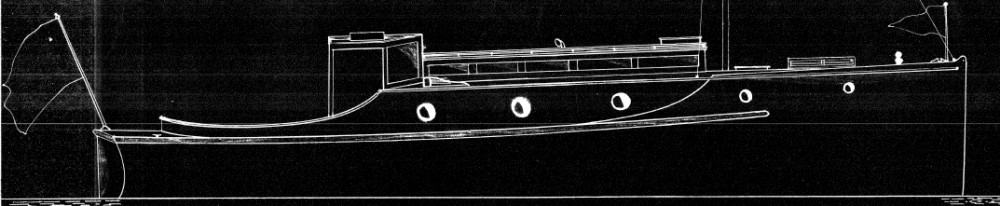
Lady Dianna, 36ft., was built by McGeady in his premises at 1A Summer St Ponsonby for Colin Lannam, a furniture manufacturer of Pakuranga c.1949.

Mr Lannam finished the interior himself at his business premises & did a superb job.

Ken & his parents were friends of the Lannams & Ken was on L.D. several times. He took the above photo in Mansion House Bay, Christmas 1949.

LD more recently belonged to a lawyer, who Ken thinks kept her in Thames, post 2000 & she was powered with a Ford Diesel.

Harold Kidd Update

LADY DIANNA and LADY DIANA got thoroughly confused in yacht registers, club lists and so on.
Colin Lannam was a cabinetmaker and lived in Lemington Road, Westmere. He finished the interior after McGeady built her. Lannam didn’t keep her long as she was owned by S.L. Wallath of Okahu St, Orakei by 1953. Later owners include H.C. Thomas of Inga Rd, Milford in 1973 when her dimensions were given as 36’x35’x11’x3’6″, her engine as a 100hp Ford diesel.and her build year as 1948 in her APYMBA record card.
According to Capt. Barry Thompson’s book “Deeds Not Words” on the Coastguard service, Trevor Kelly owned LADY DIANNA around 1985, but that’s probably a typo for LADY DIANA.

27/02/2015 – ex Karen Moren

Screen Shot 2015-04-12 at 6.50.35 PM