Waihape – Johnny Wray?

WAIHAPE

WAIHAPE

colour photos ex Dean Wright – info ex Ken Ricketts

b/w photo ex Harold Kidd ex Keith Munro

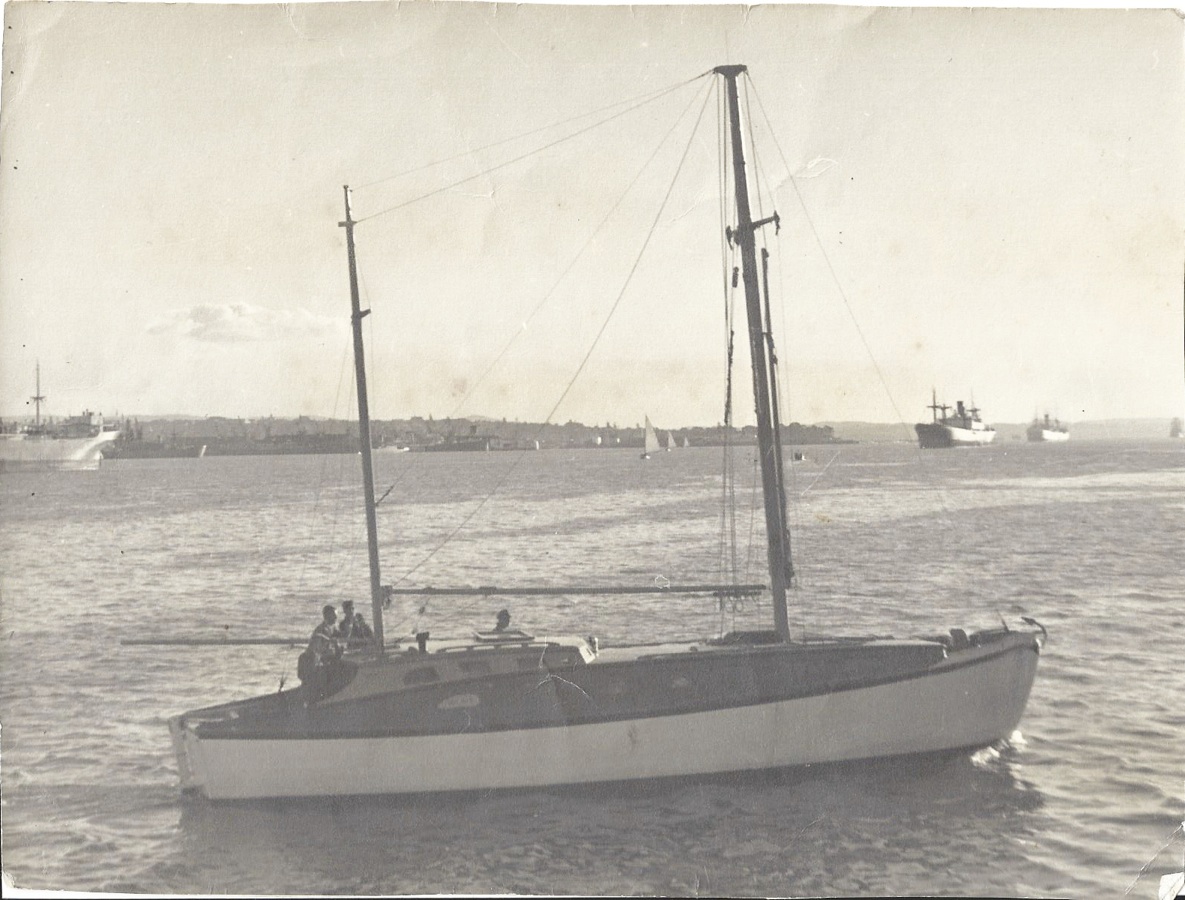
Ken thinks Waihape was the last boat Johnny Wray built in the later 1940s > early 1950s. He lived on her for many years, based at Surfdale, Waiheke, although he did sail around NZ & the Pacific in her fairly extensively. She had a fairly distinctive aft wheelhouse/doghouse which instantly “clicked” when he saw Dean’s photo.

Ken is certain he recalls seeing her in the mud at Surfdale on the L.H.S side of the bay coming in from the sea. There is even a mention of her in a write up “fun map” of Waiheke on a website Ken discovered.

Can anyone confirm this was in fact Johnny Wray’s last boat?

Harold Kidd Update

She certainly looks like the 44 footer WAIHAPE which Johnny Wray launched in December 1948, the last big boat he built. He put some unusual features into her. From his RNZAF experience she was fitted out with an aircraft-type control panel and had twin engines, small Kelvins I think. She took him to Tonga and back a couple of times and had a fair spread of sail.

14-05-2016 – A message from Helen Lee
My name is Helen Lee and as a teenager I had several cruises on Waihape with Johnny Wray, my parents Cynthia and Jerry Wilcox, my brother Michael Wilcox and once with my cousin Mike Lambert.
I have wonderful memories of these trips [early1960’s] and a few treasured photos. I realized when i saw the ww photos of Waihape that mine are all taken on the boat, not ‘of ‘ the boat. However you may like to see them.
Johnny was a long time friend of my Dad’s as they were both living in Lucerne Road as young men and Dad had worked with Johnny when he was building his first boat, Ngataki.
The photo below taken at Mansion House, Kawau Island, is Johnny trying to look like the coconut he is holding.

Johanny Wray @ Mansion House

The Rudder Cup

Image

The Rudder Cup

The article below was penned by Harold Kidd with the intention of creating interest among the classic launch community to re-run the 1908 race in 2008 to celebrate the centenary of the event. As tends to happen with most things HDK puts his name to, the 2008 race happened.
Pauline & Harold Kidd donated a cup, the Rudder Cup Centennial Trophy for the race & now each year CYA launches race to Patio Bay for the cup. Today is that day so it seems appropriate to feature the 1908 race. I very proud to have Raindances name on the cup (2012 winner).

Enjoy the read & thank you Pauline & Harold. Alan H

THE GREAT LAUNCH RACE OF 1908 – The Rudder Cup race around Sail Rock

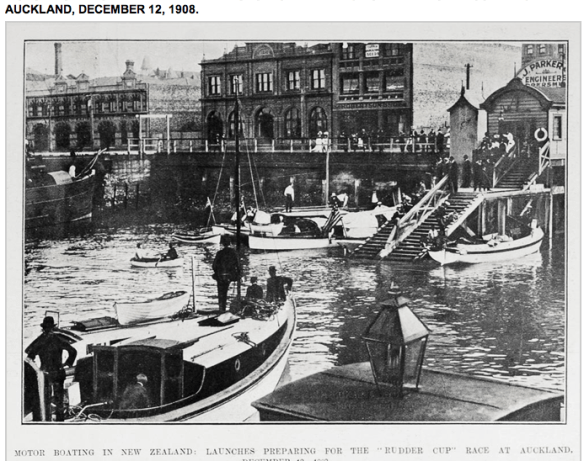
The Rudder Cup launch race around Sail Rock and back, a distance of 108 nautical miles, was set to start off Queen Street Wharf at 10 pm on Saturday 12th December 1908. All week the weather in the Gulf had been heavy, all day a stiff southerly blew, but at sunset this died to a flat calm. Shortly before the start, a light westerly breeze came up and that quarter prevailed throughout the race. The Squadron race committee made a serious mistake. Despite the fact that the weather was clearly settling, it decided to apply the heavy weather handicaps, handicaps that made the larger, more powerful launches give big time allowances to the smaller fry. Happily, for the moment, and for the peace of mind of the faster contestants, the handicaps were sealed.

Of the 14 entrants, only 12 made it to the start. The brand new 42 footer Alleyne, owned by Arthur Brett, Commodore of the New Zealand Power Boat Association, scratched for some undisclosed reason and so did Leo Walsh’s Kelvin, with a slight engine problem.

The massed flying start was a pretty sight as eleven of the twelve launches throbbed their way, “with the cyclonic whirring of gas engines”, said the Star, down the Waitemata, around North Head and into a calm but very dark night. Floral had been first over the line but James Reid in Seabird took the lead by North Head. Eliza had a problem restarting her engine and was trailing behind. The moon rose in the East as the launches approached Tiri and droned on into the night, the little fleet now becoming strung out with only their nearest competitors in sight. There was a beam swell and sea off Kawau but it moderated, then got up again when a fresh westerly kicked in as they entered Bream Bay.

At 0414 on Sunday morning Seabird was the first to round Sail Rock and turn for home. She was followed by Matareka, 26 minutes behind, then Alice leading the main bunch a few minutes later. The Herald reported the rest of the race,

The run home was uneventful, the westerly wind off Waipu beach being left behind and a southerly with a bumpy sea being run into at Whangaparaoa Passage. Seabird gained on all the launches and Matareka also improved her position, but neither of the leading boats had sufficient in hand to secure a win.

But, until it was all over, and the handicaps opened, neither skipper knew that.

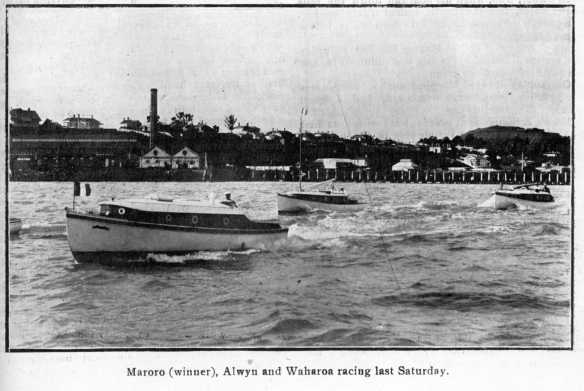
Alleyne met Seabird as she rounded North Head, out on her own, and she came tearing up the harbour to finish at 1030, cheered by a very few of the NZPBA faithful on the wharf that Sunday morning. Seabird was 53 minutes ahead of Matareka which was 28 minutes ahead of Alice. All the remaining boats had finished by just after 1300 in the following order, Wanderer, Maroro, Kotiro, Eliza, Vanora, Floral, Winsome, Waipa and Petrel. Seabird averaged well over 8 knots for the run, a great turn of speed for the time, point to point in the open sea.

When the handicaps were opened it was found that Seabird had to concede a time allowance of 3hrs 23 min to Maroro, something that was impossible in the conditions. The handicap results were Maroro 1st, Winsome 2nd, Petrel 3rd and Alice 4th. So the Rudder Cup went to the Matheson brothers of Maroro.

Not surprisingly, there was much criticism of the outcome. Some said that Seabird was the moral victor, some said that Chas Bailey’s Alice had performed best in comparison with the others having regard to her size and horsepower and should have won with proper handicapping, all said that the handicappers had done a bad job. A protest was lodged with the Squadron but failed. The real winner was the reputation of the motor launch and of the marine engines of the day. The Herald said,

The race is considered by motor launch owners as a triumph for the reliability of the motor boat. Twelve boats went round the course, and not one engine is reported to have stopped throughout the long run of from 12½ to 15 hours.

But the fun was not yet over. Immediately after the race, Harry Adams issued a challenge to Maroro, “or any other competitor” to a race from Queen Street Wharf around a buoy off Russell Wharf and back, non-stop, 240 nautical miles, for ₤50 a side, a preposterous sum at the time. Adams was taking a shot at James Reid and Seabird. Possibly he was driven by the need to dispel doubts about the Auckland-built Adams Kiwi engine in Eliza which had played up at the start of the Rudder Cup race. James Reid accepted at once.

Arthur Brett was stakeholder, starter and judge. Eliza’s crew consisted of Capt. Ted McLeod, master of the Northern Steamship Co’s coaster Clansman as skipper, Bill Cook, later of the Whangamumu whaling station, navigator, Fred Reynolds, of Whangarei, engineer, and Charlie Mitchell as engineer’s mate. Harry Hopper stayed ashore. James Reid employed Capt. J. Quinn, master of the auxiliary schooner Endeavour, as pilot and had as crew K. and H. Boyd, A. Tyer, and E. Akersten.

There was nothing like a big wager to stir interest in the Colonial heart so there was considerable attention paid when the race started off Queen Street Wharf at 0750 on Saturday 30th January 1909, the day after the Auckland Anniversary Regatta.

James Reid told the Star,

“The boats got away to an even start, but one at once knew that something was wrong with the Seabird; there seemed no life in her. The Buffalo came alongside us, and beat us easily, showing that there was really something out of order. The Eliza was drawing right away from us, and we were sure now that we had seaweed on our propeller. We reversed the engines several times, and tried her again, but could not shake it off.”

Buffalo was a new launch built by Reid’s younger brother David and was much lower powered than Seabird. Seabird carried on until Takatu Point when Reid stopped the engine. Ken Boyd went overboard and cleared the totally fouled prop with a boathook. By then Eliza was out of sight, but they gradually hauled her in. Off Bream Head the weather rolled in thick. Seabird felt her way up the coast, rounded the buoy off Russell Wharf at 2340 and then Capt. Quinn stood her out to sea till daylight when they briefly picked up the Poor Knights. Through lifting mist they raised Sail Rock in clear weather and steamed straight home from there at full revolutions. She did the 54 nautical miles in 6 hours 15 minutes, averaging a cracking 8.64 knots and crossed the finish line at 1638 on the Sunday.

On board Eliza, the Kiwi engine never missed a beat. She rounded the Russell buoy at 2250, 50 minutes ahead of Seabird. Her report made much of a rough trip home in a rising easterly,

Aboard the Eliza, one lurch threw two five-gallon drums of oil across the engine-room floor, and another threw the engineer right across his engine. The launch went under the Hen to get smooth water, to enable her to fill her oil tanks, and owing to the rough sea she went outside Piercy Island to get calmer water.

Eliza finished at 1425, 2 hours 13 minutes ahead of Seabird to win the wager.

James Reid pooh-poohed Eliza’s rough weather talk.

“I must contradict the report that both boats were knocked about in the sea. …we did not get a drop of water on the decks.”

And that was that. The reliability of the modern internal combustion marine engine had been further enhanced, there had been some heroics to suit the taste of the time, and honour was satisfied all round. But the story doesn’t end there.

It will come as no surprise to readers of Vintage Viewpoint and our books that, almost a hundred years after the Rudder Cup race, the main protagonists of 12th and 13th December 1908 are still soldiering on.

Eliza was run by Harry Hopper for some years and was bought by brothers J.T. and J.W. Mason of Whangarei in 1920, renamed Kumi, Maori for a fabulous monster, like a taniwha. They sold her to the Whangarei Harbour Board in 1929 and she stayed on strength as a tug and pilot boat, skippered by Archie McKenzie, for many years. Recently vet Haydon Afford of Taupaki bought her and rebuilt her.

James Reid sold Seabird in 1910. She stayed in Auckland in various hands until the cyclone of 1917 when she came ashore in St Mary’s Bay and was badly chafed. Charles Collings bought her and rebuilt her, then sold her to Turnbull of Lyttelton. From Lyttelton, where she spent many years as a harbour ferry, she gravitated to Nelson. She has recently been bought by Steve Thomas, a Nelson marine broker who first sailed in her in Golden Bay as a boy 25 years ago and fell in love with her.

Maroro remained with the Mathesons until 1920. She then went through a series of owners, reading like a Who’s Who of launchies of the time; W.J. Quelch, Sam Leyland, Wilkie Wilkinson, T. Macindoe; but she eventually went fishing and is currently owned by David Owen of Okupu, Great Barrier. She is hauled out directly opposite the wharf, needing a new owner desperately. She is highly restorable and highly original, the only changes from her 1908 configuration being a sensible and neat dodger put on by Lanes in 1920, beltings put on to work as a long-liner and the inevitable mechanical updates.

Of the remaining entrants, Matareka is sound and loved by the Fenelon family in Auckland. We saw a photograph recently of a launch in a shed up North that is Petrel or her twin. Wanderer is very like the Wanderer owned by Terry Curel on the Kaipara in the 1960s and may still exist. Fred Cooper sold Winsome to engineer and wheeler-dealer Peter A. Smith in 1914 and she disappears, probably with a name change, because Bailey & Lowe built a tuck stern Winsome for J.H. Foster in 1918, the boat that has been owned by the Pickmere family of Whangarei continuously since 1923.

Bailey & Lowe sold Floral in 1909 to Capt. J.S. Clark for use as a passenger and cargo launch on the Whitford run. Again, she probably still exists under a different name. We have a candidate to follow up, last seen on the hard at Coromandel. The big Vanora was sold by Lindsay Cooke to Maurice O’Connor of the Thistle Hotel in 1912. He fitted a 30hp Auckland-built Twigg engine and sold her to the Government in late 1913. We do not know her subsequent fate.

Alleyne became Daisy in the hands of W. de Renzy of Ponsonby in 1916 then went to E.J. Kelly, a stalwart of the Ponsonby Cruising Club in 1918. By then the Lozier had been replaced by a 30hp Twigg. Kelly sold her to Sanfords in 1927, so we suppose she finished her days as a long-liner. Waipa was a mystery, even at the time of the race, but we are pretty sure that she is the pretty little double-ender in a recent Boating NZ trade ad.

W.J. Harper sold Kotiro to Frank Chapman in 1919 and she became Ahuareka. We lose track of her in 1937. Bailey sold Alice to Tonga in March 1910. Kelvin carried the name on when Walsh sold her to Reg Shepherd. By then there were so many launches with the name Kelvin throughout the country that following her history is impossible.

Of the 14 entrants in the Rudder Cup, 4 definitely exist, Waipa is a probable, at least 2 more are likely and we think there’s a fair chance half the others may lurk under a new name on a mooring, up some tidal creek or in someone’s backyard.

Maroro


maroro366

Maroro (leading)

Screen Shot 2013-12-02 at 7.05.29 AM

Maroro

susie368

Susie

susie367

Susie

MARORO

photos & details ex Harold Kidd & Alan H

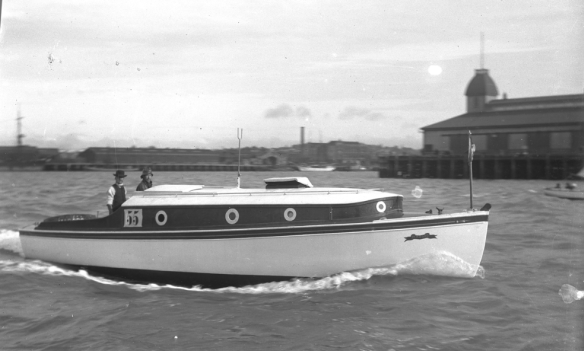
This story starts in 1907 when an Auckland family (Matheson brothers) built in St Marys Bay on Aucklands waterfront a 32 ft launch MARORO (flying fish in Maori). Her plans came from the USA Rudder Magazine and she was therefore rather unusual in design in the local New Zealand context. Maroro has a great history but her claim to fame was she won the  Rudder Cup, a night race around Sail Rock & back, held on the 12th December 1908.

Fast forward 100+ years (August 2009) & Harold Kidd, Colin Pawson & myself flew to Great Barrier Island to check out Maroro where she was ‘resting’ at Okupa in Blind Bay, you can view photos from that trip on this link http://classicyacht.org.nz/forum/viewtopic.php?f=4&t=652&hilit=Maroro

Maroro was subsequently transported back to Auckland & is now resting again at Marco Scuderi’s yard in Helensville, while her fate is decided. You will see in the Great Barrier photos she was / is as they say in the real estate game – a little distressed. There are lots of posting on the Classic Yacht Association NZ forum on Maroro if you are interested http://classicyacht.org.nz/forum

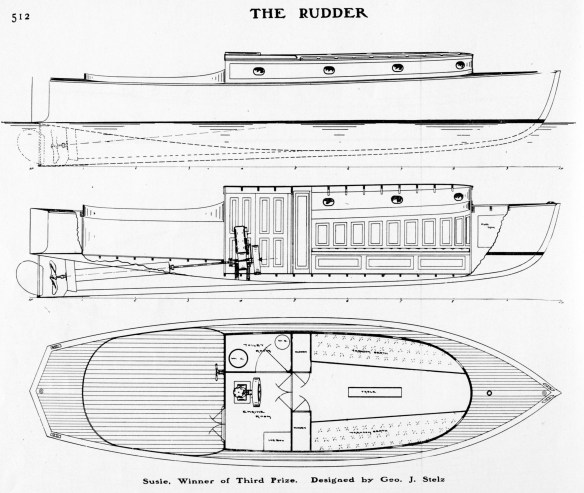
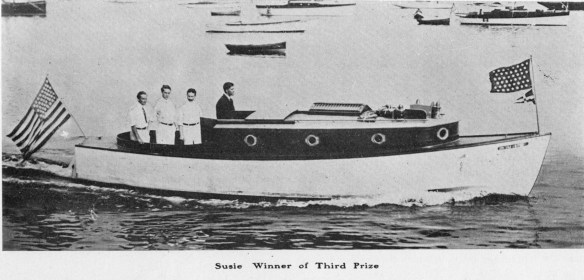
The purpose of this waitematawoodys posting is to reveal that at long last the original plans for Maroro have been tracked down by super sleuth Harold Kidd, who obtained a copy of the August 1906 edition of the Rudder magazine off Ebay. Featured were the basic layout /plans of a motor launch named Susie. She was 3rd in the Knickerbocker YC long distance power boat ocean race in June 1906, the 2boats that finished ahead of her were much bigger & more powerful. When you compare the photos of Maroro & Susie , disregard the cabin top & focus on the bow & stern, they are almost identical. It would appear that the Matheson brothers were impressed with Susie’s performance in the Knickerbocker race & built a clone.

The above photos include a shot of Susie , the plans, a photo of Maroro winning a race on the Waitemata Harbour & a rather spectacular close up shot of Maroro. What do you think – peas in a pod? (you can freeze the slideshow by clicking on a photo)

Note: the discovery of these layout / plans could help decide the future of Maroro.

A Special Woody Weekend

A Special Woody Weekend

Today was a special day on the woody boating front – Baden Pascoe officially launched his book ‘Launching Dreams – Percy Vos – The Boat & His Boys’ at the Royal New Zealand Yacht Squadron. We saw over 300 of the classic boating fraternity & people connected to Percy Vos – family, friends & ex work mates join together to celebrate the event & rub shoulders. Great speeches but the key message of the day came from John Street to Sir Bob Harvey (Chairman of Waterfront Auckland) & that was that the Vos Shed project was LONG over due & action was need NOW. Todays audience certainly agreed 🙂

A few photos from the launch / morning tea.

Copies in your local book-store now or from Baden on badenhp@xtra.co.nz


Don Brooke at the Classic Yacht & Launch Exhibition speaking about Jack Brooke & Bob Stewart

Video

VIDEO ONE – Don Brooke speaking at the 2013 CYA Classic Yacht & Launch Exhibition, hosted by the Tino Rawa Trust, which showcased the acclaimed designers Jack Brooke & Bob Stewart. Both Don & Robert Brooke spoke briefly at the launch ‘morning tea’ about their father Jack & fellow yacht designer Bob Stewart. Also view VIDEO TWO (below) which features of Don’s brother Robert, speaking on the same topic.

Robert Brooke Speaking On Jack Brooke & Bob Stewart @ Classic Yacht & Launch Exhibition

Video

VIDEO TWO – Robert Brooke speaking at the 2013 CYA Classic Yacht & Launch Exhibition, hosted by the Tino Rawa Trust, which showcased the acclaimed designers Jack Brooke & Bob Stewart. Both Robert & Don Brooke spoke briefly at the launch ‘morning tea’ about their father Jack & fellow yacht designer Bob Stewart. Also view VIDEO ONE (above) which features of Roberts brother Don, speaking on the same topic

The story of the creation & demise of the launch Tiarri

The story of the creation & demise of the launch Tiarri

photo & words by Ken Ricketts. Edited by Alan H

Apologies for the reproduction of the photos but they are over 30 years old & when taken were most likely back then, just quick snaps. Also please excuse the length of this post, but if you knew Ken you would be amazed how short it is – good editing 🙂 AH

The idea of the “conception” of Tiarri (pronounced Tie-are-i {as in ink}, came to me one Saturday in September 1974, with a chance invitation on to ‘Eros’ (later known as Lady Kiwi) whilst we were at North Harbour Ponui Island, for the weekend, in my 31’ 1953 R Lidgard launch Flying Scud.

My ex partner & I enjoyed a delightful afternoon with the original owners of Eros, Mr. & Mrs. Alf Broadhead, on their lovely 2 year old 40 ft Vindex, built for them by Orams of Whangarei, in fibreglassed kauri & powered by 2 x 165 hp Perkins V8 diesels. She was the first 40 ft Vindex ever built.

During the afternoon, the feel of Eros grew on me & right then I took the decision that one day in the not too distant future I would also have a 40 ft Vindex built. Thus the planning had begun.

During the next 2 years I acquired a set of plans from Jim Young, called tenders & eventually gave the job to a boat builder named Neeley from Howick. She was also to be built of fibreglassed tannelised kauri, with varnished sappelle mahogany combings & interior, with white formica cabin tops, above laminated mahogany beams, glued to 2 layers of pre-stressed & glued marine kauri plywood cabin tops.

I also believe, that almost all things, can be improved with knowledge, thought, planning & experience & I was of the view, that Jim Young’s Vindex design, was one of the ultimate designs of the day, however, he specified a beam of 13ft for a 40 ft boat, which was the spec that Eros was built to, whilst I was of the view, having had over 35 years of boating experience myself, at that time, along with my late father, Ralph Ricketts, who was the son of a pioneer boatbuilding family in Nelson, who had had a whole lifetime of experience before me, (about 65 years), that the beam should be 14 ft 6 inches, so that was her spec.

We increased the extra beam after the 4th frame, to retain the original lovely fine Vindex entry in to the water, which is what allowed the Vindexs to be so dainty & slice through the water so gracefully & comfortably, She never ever came down hard on a wave even at full speed. She also cruised 4 knots faster then Eros, with the same engines & same construction methods, so I like to think we must have done something right. Am not sure if Jim Young ever agreed with me, or even accepted that she was indeed a real Vindex, (professionals can sometimes have difficulty in accepting that occasionally amateurs can sometimes, tweak things, a little, to make them even a little better & since we achieved an extra 4 knots, in the same base boat & engines, I like to think we made a difference. The interior roominess was increased enormously, as well. We could have a sit down dinner for 16 & 4 couples dancing at the same time in the main cabin. She slept 10 very comfortably, to allow for the children that were in the family at that time & their friends, (they were all teenagers).

Building started in November 1976, in an unused hay shed on a Whitford farm, where Neeley built her, to the point of a rough unfinished hull. Little did I know what I was letting myself in for, when this all started. I found I had paid for nearly ¾’s of a boat & had less than 1/4 of it finished.

Unfortunately she had to be moved out of the hay shed, as the farmer only made it available to the builder for a set time & for about the next 7 months she sat out in the weather, covered only by an old tarpaulin & seemed to me to be slowly becoming firewood. Mean while the builder & I went through the ordeals of the justice system with the boat being eventually made available to me, thanks to justice being done.

The next problem, was what to do with her, where to take her & could she be saved, after her time in the elements.

I think God must have had his hand on me, as by chance, I had had some business dealings with members of a family, who had relatives, (a father & son), who were not only boating enthusiasts, but also unbelievably professional people at almost all of the important aspects of building boats, to the very highest of standards. The younger one, had already, a year or 2 earlier, built himself a very similar to Tiarri, 40 ft Vindex style boat, powered by 2 x Cummins V8 diesels & done a wonderful job. He also worked on many other boats on their family property at Whangateau, (by Leigh), where they still live. Their names are the late Rex Collings Snr. & Rex Collings Jnr., who still lives there.

These 2 very wonderful people, took me & my hulk under their wing, as it were, & allowed me to put her in a lean to, which had been built on to the side of their boat building shed, Rex Jnr. is a brilliant boat builder, refrigeration engineer, marine engineer, fitter & turner, electronics expert, welder, & a master of almost all trades associated with boats & boating. And like my precision engineer father, Ralph Ricketts, a perfectionist in all he did, who also had most of the skills of Rex C Jnr., & they did, & thoroughly enjoyed, it seemed to me, doing much work together, on all engineering aspects of Tiarri, in Rex’s beautifully equipped engineering workshop on his property.

After arriving at Whangateau, the first undertaking was initially doing fairly extensive surface cracking repairs to the skins of the hull timber, which all had to be glued & repaired, a laborious slow painstaking process, to get the perfection of the hull surface they achieved, in repairing weather damage.

Then they embarked on to making & fitting her full keel (deadwood) of laminated beautiful totara, the very best timber, I have always believed, for deadwoods on launches, both keel & timber type were something I insisted on. I did not want to risk her sitting on her propellers if she went aground, also it naturally also helped to make her easy to steer. She was a joy to steer & control & increased in stability in  big seas.

Then next, came fitting of her engine beds, at which time, her engines arrived from my parents basement garage workshop, where they had been stored for a couple of years. They were lifted in with a Hiab crane.

At this point, the bulkheads were also fitted, along with & the forward & side decks, all the underwater gear, vee struts for the propeller shafts, rudders & rudder glands & stocks, steering system, propeller shafts, shaft logs,  & skin fittings (where the shafts leave the boat under water & intermediate shaft bearings to avoid any possibility of whipping & vibration). All precision engineered in 316grade stainless steel & fitted by the 2 fantastic artisans, Rex C., & my dad.

At this point, they were unable to take Tiarri any further, because of the height restriction of the shed roof, so we then had to wait 2 or 3 months until Barry Jones artisan boat builder of Matakana, our third member of her team of ‘boatbuilding surgeons’ could fit her in to his big, full height shed.

She was approximately 6 months in Barry J’s shed, where she had her combings & cabin tops built, furniture built in, flying bridge fitted, engine installation completed, wiring installed, exhaust system installed, 12 c. ft. deep freeze & Kelvinator household refrigerator, Coroma brand, domestic toilet & all those other things that go to make up a beautiful boat, right to the last things, like Sanderson linen squabs, mid green body carpet throughout, — she was themed in green e.g curtains, crockery, cutlery & so on..

In her early days in Barry J’s shed, we filled the gearboxes with red gearbox oil & accidentally spilled a tiny quantity into the bilge.

A few days later, Barry summoned me to Warkworth, to view an “important discovery.”

To my horror, as I looked at a point under the boat, indicated by Barry, I saw on the, at that stage, unpainted keel, a large red stain, gearbox oil. I could not believe what I was seeing. We discovered that the 1st builder had tried to short circuit the construction process & I presume cost & had only applied the glue that held her together to one skin of her 2 skin kauri hull. The glue must be applied to both skins of the hull, as, with a sandwich, one puts butter on both slices of bread, & there were large areas of delamination where the glue had not adhered to the other skin, thus making the boat a potential deathtrap.

I was destroyed at this point & once again thought this can’t be happening, after all we have already been through & I saw my boating world once again collapsing around me.

However none of us were experts to advise on a problem of this nature, so I instructed the person I believed to be the leading & one of the most experienced & knowledgeable boat surveyors in NZ, to do a full survey of Tiarri. Harry Pope spent many hours tapping, looking, taking sample plugs of the hull. His decision & report said that, if all the paint were removed from the hull (it was fully painted & a terrible long & dusty job to remove) to expose the existing bronze skin fastenings, holding the skins to the stringers which were used to hold the skins together, whilst the glue dried & then refastening the hull with 2” x No. 16 gauge silicon bronze screws, that would make the boat far stronger & give it much greater structural integrity, than any hull which was held together by just properly applied glue.

You can imagine how relieved & overjoyed I was to have this news.

The final blight on the building process was the introduction by Robert Muldoon, of his boat & caravan tax of 20% on the cost of all un-launched brand new vessels, as at the 17th of May 1979.

By this point along the journey Tiarri’s cost had risen by probably several hundred percent on original projections & budgeted funding.

Well to carry on, I was particularly upset, because Tiarri had reached the stage where the engine installation was totally finished, the hull & combings were complete outside, the steering system was completed, & she could have been put in the water, taken for a short run, & then taken out & completed, without tax, as she would have been used, if only I could have known the day before, what was going to happen.

I had a number of very amicable & constructive meetings, with the departmental officer in charge of boat taxing, a Mr. Ken Shirley, who was particularly sympathetic & as helpful as the law allowed & in the end we had to pay sales tax only on work done after the 17th May & not the whole project, which saved what could have been a very large sum of un-budgeted money, to find at that time.

Tiarri left on Matakana on 18th October 1979 to make the trip via State Highway 1, over the Harbour Bridge to Half Moon Bay, where she was launched 2 days later, after a blessing by the late Dean John Rymer, of The Holy Trinity Cathedral, Auckland.

And now, as you all know, Tiarri entered the world, to become a beautiful & loved, graceful lady & join the other beautiful ladies of the sea, that grace our shores, in our paradise we call the Hauraki Gulf. She remained part of our family, until I was forced to sell her, when life took me overseas to live a good number of years later.

Sadly, Tiarri’s final chapter was written, when she became she first shipwreck of the millennium at 3am on New Years morning 2000 when subsequent owners left Tiarri unattended, off Opape Beach, East Cape, for the night, whilst they went ashore to celebrate the arrival of the millennium. A northeast gale sprang up; she came ashore on Opape Beach & was severely damaged, but not wrecked. Tiarri was then unfortunately given to a ‘boat builder’ (unskilled) to rebuild, but (in my view) was destroyed by cutting the bottom out of her. This act was to be the sad end of Tiarri .

Obituary:

My late father had only one short trip in Tiarri & took the helm only once, on launching day, for a little run, just a short distance down the Tamaki River, past Bucklands Beach & back. – It was terrible weather that day, so we just stayed on the marina, at Half Moon Bay. Tragically, he passed away 3 weeks later.

I will never forget him, his love of the sea, & most of all his love for my mother, Tiarri, & me.


waitematawoody talks on our maritime heritage

P1120035
As part of Auckland’s Heritage Festival, Harold Kidd – NZ’s leading maritime historian & waitematawoody spoke at the RNZYS tonight on the topic ” Explore the Waitematā Harbour’s commercial and recreational maritime history”

I have attempted below to summarize Harolds talk – this is just the overview, his narrative & supporting photos made the evening one of the most informative & enjoyable talks I have been to. There was not a spare seat in the room & everyone left with a smile on their face – well done Harold & Pauline.

1. The Early Period – 1840 to 1870, which saw the the european reliant on the maori for fish & produce, the development of the boat building industry & the arrival on the scene of regattas & match races.
2. Between 1870 & 1900 with the first pure yachts (versus work boats) we saw the emergence of yacht clubs & proliferation of ‘organised’ regattas.Competition was fierce in the yacht building industry & the export of yachts was happening. We also saw the increased use of kauri & the arrival of the diagonal construction method.
Open sailing boats & the rise of the mullet boat as a ‘type’ were new to the scene.
3.The 1900’s to 1920 – this period was noted for the racing of mullet boats as a class, the first centre boarders & the building & launching of over 3,000 motor boats / launches. This period was also ‘effected’ by WW1 & the influenza epidemic.
4.The 1920’s to 1945 – a post war boom & bust & then boom again marked this era. We had the rise of the one-design & restricted centre board classes. Launch & keel boat building continued to boom in the 1930’s.
5.1945 – 1965 – period marked by the postwar boom & the arrival of new materials. This saw a boom in keel boat construction for racing & offshore cruising. Yachts clubs continued to proliferate. Designers took advantage of the new materials. We started to become more involved in International contests.
6. 1965 + Increasing sophistication in design & use of materials. International racing success. The America’s Cup. All this saw NZ at the forefront of the worlds yacht design & construction.

The Gull Story

Video

The Gull Story

Now this is a hoot, a bunch of yachties with way to much spare time on their hands 🙂 The ‘boat’ does not really qualify to be a waitematawoody but the Seagull does.

The movie was actually the ‘secret’ first test of their Seagull racing boat, shot down at Henderson Creek Rowing Club, end of Te Atatu Peninsula. The boat was built for next years ‘Great Waikato Seagull Race’, the 30th anniversary of the race.

Credits:
All editing & production by: Nina Wells @ Working Edge Pictures
Facials in boat guy: Adrian J Thompson
Girl in boat: Nina Wells
Motor carrying guy: James Leddingham
Boat builder/crew: Adrian Pawson

Adrian Pawson Update: We’ve decided that the boat is a keeper for the moment. So we’ve made some performance enhancing mods, added a foredeck, some minimal framing and even entertaining the possibility of a paint job. Taking her down to Whangamata next weekend for her debut race. A round the island off-shore event…. So got a couple of weeks to grow a beard, take up smoking a tobacco pipe and source a yellow PVC raincoat. Standard entry requirements apparently.


Rewa (the hulk) + launches

Image

Rewa (the hulk) + launches

Rewa the hulk

photo ex Dave Jackson

The above photo is of the Rewa hulk and as you can see the masts are still standing. Dave thinks it’s before the WW2.

Harold commented that it looks like a Navy Liberty boat, cutter alongside Rewa.

Comments from Russell Ward on Rewa:
Rewa was bought for a fiver by Charlie Hansen who lived a hermit’s life at Moturekareka . Rewa was a beautiful ship with a lot of life left in her but alas, there was no need for that sort of ship any more.
She was towed to the exposed bay intended as a wave break. She sank in the wrong place but still continues to meet her intended purpose.
Parts of her rigging went into Johnny Wray’s boat Ngataki in exchange for provisions (read South Sea Vagabonds –a ripping yarn).
She was slowly leveled off over the years. Farnsworths tore a lot of steel out of her in the ’60s.
And there she lies, making the ultimate sacrifice. I shudder to think of the prospect of getting a resource consent to do this these days!