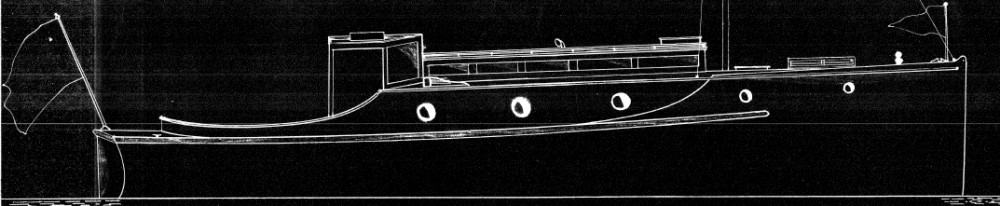
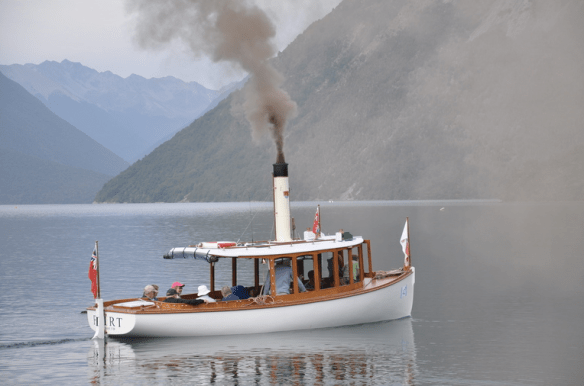
Lionel Jefcoat works out of a ‘shed’ in Havelock, where he built the historic replica steam launch Flirt – an incarnation of an 1894 British-built mail launch of the same name which plied Canadian waters. Flint is a regular attendee at the antique and classic boat show at Nelson’s Lake Rotoiti.
The project emerged from Flint’s owner Rob Hamlett’s ambition to own a classic steam launch. He went to Canada to find a steamboat, found Flirt and shipped it to New Zealand then found it was beyond restoration. The steam engine however, was in good-enough order and was installed in the new Flirt.
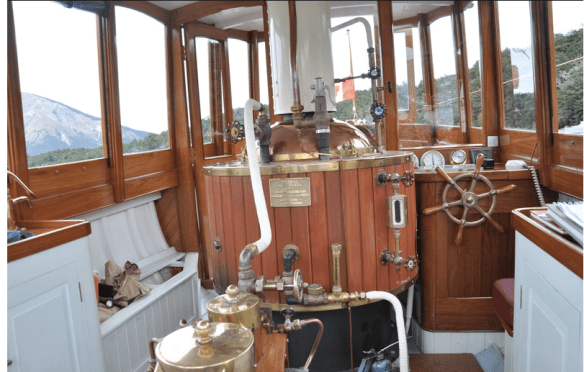
The 26′ launch, according to Lionel, has been modified slightly by Wellington naval architect Bruce Askew. Its teak decks and deckhouse, kauri stem and pressure-treated kahikatea carvel planked and caulked hull pay homage to a traditional design and construction, and a faded trade of wooden boat building.
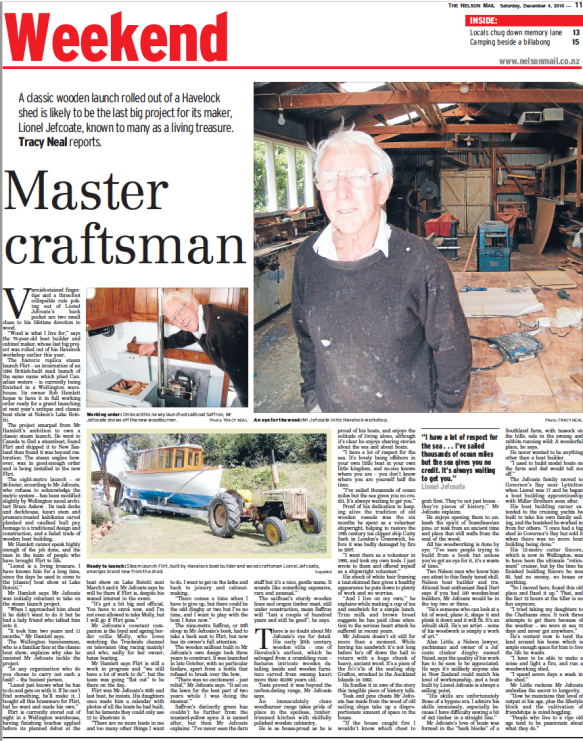
Lionel’s own boat is the 30′ wooden sloop Saffron, built to his own design, taking three years to construct. It was launched in late 2010.
Lionel’s love of boats was formed in the “back blocks” of a Southland farm, he never wanted to be anything other than a boat builder. The Jefcoate family moved to Governor’s Bay near Lyttelton when Lionel was 17 and he began a boat building apprenticeship with Miller Brothers soon after.
His boat building career extended to the cruising yachts he built to take his own family sailing, and the boat shed he worked in from for others. “I once had a big shed in Governor’s Bay but sold it when there was no more boat building being done.” His 12-metre cutter Encore, which is now in Wellington, was to have been the ultimate “retirement” cruiser, but by the time he finished building Encore he was 60, had no money, no house so Lionel moved to the 100+ year old villa & workshop in Havelock that today is home to this wooden craftsman.
Below is a link to a photo gallery of images from Radio NZ ‘Nine to Noon’ that showcase Lionel – in his early days, family life & some of many craft he built. Enjoy
A while back Rosalind discovered Lionel on her family tree (albeit way out at the end of a remote branch) and as a result of that we called on him earlier this year when we were in the Marlborough Sounds. He was not particularly interested in discovering another relative (sentiments similar to my own) but when he learned of our interest in old wooden boats his whole demeanour changed and we spent a most enjoyable three hours with him.
The workmanship in his sea chests and turned bowls was out of this world and the experience of looking at his stuff and talking to him about it, as well as his boats, was something I will never forget.
His book “57 Boats Later” is a fascinating chronicle of his life as a wooden boat builder and he was persuaded to sell me his second to last copy, although I understand a third reprint is on its way. (I must get a copy. AH)
Lionel Jefcoate RIP
Sadly, I have to advise that Lionel passed away on 17th July 2018. His funeral is scheduled for – Springlands Chapel, Cloudy Bay Funeral Home, 1:30pm – Saturday 28th July.
I was sent the photos below & copy by Russell Ward ex Rob Hamlett.
The above video records the renovation of the classic 1965 Lane Motor Boat Co. built launch Arohanui. The refit work was undertaken in 2015 at the Sandspit yard of Lees Boatbuilders for owners Fiona Driver & Rod Marler. Greg Lees & his team have established themselves as the go to yard for the application of Awlwood MA (Uroxsys) the flexible polyurethane marine clear coat finish. But I have to say that the yards craftsmanship & attention to detail prior to the final applications was second to none. Lees is a very classic friendly yard & whether the vessel is sail or motorboat, large or small its in good hands.
The short film was produced by Gareth Cooke (SubZero) who also filmed the restoration of Trinidad at Lees, refer below videos.
Back in the early days of ww (2013) I did a post featuring a really cool black & white ‘home’ movie from the late 1920’s. Peter Stein’s father (also Peter) featured in the movie & its production & Peter jnr. has kindly written an article, below, on the movie, the people featured & the location.
The cameramen doing the filming were Alec and Alan Lambourne. The Lambourne’s house (now owned by the Brooks) is above the jetty in Arran Bay. They had the jetty built in the early 1920s.
The three girls were Joan Woollams, Cynthia Restall and Shirley Vicary. Joan was the dark haired girl who rowed the dinghy. The Woollams owned the house on the south side of our house (Arran House). An early scene shows them picnicking at Bulls Bay (Anita Bay) at the north-eastern end of Waiheke. The “Smuggler’s Cave” is in the main headland between Bulls Bay and Hooks Bay and is easy to find.
The smugglers were my father, Peter Stein who was a Master at Auckland Grammar School from 1918 to 1965. He was the one on the oar. The other smuggler was Arthur Nicholson also a Master at Auckland Grammar School who later became the first Headmaster of Tauranga Boys’ College.
Our boat the “Pelican” was their transport. She was named after Sir Francis Drake’s round the world ship which during the voyage had a name change to the “Golden Hind”. The Pelican was 14 feet long and was an ex ship’s lifeboat. She was clinker built. The motor was a 5hp single cylinder “Du Brie” which gave her a speed of between 4 and 5 knots. Ignition was the current from 4 large 1.5volt dry cell batteries passing through a coil. The motor was started by crank handle and had a dog clutch so there was no reverse.
The tender was the dinghy “Beagle” named after Charles Darwin ship “HMS Beagle”. She was 10 feet long and was heavily planked which made her ideal for boating activities around rocky coastlines.
The Coastguard vessel was the “Waitangi” which I described in my article about “Beautiful Waiheke” (posted on 2 September 2015). The skipper was my Uncle Tom Stein and his armed assistant was Dean Ellingham another holidayer from Arran Bay.
It must be remembered that this was the late 1920s and home movies were in their infancy. The cast were a group of people who only came together when they were holidaying at Arran Bay. My father told me that they all had a most enjoyable time putting it together which is evident from the film.
Special thanks to Roger Guthrie for forwarding this footage to waitematawoodys.
ROBYN GAE video ex Martin Turnwald, details ex Martin T & Harold Kidd, photo ex PapersPast ex Nathan Herbert
The video clip above is a little scratchy but features some good footage of the classic woody, Robyn-Gae, owned by Martin’s father, John Turnwald. There is even a cameo apperance of the 1919 Joe Slattery launch Raiona (at 1:30).
Robyn Gae started life as Water Gipsy & was launched in October 1934 for C. Miller by Cox & Filmer (Speedcraft Boat Co) with dimensions 32ft x 8ft 6in. She was a slightly extended version of a 30 footer built by Cox & Filmer for a Mr. Martin. Miller used Water Gipsy for a while and then she “disappears for a while. Ted Valintine bought her in 1937, renamed her Connie V after Mrs. V, had her lengthened to her final dimension of 38ft, with the provision of a cockpit, coaming and dodger over. The work was undoubtedly done by Lanes who also fitted her with a 6 cyl Chrysler Crown petrol engine in September 1939. That was after the Kawau petrol fire in January 1939 when Valintine scuttled her by chopping a hole in her hull, saving the boat (photos below). Valentine sold her to E.M. Henry & the Lambourne family bought her from Henry in 1939. She remained in the Lambourne family until 1956 or so but Lambourne obligingly changed her name to Robyn Gae on 14/11/49 at the time Lanes launched the second Connie V for Valintine.
She is registered as a “Her Majesty’s Ship” in London.
The Chrysler Crown engine was replaced later by a Commer TS3 two-stroke diesel . The bridge roof was raised about 20 centimeters way back in about 1979 Martin thinks, because a stroll on the bridge always ended with a ding in one’s head . The beams were just that little bit too low and the bridge deck floor had to be raised a bit to accommodate the new engine.
The Commer has since been replaced by a Perkins & with this engine Robyn Gae is able to achieve a true 9.6 knots running a 5 blade prop.
Robyn Gae is for sale – for details contact Martin Turnwald at mturnwald@bluewin.ch
WHERE IS THIS WOODYS GATHERING? photo ex Harold Kidd
Today’s photo was taken in the period 1895-1905 & is ‘around’ the Waitemata.
What say you woodys – whats the location?
Article ex Paperpast from the NZ Herald 3 Jan 1896 (ex Harold Kidd)
Also a wee bonus today – Martin Turnwald, son of CYA member John Turnwald (MV Robyn Gae), who now resides in Switzerland, has sent in a c.1993 video of the William C Daldy. We see the crew was firing up the boilers to turn the old girl around on the wharf and Martin and then girlfriend, (now wife) were on board to watch.
I was sent this movie, filmed in late1929/30’s by the Lambourne brothers (Allan & Alex) nearly 2-1/2 years ago by Roger Guthrie, it was back in the very early days of ww & since then a lot more people have checked onto the site – in fact over 100,000 people. On ww last week I bumped into Peter Stein whose father (also Peter) appeared in the movie. Peter has written a very cool synopsis of the movie & the (now) classic launches that appear in the movie. I suggest you read Peters words & then watch the movie. Enjoy 🙂
The film “Beautiful Waiheke” by Peter Stein
Introduction:
The film was produced by the Lambourne brothers Allan & Alex in the late 1920’s early 1930’s. The Lambournes owned a large furniture shop on the corner of Ponsonby Road and Pompallier Terrace. The Arran Bay house was built in 1910 and remained Lambourne property until 1964 when it was sold to the Jorgensen Family.
Water transport for the Lambournes was the launch “Nga Whare” which is the round bilged craft in the film with the two portholes in her topsides. She was sold when I was a very young boy so I remember little about her.
Our property is next door to the Lambournes. Arran House was built circa 1885 for Andrew and Mary Croll from the Isle of Arran, Scotland. They were two of Waiheke’s pioneers. Andrew was a very fine photographer and albums of his photos can be seen at the Waiheke Historical Society Museum on Onetangi Road. Among the photos are scenes of the Annual Regatta organised by Andrew and held at Arran Bay circa the late nineteenth century. These events were well supported by “boaties” of the day. The albums were kindly donated by the Crolls of Sydney. Mary Croll was a very good artist and she put many scenes of the “bottom end” on canvas. Some of her mural work is still on the walls of one of the bedrooms in Arran House. My father, P.A.S. Stein purchased Arran House from W.J. Connell (owner of Connell’s Bay Store) in 1924 and it has been in our family ever since.
The Waitangi, the launch with mast and crosstree in the film was built in 1923 for Mr Cadman. It was a classic John L. Hacker design with sharp entry and flat stern section. The original owner named her “Karamana”. She had an aeroplane engine in her and we understand she was capable of 25knots which made her one of the fastest launches on the Waitemata at that time. Harold Kidd has a very good photo of her racing on the harbour (added below. AH). In the latter 1920s she ended up on the Tamaki Drive breakwater. My father bought the severely damaged hull and had her restored by Chas Bailey & Sons. He renamed her the “Waitangi” after his father’s steamer the TSS Waitangi of the Northern Steamship Co. My grandfather Peter Anton Stein was a Captain of various Northern Steamship Co. vessels from 1895 to 1908. Chas Bailey told my father that the Waitangi had brought them good luck because the next launch off their slipway was the legendary “Shenandoah”.
The Waitangi was 28 feet long (8.5m), had a beam of 7 foot 3inches (2.2m) and draft of 2 foot 8 inches (.8m). She was built in kauri and the bottom was double skinned from the bow to the wheelhouse. The rest of the vessel was single skinned. Her Auckland mooring was in St Mary’s Bay in front of the Ponsonby Cruising Club at the bottom of St Mary’s Road. Maintenance was carried out at Collings and Bell Boat Builders adjacent to the PCC.
About 1930 my father replaced the old Studebaker engine with a 105hp Kermath marine engine. Allely Bros. of Beaumont Street imported the motor and installed it. It was known as a 6 cylinder flat top. The pistons had a bore of 4” (100mm) and each cylinder had two spark plugs. It was double ignition with one spark plug connected to the magneto and the other one the distributor. Maximum speed was 18kns and at this speed the motor burnt 8 gallons of petrol per hour. Petrol was bought in 4 gallon cans and there were two cans to a box. We still have an old Atlantic box which we use as a vegetable bin at Arran House. Petrol in the early 30s was 1 shilling and six pence a gallon. A 50% rebate brought the price back to a respectable 9 pence a gallon. My father told me that the best run home he achieved was Connell’s Point to Kings Wharf in 1 hour and 12 minutes.
The film:
The film began with shots of the Guthrie family aboard their launch “Alcestis”. It then moved to shots of Arran Bay taken from different location around the Bay. The people setting out down the path are coming from the Lambourne’s house.
The aquaplaning sequence was filmed from the shore and the “Nga Whare” which was the tow boat. My father was the young man with one of the Lambourne girls on his shoulders. Years later I learnt to aquaplane on the same board.
The “Waitangi” then heads to Bulls Bay with my father as pilot. The majority of the film is shot at Bulls Bay (Anita Bay) on the north eastern end of Waiheke. At the northern end of the bay are many small rocky islands and the launches are filmed going through the channels between the rocks. These are not hard to navigate but should be done at ½ tide or more.
The “Coughing Caves” are in the southern point of Bulls Bay. With a northerly swell and incoming tide, waves enter the caves and when the top reaches the ceiling of the cave the air behind it is compressed until it bursts out in a cloud of spray. The boy in the dingy, Reg Crawford, is trying to get as close as he safely can to the emerging spray.
The “Whirl Pool” is in the long reef extending from the northern end of Bulls Bay. Riding the swell in and out of the pool could be quite exciting as seen in the film.
The homeward bound shots of the Waitangi in the storm were taken in the channel between Pakatoa and Waiheke.
Harold Kidd Input from previous ww post
Waitangi was built as KARAMANA for F.B. Cadman in 1923 by Bailey & Lowe to a design by Hacker. KARAMANA = CADMAN in pig maori. She was later bought by Auckland Grammar School teacher P A S Stein and rebuilt as per the 2nd photo below. She was fitted with a war surplus 6 cyl Green sohc aero engine producing 120-140bhp, bore 5.5 ins, stroke 6 ins (you work out the capacity). She was pretty radical.
03-09-2015– comments
1. The Lambourne launch was called NGAWAI I think, not NGA WHARE. She was later bought by the Andrews family on the Hokianga. I remember her as a child during WW2 laid up in a shed with a Chrysler engine. Maybe another NGAWAI but she looks the same. 2. KARAMANA/WAITANGI was built by Bailey & Lowe in 1923, not by Chas. Bailey Jr who built SHENANDOAH in 1929. There’s some conflation there.
As I mentioned in Mondays post I traveled to Lake Rotoiti with Chris Miller, Chris is a very talented pro photographer & on this trip packed a lens that was longer than my arm. This enabled him to get up close to the boats & shoot from a better angle (sun was a problem). He’s also a dab hand with photoshop so these photos are stunning.
RANUI (this is a long post, keep scrolling down – lots of photos) Antartic Outpost – Campbell Island 1947 ex Richard Allen ex archives nz
I was alerted by Russell Ward of this delightful short movie that Richard Allen had posted a link to on the ww ‘Matanui’ post. In Russell’s words – “the movie shows the dear old Ranui taking a load of provisions and workers to the Campbell Islands in 1947. I humbly bring it to your attention as it should be in its own spot rejoicing the daze when men were men and mulleties were mulletiies and were permanently pis_ed in Mansion House Bay.
Its a celebration of proper sailing men who are not ashamed to smoke fags and drink a beer in one gulp on camera. Before we all got tamed by these sheilas”
I spotted Ranui hauled out at Salthouses a few weeks ago getting her bottom seen to, photos below. On one of her visits to the Pacific Islands she practiced a spot of impact hydrography & while the damage was minor the anti-fouling was scrapped off exposing bare wood which proved too inviting to the worms. Out of the water she is a rather large lady.
Update from Bob McDougall
Below is a photo I took of RANUI on Miller & Tunnage’s slip at Carey’s Bay, Port Chalmers. Dated 15-12-1962, RANUI was in for a refit in preparation for the next oyster season in two months. Her hull lines show well in this photo.
Photo ex Ian McLean Ranui entering Dunedin – mid 1990’s
Dunedin mid 1990’s
Update #2 from Bob McDougall
The Larsen concerned was one of several Norwegian men of the name, who came to Stewart Island in the mid-late 1920s, with the whalers who set up their base, workshops, accommodation etc there — best known now as the Kaipipi Shipyard. The whale
factory ship was the famous C.A.LARSEN.
The man who designed and built RANUI was Captain Korinius Larsen, and information about him, and RANUI, is told in detail in the book “Stewart Island Boats”, published in 2008 by the Rakiura Heritage Trust, P.O. Box 114, Stewart Island, for the Rakiura Museum. This magnificent A4 portrait-format book was compiled from the long-time research and writings of Merv King, who died in 2005.
Email: stewartislandmuseum@southlanddc.govt.nz
RANUI and Korinius Larsen references are on pages 119 (incl. a photo of him), 121-122, and 266.
Other references are in: “Kaipipi Shipyard and the Ross Sea Whalers” by J.P.C. (Jim) Watt, 1989. Page refs. 56, 193, 233, 236. His first name may [sic] also be spelt “Karinius” — p.236.
Larsen was assisted by Tommy Bradshaw and others, and construction took place at North Arm, Port Pegasus, between 1928 and 1936. Launch date was 27-10-1936.
When completed, RANUI was sail-only — two 60hp National engines fitted a few years later [well before being taken up for war service in March 1941.]
All in all, a thoroughly interesting little ship with a big history.
Update #3 from Bob McDougall
More RANUI info is in Ian Church’s book “Around The Bay” — about Carey’s Bay people and boatbuilding, published 2007. Pages 95, 98, 99, 108, 110, and 117.
Page 95 records show the “assistant” who helped complete RANUI at Port Pegasus in 1936 was Miller & Tunnage’s Mike Monti of Carey’s Bay. Page 117 records the conversion from laid-up oyster boat to a modern charter vessel, during 1997-1998.
RANUI’s register information:
First registered at Dunedin, No.1 of 1937, 10 April 1937, O/No.142914.
First owner, The Pegasus Fishing Co.Ltd, Invercargill.
First engines: twin screw, two 3-cyl. diesels by National Gas & Oil Engine Co.Ltd, Ashton-under-Lyne, U.K. TOTAL bhp, 60 = 9.5 knots. Therefore, engines installed by April 1937: i.e, 5 months after launching.
Registered dimensions: 66.25ft x 17.65ft x 8.35ft depth. Ketch-rigged.
Tonnages: 56.24 gross, 19.52 net.
Owners:
Sale 25/5/1939 to James William Paterson [sic?] THOMSON, mariner, of Half Moon Bay, Stewart Island.[the ‘real’ owner]
Sale 10/6/1941 to H.M. The King, in N.Z. Government Marine Dept.
Sale 28/7/1949 to ditto ditto Ministry of Works.
Sale 14/10/1949 to ditto ditto, Dept. of island Territories.
Register transferred to Wellington 16/12/1949, No.1 of 1950, 11/1/1950.
Sale 28/8/1953 to George T. ELLISON, Otakou, transport operator.
Register transferred to Invercargill 29/10/1953, No.2 of 1953, 3/11/1953.
Sale 18/2/1960 to Otakou Fisheries Ltd, Dunedin.
Invercargill register open, no further owner-changes, as at Feb. 1976.
Subsequent engine, tonnage, etc changes:
The conversion for Island Territories work, by HMNZ Dockyard at Devonport, completed in December 1949 — now 65.54g, 22.97n.
By Feb.1954 — 65.54gross, 18.18net.[conversion for trawl & cray fishing]
1956-1957 — converted for oyster dredging by Miller & Tunnage, at Carey’s Bay. First dredging season, February 1957.
By May 1965 — completion of new engines fitted: two 6-cyl. Gardner diesels, 114 bhp each; 51.63g, 13.07n; no ketch rig now.
Accidents, etc:
17/4/1938 — stranded off Stewart Island. Master – J.W.P. Thomson.
July 1944 — Damaged rudder at Auckland Islands. Ref. Church, p.98.
Nov. 1954 — A mast and boom smashed by CITY OF BIRKENHEAD, (7320gt/1950) at Dunedin.
c.Feb.1960 — Damaged the Bluff (port entrance) lightship beyond repair.
There are sure to have been other mishaps, but I have no record of them.
Finally,
I see that RANUI was put on Part B of the N.Z. Shipping Register in February 2001, as charter vessel RANUI III, Register No. NZ 654.
Regards,
Bob
24/09/2014 – A reply to the above from Richard Allen – current owner + photos
Thanks Bob, I knew Ian Church but didn’t know his book. I left Dunedin about 1999. Stewart Island Explored is a good one and there is another by Olga Sansom. Also NZ NAVAL vessels has the chapter attached plus the ships details in the schedule.
I knew Mike Monti, he was about 80 yrs old then and made the tea at Miller and Tunnage in the new shed ((after the old was burned down just after Bryan Ingles sold to his foreman Alvin Smith, about 1985.. The charred Timaru trawler that was inside the shed became the centre piece of a famous Ralph Hotere exhibit called the “rise of the phoenix”.)
He told me Larsen hired 6 of the toughest guys he could find on stewart island(including Mike) to hunt thru the bush for grown curved totara for ribs and floors. He told me the toughest only lasted a week and after that Larsen did it all on his own. He was , he said , a “bull of a man, nearly as wide as he was high” .
Eric Chester a long time Otakau fisheries engineer found the original “Browns Tele motor & Steam Tiller co of Edinburgh” steering wheel still on her now.
Chris Spiers first job as apprentice at Miller and Tonnage was to rip out all the red carpet brass and mahogany from her time as the official government ship . His second job was helping cut up two totara telephone poles used to make her rolling chocks (or bilge keels) .
I bought her over the phone while I was in Savannah in 1996 with NZ Yachting team(Tornado). She used to be moored right next to my Fishing Trawler ELAINE , 39 ft 6 in , also a 1924 double ended Miller and Tonnage barracuda boat. So I knew her well when I was a commercial fisherman and always thought she would make a safe husky expedition boat.
Its maiden sail after the Miler and Tonnage refit in 1999 was a grade 3 oceanic search we did for the RSCC to Antipodes Islands to find well known sailor Gerry Clark and the Totorore, see newspaper article attached. Also see the article I wrote about that trip published in Boating NZ on http://www.ranui.co.nz.
The Gardners were not powerful enough (only 6 LW’s) so the Detroits were put in in 1977, rebuilt 1999 by Wilson bros.
She swings two 40 in x 24.5 3 blade props through 3:1 Allison hydraulic boxes. The Detroits are a matched set opposite turning.
Ranui has now taken our family around the Pacific and Southern Ocean many times and she’s never scared anyone. I guess we are up over 75000 miles. Now she carries about 2900 sq ft of sail with all set, including mizzen staysail.
Incidentally , when looking through her survey papers I found the Invoice from Naval Dockyard to Minister of Finance for 13000 pounds. The minister wrote back to the Naval Superintendent querying the bill , saying they paid 3000 pounds to buy her , could have built a new one for 9000 pounds…, but I’m told it was classic Navy with a Rum Locker , Paint locker and all! .But I now know how the Minister felt. Salthouse’s are doing a meticulous and loving job on her hull right now, including complete recaulk, fastenings inspected all ok ,( 5 in copper dumps in perfect condition), new starboard belting, new garboard, refurbished rudder, shafts, bearings , steering, repaint with 8 coats International etc etc
I just ripped off the last of the muntz metal the Navy put on her , some 64 years later….
Click the photos to enlarge
Ranui off Maskelynes Islands, Vanuatu 2010
Photo below – Probably in the late 40¹s when Capt Noel Worth was skipper at Port
chambers wharf
Ranui during a ‘bad hair’ (ugly) period. Photo ex Ross Walker, taken in Bluff approx. 20 yrs ago. Ranui is arriving back after a day on the oyster bed.




 waitematawoodys.com #1 for classic wooden boat stories, info, advice & news - updated daily - 15+ million views