Charles (Chas) Collings – Designer / Boat Builder

Image

This slideshow requires JavaScript.

Charles (Chas) Collings – Designer / Boat Builder

The story below on Charles Collings’ approach to design in the immediate post-WW1 period has been penned by Harold Kidd.

Charles Collings emerged from World War I with a massive reputation for fast craft. In late 1914, when the war was just a distant rumble in France, he had built the 21ft restricted racer FLEETWING with which he raced and beat the Christchurch boat DISTURBER on the Waitemata in April 1915 at exactly the time of the landings at Gallipoli. He developed his “concave-convex” hull design where the chine hull had a convex (hollow) entry and progressively transitioned though straight to convex at the stern. He was by no means the originator of the idea, but certainly grabbed it as his own through decades of successful planing hulls he built for racing, fast cruising and whale chasing.
There is no doubt that he was well ahead of his time in a local context, although Major Lane was close behind.
By war’s end in 1918 Charles Collings had been a notable war effort contributor as a pal of local motorboat guru Charles Palmer (see ADELAIDE on this site), had lost his partner Alf Bell who had gone to the Walsh Brothers helping them build flying boats at Kohimarama for their flying school (and did not welcome him back afterwards), and was preparing for the post-war boom in large launch building that was inevitably coming, during which he built MARGUERITE, PAIKEA and RUAMANO amongst many others.
I have had a chip at his aesthetics from time to time but, to be fair to the man, he did not have the hindsight we have on the way launch design went and could not know what looks good to us today.
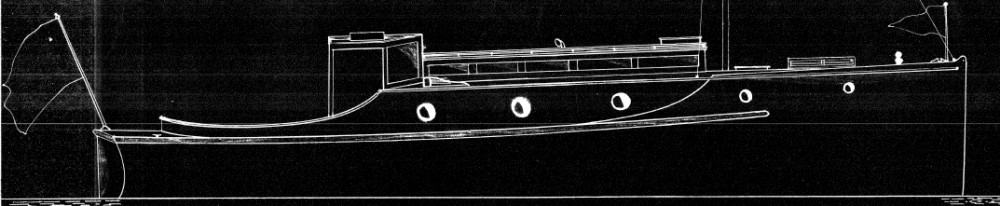
Faced with the design of a fast cruiser, only 32ft loa by 8ft 6in beam, and the desire for headroom in the main cabin, he came up with his second motorboat called FLEETWING (by now a brand for him). She was an extension of the ideas in the 1915 ADELAIDE.
I think, with this second FLEETWING, Collings’ first training as a civil engineer shows through more than his secondary training with Robert Logan Sr. as a shipwright. To obtain headroom he carried the tramtop/clerestory concept to the point IMHO of ugliness, using the parameters of the railway carriage, the electric tram and the motor bus of the time, abandoning completely the parameters of the yacht, even a token attention to which had kept launches aesthetically pleasing until now.
Anyway, see what you think of this image of the second FLEETWING which I have taken from one of Collings’ own glass plates, very decayed, but an amazing insight into the goings on in St Mary’s Bay in late 1920. Collings & Bell’s yard is out of picture to the left, so we see the yards of Dick Lang and Leon Warne close up.
This launch was on TradeMe at Picton recently, erroneously called MISS FLEETWING.

Update: Charles Collings was a very good amateur photographer with excellent gear. After his death in 1946 his glass plates got scattered around in the workshop, many were used for skipping across the Bay, most were smashed one way or another. A very few survived, most cracked or with their emulsion badly decayed. I have a handful more of which a couple are excellent and the definitive shots of his 26ft mullet boat CORONA after her launching in 1936.

PS Leon Warne took over the shed on the right in 1916 from Henry Barton who left for the US with his family because of his anti-war convictions (and had a shocking time on the way). Warne had served his time with Collings & Bell. He painted up the shed very nicely as you can see but was building in St.Mary’s Bay only until c1924 when he and his brother set up in Russell, building and chartering game fishing launches.
Jeunesse

Image

Jeunesse

JEUNESSE

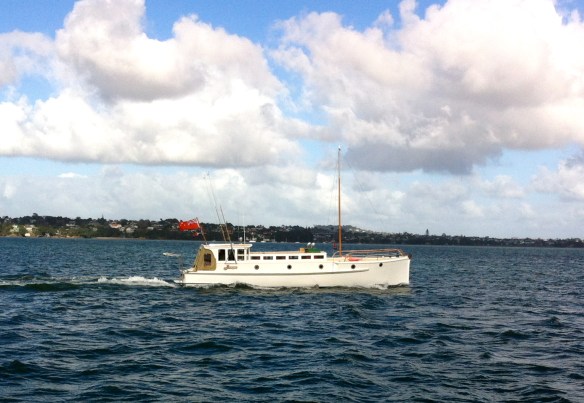
‘Probably’ built in 1927 by Dick Lang, the owner is looking for anymore details on her past. Previous owners include a Dr. McFarlane?? & TG Shaw from the cartage contracting firm.

Photo taken by AlanH on July 7 2013 as she was heading up the upper harbour. She is rather quick, from memory having had the same zoom zoom transplant as Falcon i.e. a big Hino (turbo?)

Harold Kidd Update

The 37 footer JEUNESSE was built for W J Harper and launched in March 1919 as RAMBLER. Harper changed his mind and renamed her JEUNESSE by the start of the summer of 1919-20. None of the magazines or newspapers say who built her but Dick Lang seems a fair bet as she was built in St. Mary’s Bay. Reportage on such things was pretty scant at that time because of the Spanish ‘Flu outbreak. She was fitted with a 40hp Reutenberg 4 cylinder engine. Harper sold the launch KOTIRO when JEUNESSE was built. He kept her until 1923 when he sold her to H Hewson. N C McLean & R Kirkwood owned her in 1926. She spent a lot of time in Whangarei after that. In 1951 she was owned by S H R Smith of Onehunga, Richard Leary in 1990, John Wright in 2003; that’s all I have.

Want to be a waitematawoody?

Easy – buy Rotomahana, the 1923 Bailey & Lowe launch. Harold Kidd referred to her as a ‘baby Romanace II’, owned long-term by Humphrey Duder of Devonport.
33ft, kauri hull, 45hp dsl, 4 berths, toilet with holding tank, gas cooker, fridge, gps chartplotter, depth sounder, 2 x batteries, shorepower, electric capstan, aft boarding platform. A well presented classic. Call Gavin in Picton on 0272 757 716 Reduced to $32,500
 
 More photos & details here 

Classic dinghy moments

This slideshow requires JavaScript.

Classic Dinghy Moments

In the clinker (L>R) Douglas, Hugh & Ivan Guthrie. fyi Hugh celebrated his 93 birthday in June.

 
They always said ……we can get another in…..no fast boats to whip around the corner & swamp everyone in those days. We used to do it ourselves when young. It was very hard to get a good pull on the oars with a crowd. However we survived 🙂
 
photos & words from Roger Guthrie

Winter Cruising

This slideshow requires JavaScript.

Sure its winter but if you rug up, the evening light makes it all worth while + only 5 boats in the bay.

This was at Owhanake Bay , Waiheke Island last night – no special effects, straight out of the camera – amazing.AH

Ramona

This slideshow requires JavaScript.

RAMONA
story & photos ex Harold Kidd
The photos above show the 25 footer RAMONA racing with the NZPBA in 1928 and in 1931. She usually raced in the “Cruisers, over 12 knots” races.
She was built by S. Granros of Ponsonby in September 1928 for F. J. Fawcett of Mount St. John.
Unsure what power she had, but it was obviously more than adequate.
Fawcett cruised and raced her until November 1933 when he sold her to Hans Molgaard of Tauranga who still had her in 1936. I don’t know her subsequent history, probably a name change as the popular song “Ramona” from the 1928 film of the same name became somewhat passé.
Her builder, Sam Granros was a Finn who came to NZ in 1904. He built a lot of speedboats and launches in St. Mary’s Bay and at 12 Hackett Street, Ponsonby, for example, HILMA, NURMI, ALMA, RAMONA, RAMONA JR. (1930), CYGNET I, II and III, ESTHER, MISS PONSONBY, all go fast outfits. NURMI was a 1926 20ft 6in speedboat with a 120hp Hall-Scott, although she was originally going to be fitted with a 6 cylinder Napier car engine which would have been pretty heavy.
Sam later moved to Oneroa and died in 1946.

Rehutai (Wellington)

Image

Rehutai (Wellington)

REHUTAI (Wellington)

story & photo ex Russell Ward

Rehutai (this one) was (according to Harold) built in 1926 by Sam Ford at St. Mary’s Bay for C.C. Ross of Wellington and had a 50/75 Stearns engine.
Ross owned her at least until 1933. In 1957 she was owned by R.N. Barton of Featherston.
I would have sworn she was a Lanes boat. Just shows you.

Harold Kidd Update:

ALL ROADS LEAD TO LANES! Actually Garth Lane personally built every launch constructed in Auckland from 1905 onwards and licensed/franchised boatbuilders to put their nameplates on them. But seriously, you can tell an Auckland-built launch at a mile; there was an Auckland “look”. Compare images of contemporary Dunedin/Australian/ US/British/French/Italian/wherever launches and there are strong family resemblances within Auckland launches. It’s not hard to figure out; it’s a cultural and fashion thing. So, when Logan Bros went out of business in 1911, lots of builders started building Logan-style double-enders of class. They all built what their owners wanted them to build. I defy anyone to get the provenance of an Auckland launch right just by looking at an image of it, particularly when, like this Sam Ford REHUTAI it has been changed time and time again over the years.

PS Recently I did a count of the “Oliver & Gilpin” launches then currently on TradeMe. There were 9 of which only 4 were built by Oliver & Gilpin, the rest were knock-offs. With the other 5, that distinctive O&G style had been copied so well that their owners were convinced and had no hesitation in claiming O&G provenance (with potentially dire commercial consequences for misrepresentation).

NZPBA Championship 1929

This slideshow requires JavaScript.

NZPBA championship races of 1929 on the Whau River (upper harbour)

The small speedboat in photo1 is OP-IT. She was built by Jack Brooke in late 1928,.and according to Harold Kidd & the Brooke family, that’s probably Jack racing her in the C Class outboard race)

Update from Harold Kidd

Photo 1 is certainly of Jack Brooke and his C Class (20 cu in) outbioard racer ‘OP IT which he designed and built himself. 
Photo 2 is MISS CLEVEDON (S2) and SPOT II (S15). MISS CLEVEDON was built and raced by T M Roberts and was one of the fastest in the over 20 knots category. I don’t know what power she had. Roberts also raced an outboard MISS CLEVEDON which had a 10hp Dunelt 249cc. Dunelt were upper quality English motorcycle manufacturers of the time who were trying to beat the Depression by getting into the outboard racing craze sweeping the world. SPOT II was a single step hydroplane built and raced by Alf Williams of Ponsonby. She had a “high-speed” Rugby 4 cylinder car engine, a favourite for marine use. The Rugby was built by the Durant Corporation and was the Star car rebadged for British Empire markets as there already was a fine English Star car, built in Wolverhampton and very like the contemporary Sunbeam. 
Photo 3 is HOBO (S3) which was built and raced by R. Mouat. She had a 6 cylinder Buick engine with which she won 2nd place in the Masport Cup in January 1929 at Wanganui. She was a crib of the American MARGARET III type.

Update from Colin Orum 30/03/2014

Photo 2 above is a photo of my grandfather Tom Roberts driving boat Miss Clevedon. I have heard quite a lot about his speedboat escapades from Mum now 88 and it was mentioned today. I thought to inquire if any information photos etc. were available. I was quite friendly with an old bloke at Waiheke named George Rose who(as a boy) new Tom quite well and used to tell me stories about his time with the racing boats. George said the power in Miss Clevedon was a Beardmore aero engine. Today Mum said the last she can remember is that Tom was taking Miss Clevedon on a practise run on the Clevedon river, struck a submerged log and sank, we assumed that it was recovered but unsure what happened after that. My brother has a cup trophy for Tom for Auckland speed boat champion around 1929-30.

Shenandoah Hauled Out

This slideshow requires JavaScript.

A collection of photos showing the  1929 Chas. Bailey & Son built  launch Shenandoah when she was hauled out for work at the Te Atatu boating club. a few years back. I had to include one old b/w image to remind us what a beauty she was when launched.
Photos supplied by Russell Ward
10-10-2016 Photo ex Ken Jones, via Ken Ricketts – off Devonport.
shenandoah