A Visit to Chris McMullen’s Boat Shed

One of Chris’s experiments

And of a few photos of one of the prettiest boats on the Waitemata – Wirihana, the 1933 Colin Wild launch.

A Visit to Chris McMullen’s Boat Shed

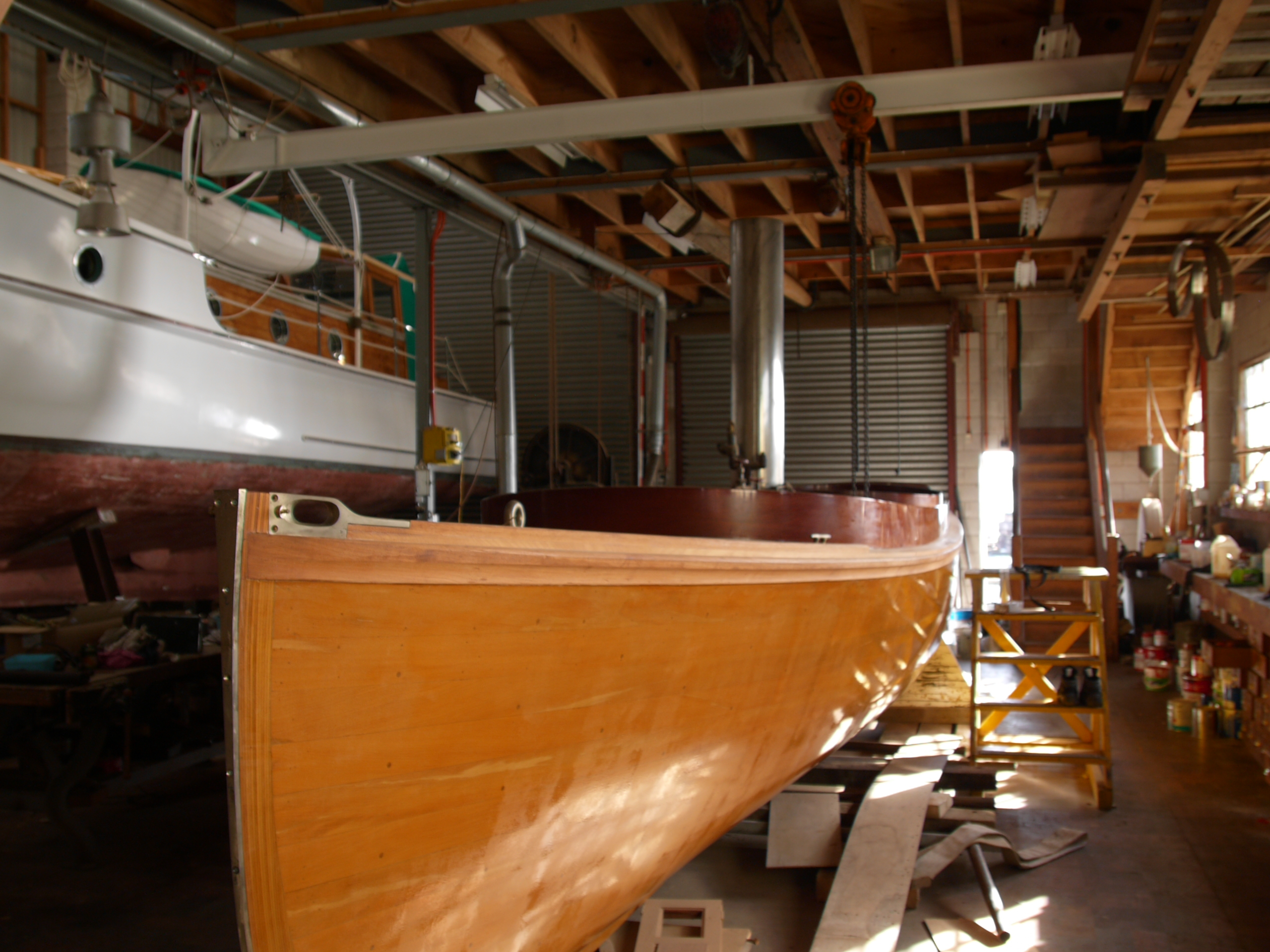
Yesterday was a biggie on the wooden boating front – Barbara Cooke & myself organized for the Classic Yacht Association a visit to Chris McMullen’s workshop & boat shed. I have posted photos of the shed & its contents on ww before & ww has published several of Chris’s posts on the topic of electrochemical damage to wooden boats – but it was special for the members to meet the man himself & hear him speak on his past, his current passions / projects & future plans. The reproduction 1898 Herreshoff steam launch project just has to be one of the best kiwi ‘can-do’ tales around. The day she hits the water will be a very special occasion, I just hope I’m around to see it 😉

Today two things stood out for me:
1. The turn-out of two wooden boating icons – John Salthouse & Max Carter
2. The healthy number of sub 35 year old guys with a new found passion for classic wooden boats in attendance

If your a CYA member & you didn’t make the effort to come to the event – more fool you – as one of your most respected members said to me “today was a privilege, Chris is a one of a kind, his practical knowledge on boat building and engineering is unique”.

In my time as CYA launch captain one of my personal goals was to help deliver up events & access to people & ‘cool stuff’ that people would not normally have access to without being CYA members – from the comments & the smiles as people where departing today, Barb & I got it right today 🙂

To read / view more on Chris, his boats & the topic of electrochemical damage to wooden boats just enter – Chis McMullen – in the ww search box 😉

Ethel

ETHEL
Info below ex Capt. Tom Leary    B.V.A. (Syd.)  C.L.M.  N.Z.W.G. – sent in by Judith Gardiner (+ b/w photos). Colour photos ex Alan H
Designed and built by the Logan Brothers at their Devonport shipyards in 1896 (Nov 16th) for H. Dawson the owner of Greater Mercury Island. She was 60′ LOA, 11’8″ beam & 5’8 draft. Triple skin kauri & copper roved. Ethel was built as a family cruiser/ racer with slightly more beam than those of her contemporaries. Ethel spent her early years cruising and racing mainly around Auckland but also in Wellington.

Around 1918 Ethel was taken along with other larger vessels into the snapper fleet and given the sail # 33. After the war years she moved to Waitara on New Zealand’s West coast where she remained for fifty years long lining for snapper, it was during this time she had an engine fitted. Whilst in Waitara where she had her own wharf, she was called by the locals ‘The Queen of Waitara.’

About 1970 she returned to Auckland and continued to fish out of Westhaven.

In approx. 1975 she was purchased by John Smith from Thames who did extensive restoration work including new decks new cabin, new interior work and restored her original yawl rig as the mizzen mast had been removed for fishing.

In 1999 I purchased Ethel from John and again an extensive refit began.

Half of her port side was replaced due to dry rot. New fuel tanks, a recond. engine was fitted, new electronics/ wiring including smart charging systems, electronic toilet  and fridge installed she was completely recaulked including scarfing in slithers to her garboard plank. All this work was done under the guidance of Nortel surveyors. 2003 saw more work done during a winter refit her coach roof was glassed over, her main mast and gaff had another two meters added to them to take her back to her original rig. Her cockpit area was increased with self drainage this was done to take six to eight people comfortably. Wheel steering was added and her decks were recaulked with sika. A yard was added and new sails cut to fit. All Ethel’s standing rig is new galv. most of Ethel’s running rig is also new. Ethel is a very well appointed and maintained classic and has been chartering successfully for the past three years.

The Auckland museum has many early photographs of Ethel, as with today, she is a much admired and photographed yacht.

Alan H – Ethel is now owned by Keith Munro & has again undergone an extensive refit & you will see from the photos below is looking rather smart.

Info ex Judith Gardiner on Ethel’s first owner – Herbert Dawson, who was Judith’s great grand uncle through her mothers line.

Herbert Dawson was born 19 April 1859 In Leeds Yorkshire. He married Jane Eleanor Darrell  on 29 December 1886 in Hutton Buscel East Yorkshire & they had two children –
Ethel Fanny Dawson
Born: 14.11.1887 – Lebberston, Filey, Scarborough

Eleanor Sybil Dawson
Born: 03.05.1889 – Falsgrave, Scarborough

Herbert, Jane, Ethel and Eleanor (known as Sybil)  emigrated to New Zealand and landed at Port Chalmers.  They had sailed on the ship Tainui which had left London on 12 May 1892. Herbert purchased Great Mercury on 02.10.1893. Herbert sold Great Mercury Island on 26.02.1912 to John Kemp of Epsom and Frederick William Kemp of Tauranga.

Herbert contracted Logan Brothers of Devonport shipyards to build a ‘boat’ to accommodate his need to transport to and from Great Mercury Island.  It was launched on 16 November 1896.  It was probably sold within the year that Herbert left Great Mercury Island.

Judith would very much like to know who owned it after Tom Leary any other information would be appreciated.

Herbert & Jane Dawson

Herbert Dawson Jane Eleanor Darrell

Ethel – Sailing Sunday


ETHEL
I took the above photos of Keith Munro’s 1896 yacht Ethel at the CYA Patio Bay Weekend. The close ups where when she was rafted up to Dave Gidden’s Allergy.
Hopefully Harold will chip in with details on Ethel.

Harold Kidd Update

ETHEL was built by Logan Bros for Herbert Dawson who owned Mercury Island. He used her for carrying supplies to the island and wool and stock to the coast, usually Whangapoua. She was therefore more generous in beam than most yachts of her time which proved useful when she was later used for racing on the Waitemata by W.J. Quelch and W.R. Ingram after Dawson sold her in 1912.

Jack Brooke Collection #7 – RNZYS Centennial

Jack Brooke Collection #7 – RNZYS Centennial 1871 – 1971

waitematawoodys again thanks Robert Brooke for making the remarkable drawings done by his father, Jack Brooke, available to ww followers. Jack produced a hand drawing on each cruise, this one was done to record the RNZYS Centennial celebrations in 1971. Today’s post is the seventh of several – enjoy.

Blow up / enlarge the drawing to view all the historic events recorded – One Ton Cup win, Woman admitted as members, Charter to wear the Blue Ensign, Charter to wear White Ensign, the list of Distinguished Guests & more. The drawing of Kiariki just illustrates how talented Jack Broke was.

To view Jack Brooke’s other drawings type Jack Brooke in the ww search box.

Heads Up – over the weekend I will be postings a cracker of a read so make sure you check in 🙂

Chris McMullen Herreshoff Steam Launch – Part 2 (the engine)

The building of a replica 1898 Nathanael Herreshoff triple expansion steam engine – as told by Chris McMullen.
CMcM SteamLaunch AH6

The Herreshoff engine is a triple expansion type with cylinders 3-1/2” x 5”x 8” with a 4-1/2” stroke. It is a smaller version of that depicted in the L Francis Herreshoff book ‘The Wizard Of Bristol’ page 228.

The engine is very different to what the textbooks on the subject show. Everything designed by Nathanael Herreshoff seems to be that way. He certainly never copied traditional thinking but worked it out for him self.

Those interested may notice the two crankshafts gear driven one to one. The right hand one drives the piston valves. Going astern is effected by sliding bush or sleeve within the driven gear activated by a lever, this rotates the valve C/S to a new position. The bush, gear and shaft required machining male and female three start threads, left and right hand 8” pitch!  Not easy. The threads have / had to be cut on a planer using a dividing head coupled to the motion. Modern cars use a camshaft driven by a timing belt, similar to Herreshoff but remember this engine was designed in 1898!  The engine is very short to allow the crankshaft to be supported by two bearings and also to prevent loss of heat as the exhaust steam travels from one cylinder to the next, thus trying to reduce pressure loss.

If you look at the image of the crankshaft casting (below) you will notice the overhung balance weights. Notice the lack of material in the web between the second and third journal. The crank can’t be ground and there is no easy way to machine the metal designed to be eliminated by casting.  Casting this crank was a mission in SG iron. To cast it in steel (with 1/4” to the foot possible contraction) is going to be more difficult to achieve the correct length.

H.M.C.O had an outside foundry cast their steel but I notice in reading a recent article on Herreshoff Anchors they did have problems with their steel castings.

The base of the engine is a bronze casting to hold oil. The engine max revs are about 700 so the engine will have to be enclosed or throw oil everywhere.

There are good drawings available for this engine but no tolerances are given. I guess the fitters knew what was required. The original drawings were coloured to show the different materials, as was normal drafting practice.  The prints I got were black and white and difficult to read. No layers as in CAD drawing.

The Boiler is a three-drum type with curved tubes. It is similar to a Yarrow Type boiler. All the circulation is achieved in the tubes, the outer tubes being cooler than the inner. Once the circulation starts it continues. This was proven by Yarrows experiment in the early 1900’s. So Herreshoff and Yarrow, an ocean apart, came to similar conclusions. The upper drum of the boiler is 8“ OD, the lower drums 4-1/2” all with 5/16” wall. The 1/2“ tubes are expanded. Not easy to do up a tube just over 4” ID.

The boiler was built under survey. The working pressure is 250 PSI.

There are no pumps on the engine. The boiler is fed and the cooled exhaust condensate is removed for reuse by an independent steam driven combined feed and air pump. These pumps were the only item on the launch not made in house by H.M.C.O.  There were no drawings of these Marsh Pumps made by The American Steam Pump Co., Battle Creek Mitch. I copied mine from ‘Vapo’, an incredibly clever but simple pump with two moving parts but very difficult to manufacture.

I should add there has been no fabrication. Everything has been cast in iron or bronze.

Again this interesting project has been done for no other reason than for my own personal satisfaction.  I guess Prof. Evers Burtner’s comments (see copy of magazine article below), I quote “It is too bad that this engine is so complicated that amateurs would not be tempted to build one of their own”, was red rag to a bull.

To view part one i.e. the boat click here https://waitematawoodys.com/2014/07/07/chris-mcmullens-herreshoff-steam-launch/

Click Any Image / Photo Below To Enlarge


Can Anyone ID This Yacht?

Image

Can Anyone ID This Yacht?

Who Can ID This Yacht

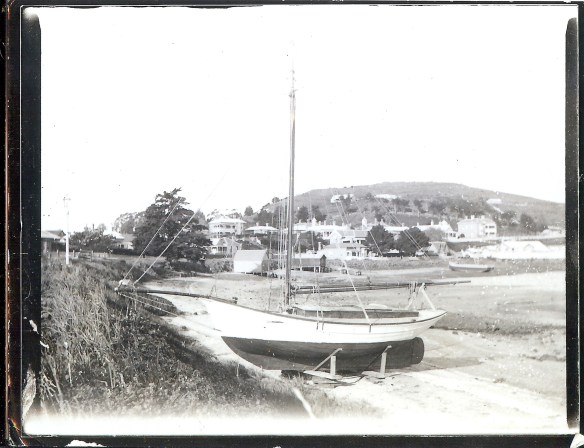
We are over due for a little bit of yachting – now this one will have the crusty old salts scratching their heads. The image is a contact print off a glass plate that was sent to me by Keith Ottaway. The original was taken by his wife’s great grandfather, Richard George Collins.

The location is obviously Devonport & as a starting point, RGC started ‘taking’ photos c.1895

Harold Kidd Update

A most unusual hull-form for Auckland, unlikely to have been built by any of the mainstream builders like Logan or Bailey.  She’s a Devonport boat, hauled up alongside the wharf at the foot of Church Street.
My wild guess is that she’s the 4 tonner WANDERER, built in Devonport by Tom Le Huquet in October 1891, soon after he set up in business there. If so she was built as a cruiser for J.C. Webster but was a total loss when she broke away from her moorings under North Head in a hard NE blow in May 1893. She came up on the rocks at St Mary’s Point and was badly damaged. From the sound of it she was beyond economical repair.
Jack Webster immediately ordered another yacht from Robert Logan, the 38ft cutter NGARU, which also had a sad fate when she was wrecked on the south end of Rangipuke Island at Christmas 1900 when owned by C.B. Stone.
The hull-form of the yacht in the image is almost French smack and quite reminiscent of the oyster and crabbing boats Le Huquet had been building in Jersey,. particularly the treatment of the stern. But there were all sorts of hulls being built at the time and I am likely to be totally wrong.

 Follow up update 05/05/14

If I’m right, and she does have the ancestry I think, then you can see how this form of hull would work well in an environment where the tides average 40ft and all boats dry out on legs. The extended, flat forefoot, the protected and vertical rudder, plus the great deal of sheer to cope with the short steep seas in the very shallow waters around the Normandy/Brittany coast with strong winds and 10+ knot tides on occasion where much passage making is done by sling-shotting the tides.

Kate

Image

Kate

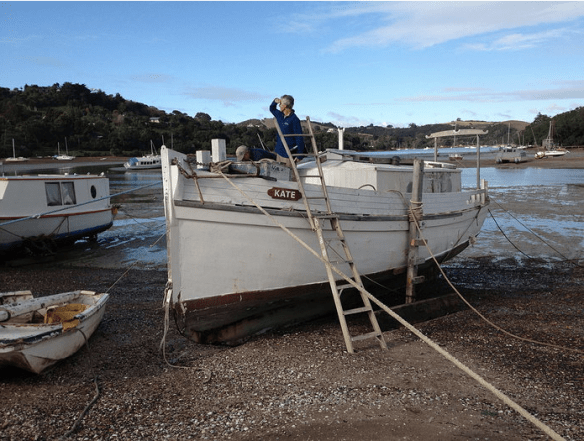
KATE

photo ex classicboatnz

Built in 1884 by Thompson Bros. in Dargaville. Photo looks to be taken at Waiheke Island (tbc)

Harold Kidd Update

According to the Register of British Ships she was built in 1894 by C. Thompson at Aratapu, not in 1884. She was also called KAIPARA KATE in 1932 when owned by A G Curel of Helensville, but seems to have reverted to just KATE. The earliest reference I have to her is her entry in the Pahi Regatta of 1899 as a sailing vessel.

Graham Guthrie Update

Kate is indeed on the Causeway on Waiheke Island. She has been aquired by Bernard Rhodes, a sailor who has built his own vessel and sailed her around the world. A Waiheke resident, Bernard is seeking to restore Kate to her former glory as funding permits, and then use her as a sail training ship for the youth of Waiheke and Auckland. As a boatbuilder of considerable talent Bernard has taken under his wing 2 lads who he is teaching  various skills as they assist in the restoration.He has produced an interesting brochure on the history of Kate and how she should look when restored. I will retreive this from Kailua and see if it can be uploaded onto the ww website.

Now members have successfully completed the restoration of Gypsy, if they have any surplus funds, Kate would be worthy of consideration.

A proud NZ maritime family – the Guthrie’s

This slideshow requires JavaScript.

The Guthrie’s

CYA member Graham Guthrie & brother Roger’s great grand father, Henry Guthrie, settled in Dunedin in July 1864 from Largo in Scotland. He married Isabella Graham in 1866 & became a ship owner & broker. Most of the ships owned by Henry initially were jointly owned with mainly with his younger brother Walter. Sir William Larnach (Larnach Castle, Dunedin) was another co-owner & several joint ships can be viewed today on the walls of the castle. One joint ship has the claim of taking the 1st shipment of frozen lamb to Britain.

However from 1878 he was essentially the sole owner of the vessels.The Laira an iron barque built in Sunderland,England was owned by Henry from 1889 to 1893.
A large number of ship passed through his hands in his role as a broker. He was a member of the Otago Harbour Board in 1879-1883 and 1892-1894.
It appears that he was bankrupted in the late1880’s but all their children received a sound education and the family lived a settled and comfortable life.
Henry died  on 21st April 1913 in Rattray  St Dunedin as he was walking up the steep hill to his home.
The photo above shows the ship Alcestis when she ran aground in Otago Harbour c1880. This ship ‘gave’ its name to the Guthrie family launch, Alcestis (photo attached), which features frequently on this site.
Update / photo from Russell Ward – photo of an unidentified tug -possibly ‘Dunedin’ – towing Alcestis out of Otago after her grounding.
I guess she lived to sail another day unlike many of them on that coast.
photos & details ex Roger Guthrie

Waitangi Relaunch

This slideshow requires JavaScript.

WAITANGI

The big question around the waterfront was answered today when the 1894 Robert Logan snr. classic yacht Waitangi was re-launched following her recent ‘refurbishment’. As the photo’s shows, Henry Ford would approve – she is black. There had been some ‘debate’ as to whether W should revert back to the white that she sported for a large part of her life, while across the ditch in Australia. Personally I like the black & it makes her the only classic you can sight from a distance & say ‘there’s Waitangi’.

A crowd of over 100 assembled at the Royal New Zealand Yacht Squadron on Sunday to celebrate & reflect on Waitangi’s history and the achievements made to ensure her future is preserved. The Classic Yacht Charitable Trust is a wonderful group of people & their vision, passion & tenacity for classic wooden boats is to be admired & supported. Check out their website http://classicyachtcharitabletrust.org.nz to view their fleet & the many ways you can become involved.AH

A pictorial record of her restoration can be viewed here http://classicyachtcharitabletrust.org.nz/gallery.htm?gallery_id=51