Charles (Chas) Collings – Designer / Boat Builder

Image

This slideshow requires JavaScript.

Charles (Chas) Collings – Designer / Boat Builder

The story below on Charles Collings’ approach to design in the immediate post-WW1 period has been penned by Harold Kidd.

Charles Collings emerged from World War I with a massive reputation for fast craft. In late 1914, when the war was just a distant rumble in France, he had built the 21ft restricted racer FLEETWING with which he raced and beat the Christchurch boat DISTURBER on the Waitemata in April 1915 at exactly the time of the landings at Gallipoli. He developed his “concave-convex” hull design where the chine hull had a convex (hollow) entry and progressively transitioned though straight to convex at the stern. He was by no means the originator of the idea, but certainly grabbed it as his own through decades of successful planing hulls he built for racing, fast cruising and whale chasing.
There is no doubt that he was well ahead of his time in a local context, although Major Lane was close behind.
By war’s end in 1918 Charles Collings had been a notable war effort contributor as a pal of local motorboat guru Charles Palmer (see ADELAIDE on this site), had lost his partner Alf Bell who had gone to the Walsh Brothers helping them build flying boats at Kohimarama for their flying school (and did not welcome him back afterwards), and was preparing for the post-war boom in large launch building that was inevitably coming, during which he built MARGUERITE, PAIKEA and RUAMANO amongst many others.
I have had a chip at his aesthetics from time to time but, to be fair to the man, he did not have the hindsight we have on the way launch design went and could not know what looks good to us today.
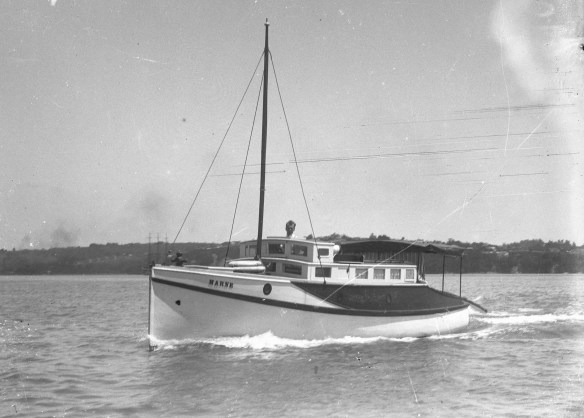
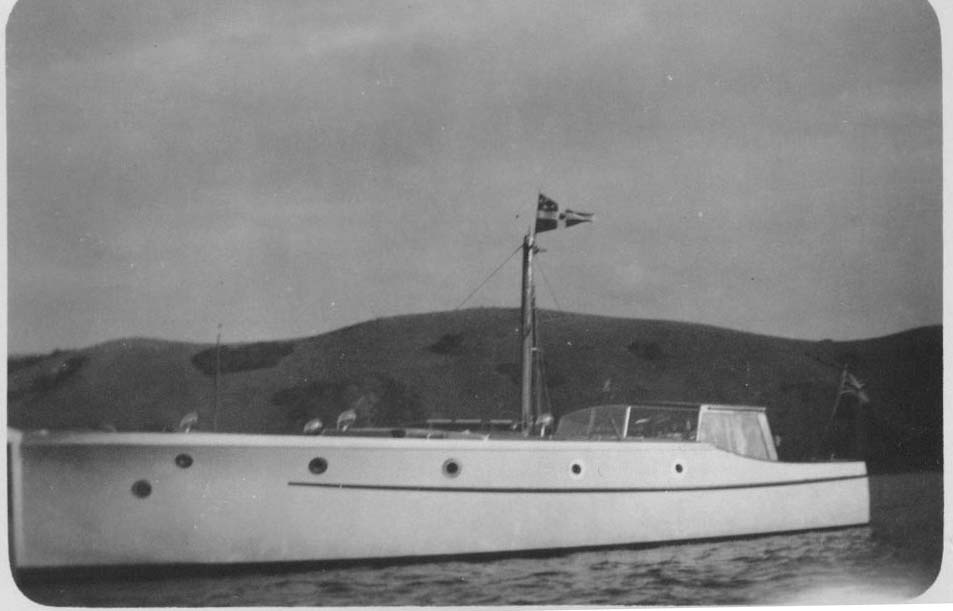
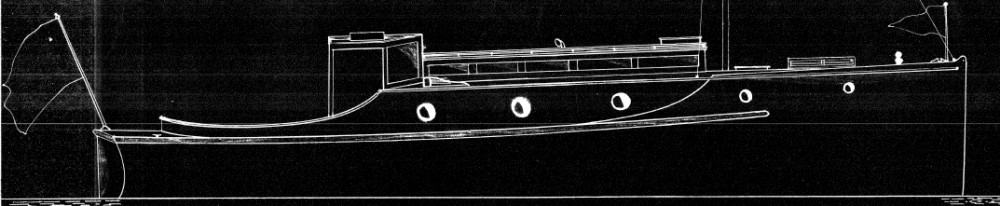
Faced with the design of a fast cruiser, only 32ft loa by 8ft 6in beam, and the desire for headroom in the main cabin, he came up with his second motorboat called FLEETWING (by now a brand for him). She was an extension of the ideas in the 1915 ADELAIDE.
I think, with this second FLEETWING, Collings’ first training as a civil engineer shows through more than his secondary training with Robert Logan Sr. as a shipwright. To obtain headroom he carried the tramtop/clerestory concept to the point IMHO of ugliness, using the parameters of the railway carriage, the electric tram and the motor bus of the time, abandoning completely the parameters of the yacht, even a token attention to which had kept launches aesthetically pleasing until now.
Anyway, see what you think of this image of the second FLEETWING which I have taken from one of Collings’ own glass plates, very decayed, but an amazing insight into the goings on in St Mary’s Bay in late 1920. Collings & Bell’s yard is out of picture to the left, so we see the yards of Dick Lang and Leon Warne close up.
This launch was on TradeMe at Picton recently, erroneously called MISS FLEETWING.

Update: Charles Collings was a very good amateur photographer with excellent gear. After his death in 1946 his glass plates got scattered around in the workshop, many were used for skipping across the Bay, most were smashed one way or another. A very few survived, most cracked or with their emulsion badly decayed. I have a handful more of which a couple are excellent and the definitive shots of his 26ft mullet boat CORONA after her launching in 1936.

PS Leon Warne took over the shed on the right in 1916 from Henry Barton who left for the US with his family because of his anti-war convictions (and had a shocking time on the way). Warne had served his time with Collings & Bell. He painted up the shed very nicely as you can see but was building in St.Mary’s Bay only until c1924 when he and his brother set up in Russell, building and chartering game fishing launches.
The Collings and Bell bridgedeckers

MAKURA, KAWHITI, TAMAROA
 
story & photos from Russell Ward + details & photos from Harold Kidd
 
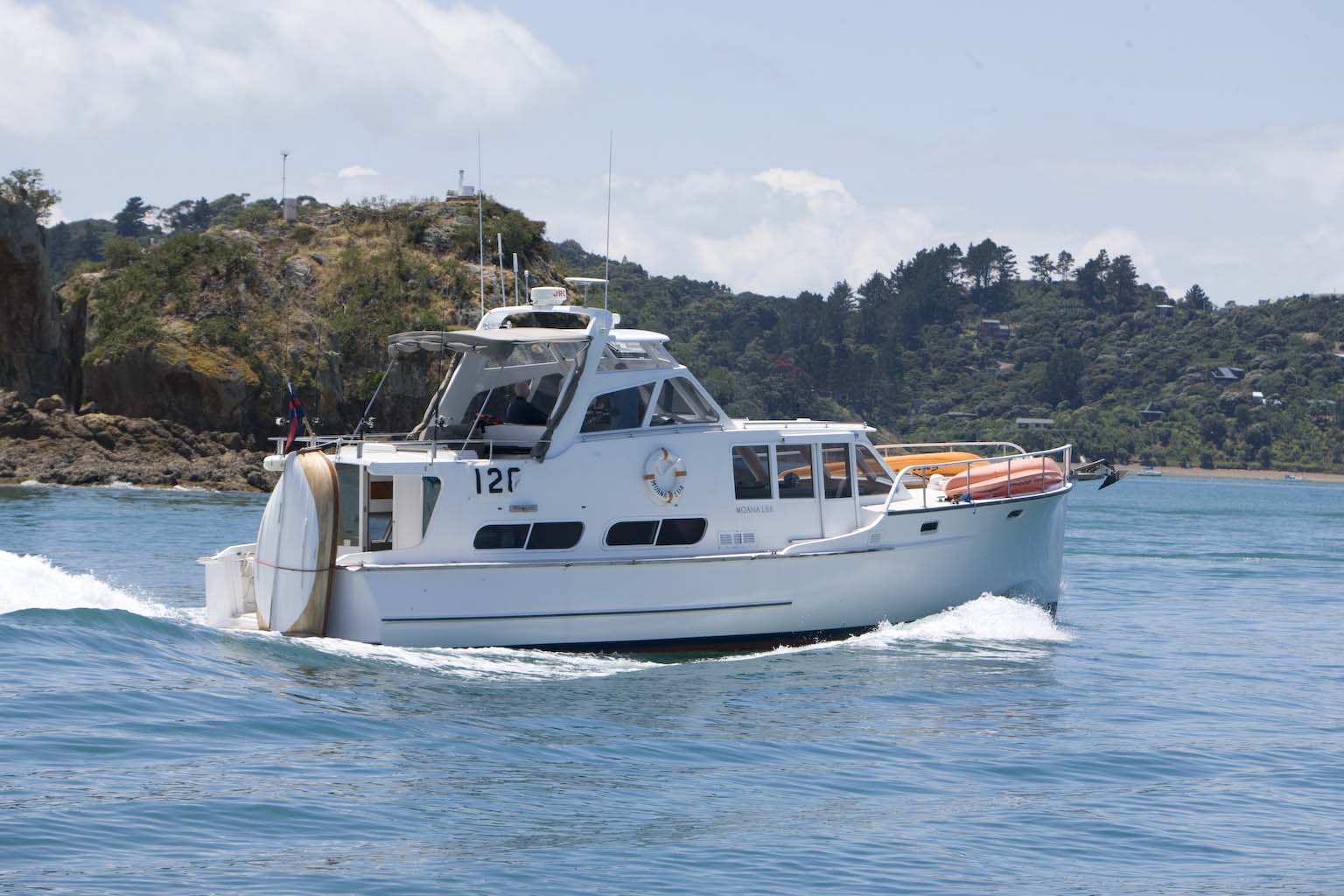
In the early ’50s –1951 or so, Collings and Bell built Makura, Kawhiti & Tamaroa. They were nicely lined and all the angles were right (for a change).
 
MAKURA
She was built in 1949 for W D C  & C H Leighton and fitted with a 6 cylinder Chrysler Crown. They sold her to Phil Seabrook of Seabrook & Fowlds in 1957. He fitted the Nordberg a year or so later. Phil Seabrook had Billy Rogers design and build LADY DIANA for him in 1950 and fitted her with the Austin Skipper from new, replacing it with a 155hp Nordberg sleeve-valve engine in 1956 shortly before he sold LADY DIANA to Monte Winter and bought MAKURA.
 
 
Later owners were V F Adams (1966) and W G Boughtwood (1973). She’s now in Picton.
The photo of Makura I took in ’61. Fine looking ship. Note the four scuttles to stb unlike the recent pix posted of Kawhiti. Ahead of her you can see one of what I think is the Shipbuilders boats that were produced when Roy Steadman was OC. Also shown is a photo of Makura as built from the July 1951 edition of Sea Spray. Very like Tamaroa.
 
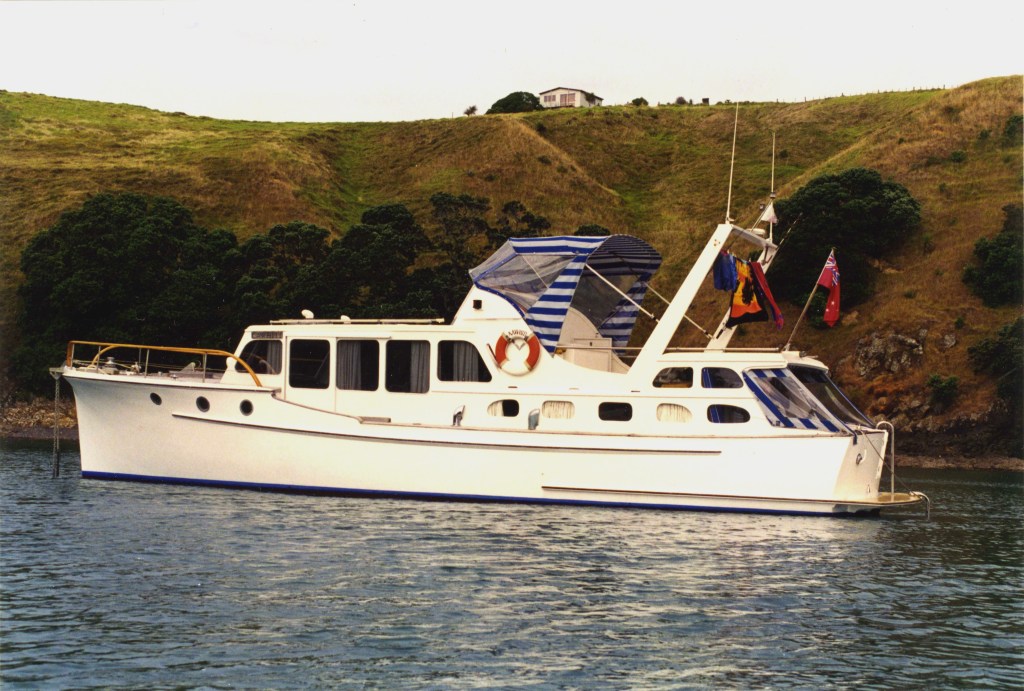
KAWHITI was built in 1952 for D A Wilkie, later owners J M Simpson of Beach Road, Howick (1958). Terry McAvinue owned her from 1968 to 1997 when Harold Kidd took the above colour image of her in Matiatia.
Kawhiti seems to be for sale just now and has a Ford diesel. She has a screen fitted and a flying bridge. The studious will note that the fwd screen is a three piece. The pic of Kawhiti shows her to be a straight front. Also, if I use my imagination, I can read her name.
 
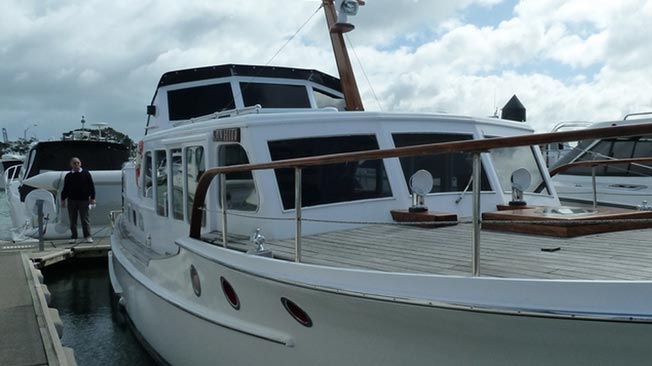
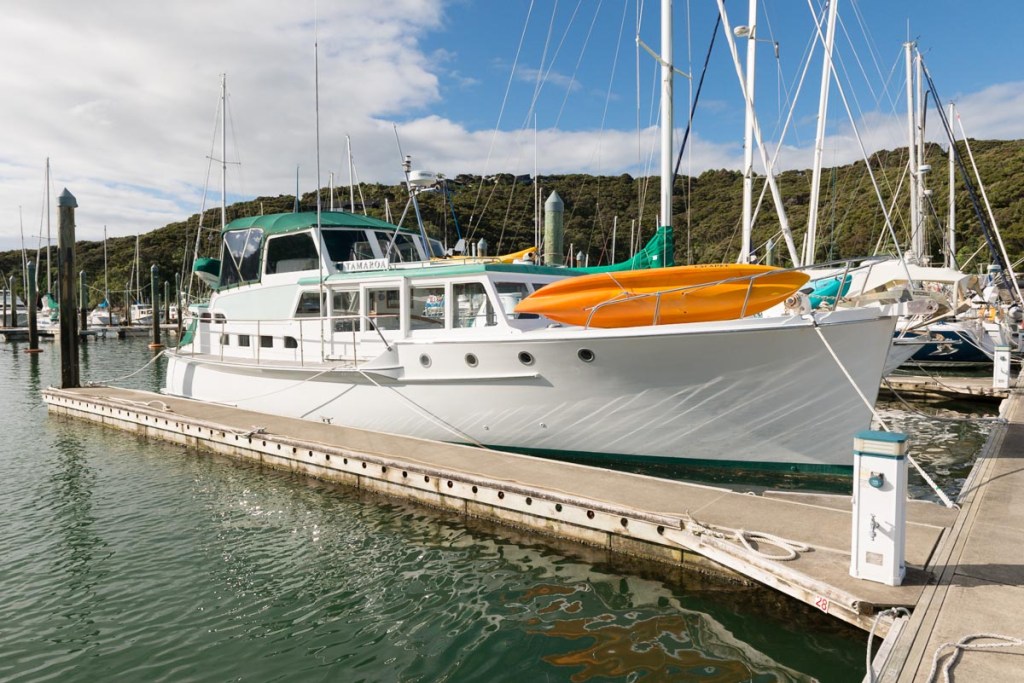
TAMAROA was built in 1953 for A E Fisher of Whangarei with a 100hp Austin. I guess that was the 4 litre truck engine that was so refined in the Austin Sheerline.  She was sold to Dell of Whangarei and came back to Auckland in the late 90s when Harold Kidd took the above colour image in Woody Bay. Eric Stevens bought her in the late 1990’s  and the picture of her in Squadron Bay (?) c.1996 is before he did a major makeover.
 
Makura & Kawhiti differed in the line of the cabin tops:  Kawhiti’s had rather more camber and was sharply brought down to the coaming sides.Kawhiti had a slightly shorter raised deck fwd and has one fewer scuttle than her two sister. It was a bit clumsier than Makura’s IMOH. The picture of Makura behind the 17′ Millie II shows how this scuttle opens into the deck space behind the break in the gunwale and was thus put in purely for style to make them good looking. The guy that designed those three ships (not Alex Collings) had a good aesthetic sense. They were cool!
 
It was an old trick to put that extra scuttle in to give better looks –Lady Karita has the same effect. Her aft scuttle is also sham –it opens into the deck space beside the wheelhouse.
 
In my youth, Kawhiti was painted cream on the tops, Makura blue. Both had bright finished coamings.
 
Harold Kidd Update

It’s sadly true that Alex Collings had little skill in designing superstructures and did not appear to have much of a sense of humour or a sense of aesthetics (nor did his father IMHO). Are these launches too early for Peter Peel? Dave Jackson will know.

HK Update 2:

Dave Jackson was unimpressed with my slur on Alex Collings’ sense of aesthetics. Dave worked on TAMAROA and was familiar with all three of these Collings & Bell bridgedeckers. He categorically states that they are 100% Alex Collings’ designs. Peter Peel may have done some drafting work but had no hand in their design. Dave also worked on the 1957 43ft flushdecker MATIRA for N S Hopwood, again 100% Alex Collings.


St Marys Bay Auckland

Image

This slideshow requires JavaScript.

A view of St Marys Bay with the wharf (left), several boats and boatsheds, premises of Collings and Bell, boatbuilders in St Marys Bay Road (left) and residences in Ponsonby overlooking the bay. An interesting collection of photos, same area but taken at different times. The ‘aerial’ one of all the boats stowed in the valley is fun – last boat out is the first one in for the summer.

Input from Harold Kidd (to photo A)

At the end of the wharf is the Ponsonby Cruising Club’s premises before the second storey and balcony was added. Collings & Bell’s original shed is directly behind. To the left of the PCC is the small building in which various things happened like Collings had his test tank, George Murphy lived when he was fishing with ETHEL which tied up alongside the jetty, and Des Donovan did some clinker work post WW2 with Fred Steele as “20th Century Boats”. I may have conflated some of these functions.
To the right of C&B’s slipway is the shed of Peter A. Smith, the engineer who was agent for Alpha marine engines (Danish-made I think) and who commissioned many launches from people like Dick Lang and Tom Le Huquet for customers fitting Alphas. He also traded in boats. Next right is the yard of Peter Barton who did repairs and hired out small boats, later joined by his son Phil, a true gentleman. Dick Lang and later Sam Ford were here and I think used Smith’s premises. I was born in London Street, just out of frame to the left (not terribly much after this image!) by which time the PCC was fully built up and C&B had built a large half-round shed at the back.
It really was the centre of the known universe.

Ruamano

Image

Ruamano

RUAMANO

Another of those very special parts of our history & heritage & part of the group that could perhaps include vessels such as LINDA, LADY GAY, WIRIHANA, RAIONA, etc., She was built for the Court family of John Courts Ltd major department store owners in Queen St Auck, in the late 1920 or early 1930s. was 46 ft long, & was sadly lost at sea, off the West Coast post 2000, by the owners of the day, who abandoned her at sea during a circumnavigation attempt around NZ, which she had previously completed once before, in her earlier days,. They left, in inappropriate conditions, struck high seas off the West Coast of the North Island, were taken off by a merchant vessel in the area, & they abandoned her with the engine running, & left her to founder ( she was seen a few days later by another merchant vessel still with the engine idling) — very sad ending for a very beautiful lady.

When built she had 2 Redwing Petrol engines which were replaced about 1947 with a single Graymarine 6-71 diesel, a 2 cycle diesel engine, — virtually a GM Detroit, marinised by Graymarine, which she had until her demise.

During the mid 40s she had her original dodger replaced with the beautiful stainless steel dodger which she has in the pic, which must have cost a fortune, but suited her very well. I only ever saw her once with her original dodger & have known her since 1946. I took the pic in Matiatia in 1949 She belonged to Jim Luke of the Claude Neon Lights Ltd family, of Glendowie whom I knew, in the later 40s & 50s.

Story & photo supplied by Ken Ricketts

NOTE: In a later posting of waitmatawoodys I will expand on the ill fated circumnavigation story. alan h

Jane

Image

Jane

JANE

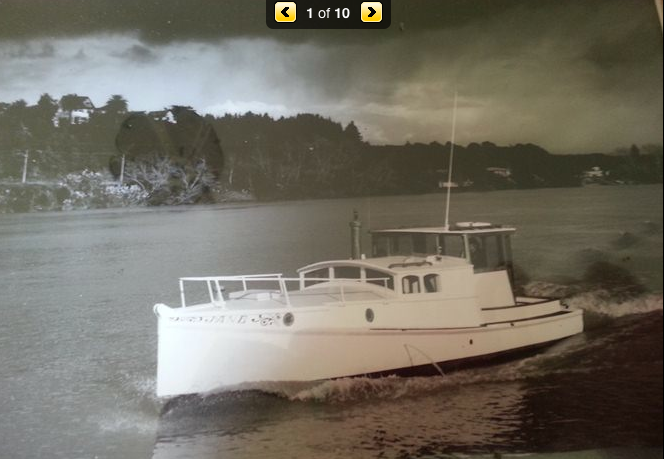
Built by Collings & Bell 1913. Hull shaped similar to the old whale chasers so she cuts a fine track thru the water. Any more details would be appreciated.

Currently for sale on trademe
http://www.trademe.co.nz/motors/boats-marine/motorboats/auction-581375297.htm

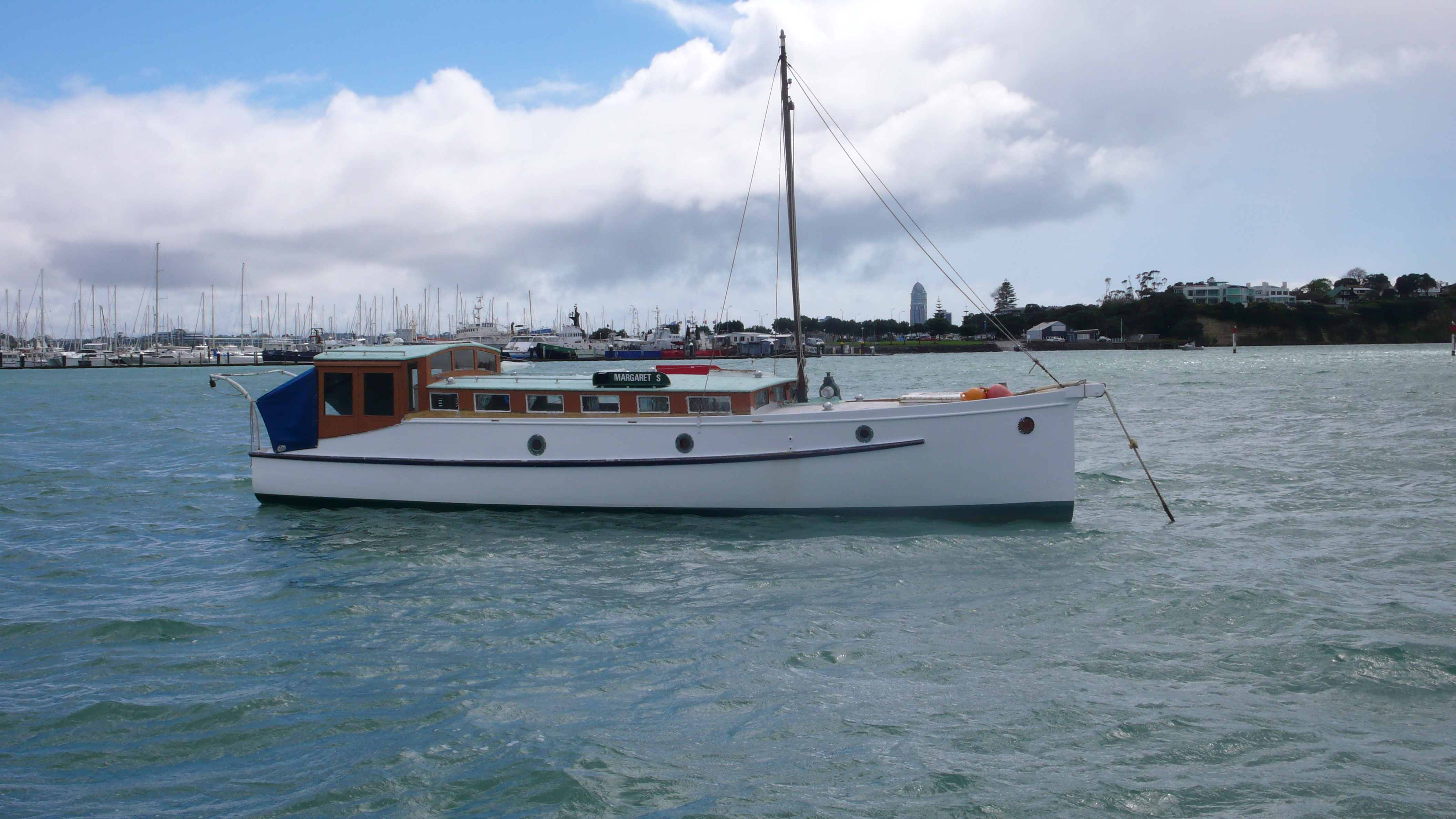
Margaret S

Image

Margaret S

P1110259

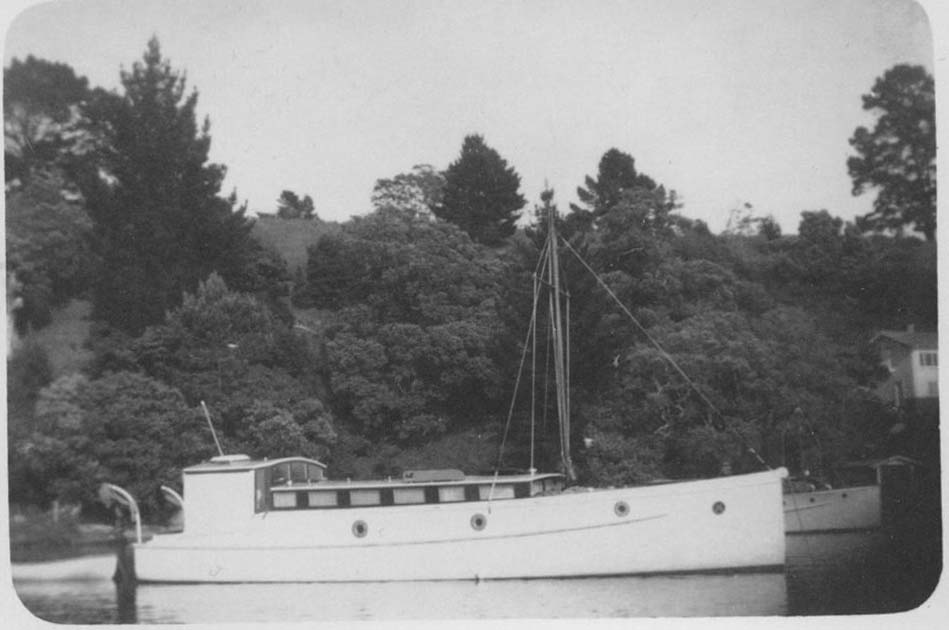
Margaret S was built as MARNE around 1918-9 by Collings & Bell for J. Goodwill who had owned Lizard before. She had a Fay & Bowen Reliable 40 marine engine for many years during her ownership by W J Parker who installed it in 1923. Guy Tattersfield owned her in 1932 but she appears to have had her name changed to Margaret S when bought by panelbeater Alex Stewart of Prospect Tce Mt Eden around 1938. The Johnson family bought her in 1967 and she still had the Fay & Bowen then. They must have been good engines. Coquette had one installed at the same time as Marne/Margaret S.
Ken Ricketts took the old photo in Schoolhouse Bay Kawau Island Christmas 1948 when owned by Alec Stewart
Recently she sank at her motoring in Bayswater & was resuscitated by her owner – new photo by Alan Houghton