Beautiful Waiheke – 1930’s Boating Movie with updated story

Beautiful Waiheke – 1930’s Boating Movie

I was sent this movie, filmed in late1929/30’s by the Lambourne brothers (Allan & Alex) nearly 2-1/2 years ago by Roger Guthrie, it was back in the very early days of ww & since then a lot more people have checked onto the site – in fact over 100,000 people. On ww last week I bumped into Peter Stein whose father (also Peter) appeared in the movie. Peter has written a very cool synopsis of the movie & the (now) classic launches that appear in the movie. I suggest you read Peters words & then watch the movie. Enjoy 🙂

The film “Beautiful Waiheke” by Peter Stein

Introduction:

The film was produced by the Lambourne brothers Allan & Alex in the late 1920’s early 1930’s. The Lambournes owned a large furniture shop on the corner of Ponsonby Road and Pompallier Terrace. The Arran Bay house was built in 1910 and remained Lambourne property until 1964 when it was sold to the Jorgensen Family.

Water transport for the Lambournes was the launch “Nga Whare” which is the round bilged craft in the film with the two portholes in her topsides. She was sold when I was a very young boy so I remember little about her.

Our property is next door to the Lambournes. Arran House was built circa 1885 for Andrew and Mary Croll from the Isle of Arran, Scotland. They were two of Waiheke’s pioneers. Andrew was a very fine photographer and albums of his photos can be seen at the Waiheke Historical Society Museum on Onetangi Road. Among the photos are scenes of the Annual Regatta organised by Andrew and held at Arran Bay circa the late nineteenth century. These events were well supported by “boaties” of the day. The albums were kindly donated by the Crolls of Sydney. Mary Croll was a very good artist and she put many scenes of the “bottom end” on canvas. Some of her mural work is still on the walls of one of the bedrooms in Arran House. My father, P.A.S. Stein purchased Arran House from W.J. Connell (owner of Connell’s Bay Store) in 1924 and it has been in our family ever since.

The Waitangi, the launch with mast and crosstree in the film was built in 1923 for Mr Cadman. It was a classic John L. Hacker design with sharp entry and flat stern section. The original owner named her “Karamana”. She had an aeroplane engine in her and we understand she was capable of 25knots which made her one of the fastest launches on the Waitemata at that time. Harold Kidd has a very good photo of her racing on the harbour (added below. AH). In the latter 1920s she ended up on the Tamaki Drive breakwater. My father bought the severely damaged hull and had her restored by Chas Bailey & Sons. He renamed her the “Waitangi” after his father’s steamer the TSS Waitangi of the Northern Steamship Co. My grandfather Peter Anton Stein was a Captain of various Northern Steamship Co. vessels from 1895 to 1908. Chas Bailey told my father that the Waitangi had brought them good luck because the next launch off their slipway was the legendary “Shenandoah”.

The Waitangi was 28 feet long (8.5m), had a beam of 7 foot 3inches (2.2m) and draft of 2 foot 8 inches (.8m). She was built in kauri and the bottom was double skinned from the bow to the wheelhouse.  The rest of the vessel was single skinned. Her Auckland mooring was in St Mary’s Bay in front of the Ponsonby Cruising Club at the bottom of St Mary’s Road. Maintenance was carried out at Collings and Bell Boat Builders adjacent to the PCC.

About 1930 my father replaced the old Studebaker engine with a 105hp Kermath marine engine. Allely Bros. of Beaumont Street imported the motor and installed it.  It was known as a 6 cylinder flat top. The pistons had a bore of 4” (100mm) and each cylinder had two spark plugs. It was double ignition with one spark plug connected to the magneto and the other one the distributor. Maximum speed was 18kns and at this speed the motor burnt 8 gallons of petrol per hour.   Petrol was bought in 4 gallon cans and there were two cans to a box. We still have an old Atlantic box which we use as a vegetable bin at Arran House. Petrol in the early 30s was 1 shilling and six pence a gallon. A 50% rebate brought the price back to a respectable 9 pence a gallon. My father told me that the best run home he achieved was Connell’s Point to Kings Wharf in 1 hour and 12 minutes.


The film:

The film began with shots of the Guthrie family aboard their launch “Alcestis”. It then moved to shots of Arran Bay taken from different location around the Bay. The people setting out down the path are coming from the Lambourne’s house.

The aquaplaning sequence was filmed from the shore and the “Nga Whare” which was the tow boat. My father was the young man with one of the Lambourne girls on his shoulders. Years later I learnt to aquaplane on the same board.

The “Waitangi” then heads to Bulls Bay with my father as pilot. The majority of the film is shot at Bulls Bay (Anita Bay) on the north eastern end of Waiheke. At the northern end of the bay are many small rocky islands and the launches are filmed going through the channels between the rocks. These are not hard to navigate but should be done at ½ tide or more.

The “Coughing Caves” are in the southern point of Bulls Bay. With a northerly swell and incoming tide, waves enter the caves and when the top reaches the ceiling of the cave the air behind it is compressed until it bursts out in a cloud of spray. The boy in the dingy, Reg Crawford, is trying to get as close as he safely can to the emerging spray.

The “Whirl Pool” is in the long reef extending from the northern end of Bulls Bay. Riding the swell in and out of the pool could be quite exciting as seen in the film.

The homeward bound shots of the Waitangi in the storm were taken in the channel between Pakatoa and Waiheke.

Harold Kidd Input from previous ww post

Waitangi was built as KARAMANA for F.B. Cadman in 1923 by Bailey & Lowe to a design by Hacker. KARAMANA = CADMAN in pig maori.
She was later bought by Auckland Grammar School teacher P A S Stein and rebuilt as per the 2nd photo below. She was fitted with a war surplus 6 cyl Green sohc aero engine producing 120-140bhp, bore 5.5 ins, stroke 6 ins (you work out the capacity). She was pretty radical.

03-09-2015– comments

1. The Lambourne launch was called NGAWAI I think, not NGA WHARE. She was later bought by the Andrews family on the Hokianga. I remember her as a child during WW2 laid up in a shed with a Chrysler engine. Maybe another NGAWAI but she looks the same.
2. KARAMANA/WAITANGI was built by Bailey & Lowe in 1923, not by Chas. Bailey Jr who built SHENANDOAH in 1929. There’s some conflation there.

Curlew

CURLEW
photos ex Thomas Gross, details ex Harold Kidd

Curlew was built by Bailey & Lowe at Auckland for Percy Dufaur and launched in February 1912. Percy Dufaur was a law clerk working for the legal firm Dufaur Fawcett (now Cairns Slane). He owned many yachts in his time but was very fond of the concept of a small, seaworthy cruising boat.
Curlew had a 4hp Auckland-built Kapai auxiliary from new and was a centre boarder. Dufaur sold her to W. Abbott in 1914 and he sold her to H E Chamberlin of Ponui Island in 1918.
In 1919 A T Jamieson of Northcote bought her. He had admired Curlew and had had Bailey & Lowe build him a very similar yacht called Kereru in 1916 although she was a keel yacht. Jamieson kept her for 2 years, selling her to George Lepper of Northcote who used her to transport NZ Herald newspapers to Northcote for distribution every morning, 6 days a week.
W. Keen owned her in 1946 and D J Best 1946 to 1951 when boat builder Dave Jackson bought her (hopefully Dave J can tell us more about her recent history).
K Darrach owned her in 1973 and Bert Knight of Ngunguru owned her in 1989.
From 1946 her registration number was O15.

These days Curlew is owned by Thomas Gross & moored at Bucklands Beach.

ADVICE NEEDED 🙂
Thomas has a question for the woody boaters out there – he is after some guidance on how to re-build Curlew’s rudder that broke in 2 pieces. He has the pieces stored on the boat to bring home and use as form for the new one, but was wondering where to start, e.g. he has read that he should use different sheets of plywood and put them in different directions etc, but was wondering if the ww followers know of more information on this or what other options to rebuild the rudder.

Update – 19-09-2015

Whangateau Traditional Boay yard have been helping Thomas with the repairs – Pam’s words “Lots of good wood still so George decided to make some simple repairs.
New rods with thread and nut to draw it all up tight again”

And for the yachties – todays bonus is a link to Day 4 + Ladies Race photos from the British Classic Week. Enjoy

Day 4, Race 5 & Ladies Race at British Classic Week

Royal Irish

ROYAL IRISH
photo & details ex Harold Kidd

Royal Irish was built by Bailey & Lowe in August 1913 for H.C. Williamson of Cape Runaway and named after a currently popular racehorse.
She is a 32 footer, originally powered by a 4 cylinder 18-35hp Sterling marine engine. She broke away from her moorings in the winter of 1914 and was shipped by scow back to Bailey & Lowe in Auckland for extensive repairs.
Royal Irish remained on the Bay of Plenty coast for many years. Joe Addison of Waimana owned her during the 1940s when she had a 3 cylinder Ailsa Craig diesel. In 1941 she broke down off the Raurimu Islands. Addison sent off a carrier pigeon with the details. The Whakatane pilot boat ‘Port Whakatane’ went out and towed her in. Addison sold her to Charles Bell of Waimana who replaced the Ailsa Craig with a BMC Commodore.
By 1975 she was owned by Barry Davies of Leigh and she’s been in and around Leigh ever since. In fact still fishing out of Leigh today.
Tough old bird!

Tamati


TAMATI
photo ex Bob W.

The above photo was found at the Waiuku museum the other day and there was no supporting information on the vessel. Can someone throw some light on her for us. Given the ladder on the deck, it safe to assume this was a lake photo.

Update from Paul Drake (mans a legend)

This is a great photo. This is TAMATI at Lake Taupo. Built by Bailey and Lowe (I have seen her builders plate), she still exists under the same name but otherwise unrecognizable at Paeroa. She is a side-wheeler, having been converted at Hari Hari (west coast of the South Island) some years ago. She operated commercially on Lake Ianthe. Prior to this, she languished for many years on a front lawn in Paraparaumu. And prior to this, she was a private launch on Paremata Harbour, north of Wellington. At Taupo in the 1930’s, she operated commercially in tandem with  Bailey and Lowe’s TAINUI (destroyed by fire in 1937), servicing a fishing lodge based in Boat Harbour (Western Bay). This fishing lodge was the former steamer TONGARIRO (Bailey and Lowe 1899), which ran a service between Tokaanu and Taupo until 1924. Following her years as a commercial launch at Taupo, and after WW2,  TAMATI was altered by local boat builder Jack Taylor, who raised her bow and constructed a new (plywood) cabin, which eventually rotted off.  TAMATI operated as a private launch owned by the Butler family. Said to be 28 feet LOA.

Photo below showing TAMATI in Boat Harbour, with the fishing lodge (ex TONGARIRO) in the background, and the Collings and Bell PIRI PONO (now at the Auckland Maritime museum) in the fore ground.


More photos ex Paul Drake


Photos below ex Heather Reeve, friends of current owners Colin & Gloria James


23-01-2018 Input from Clive Field

This is from an email back to Blighty in 2001 — Clive & Jill Field — Two Brits enjoying Aotearoa
For the first time in five weeks, we were on schedule! I should explain that until now we have not been running to any fixed schedule at all.
All was going well when we passed a sign that said Lake Ianthe Historic Paddle Boat trips.
We threaded our way along the jungle edged highway that separates the sea from the mountains to our left. What a mixture of sights sounds and smells to absorb? Then Lake Ianthe came into view.

Modestly advertised with just one well-written roadside tent sign we found the Paddle Vessel Tamati, (Maori for Thomas?) The newly painted vessel is the pride and joy of a former sawmill owner who has ventured out from a business with diminishing returns to capture the tourist dollar. The boat was indeed a joy to behold. Tamati is a paddle wheel conversion of an aged wooden pleasure boat built originally for the Edwardian tourists who thronged to Lake Taupo on the North Island.

David, the saw miller, told us it was built of Kauri planking, which had meant it survived many years afloat, and many more ‘upside down on a bloke’s lawn in Wellington.’ “I bought it and stuck the top on and fitted the paddles… did it all from scratch. I found some stuff on a Scottish Paddle steamer Lady of the Loch on the Internet. It was all trial and error really except luckily we didn’t seem to make any errors. We dropped it in the lake at Christmas and she just floated and went beautifully.”

David’s description of ‘sticking the top on and fitting the paddles’ is the classic understatement of a person with energy, vision and skill. It is yet further evidence of the oft-quoted ‘Kiwi Ingenuity’.
The hull has long sweeping lines. The cabin follows the classic bow fronted paddle steamer wheelhouse. The framing is in a soft salmon pink indigenous wood I think he called Ramaiti. The paddles are ‘feathered’ which means they are cranked in order that they enter the water vertically thereby immediately gaining the maximum grip on the water. Interestingly enough the paddle guards over the paddles are heavy duty clear Perspex. “Why the Perspex covers?” I asked. “Just because I reckon those wheels are beautiful and I wanted to see them going round and round” he smiled.

He was right they were beautiful pieces of engineering in wood, steel and aluminium. We discussed engines and he opened a cupboard beneath the cooker hob and there was a little Japanese diesel powering an hydraulic drive to each paddle.
We helped ourselves to tea and coffee and enjoyed the 45-minute trip around a lake formed by glacial action thousands of years ago. Two black swans paddled their serene way across the lake. David made no mention of them until I pointed out their stately progress. “Yeah, all you Brits mention them. They were introduced in Victorian times I think, but to us, they are a bloody pest. Vermin even. They crowd out the natural species and breed like rabbits… or swans really.”

The lake is edged by natural un-husbanded forest. David explained what to look for to identify such tree cover. “It is all affected by earthquakes you see. We get a real shudderer every 250 years – give or take fourteen years. The mountains just shrug off their tree cover and when they re-generate they all end up the same height. It gives a sort of blanket effect.”
(That explains our earlier candlewick bedspread analogy I thought.)

When we came to rest back at the picnic site wharf we chatted about the boat and the tourist business. “It was a bit sobering really because I wanted to finish the boat for the Christmas holidays I got wound up like a spring working it all out and doing the finishing touches. I thought it was just a case of putting up the sign on the road and I would be packed out… but it is slow starting off.”
We agreed that ‘trips every hour’ was a good way of announcing the fact that the boat went however many turned up.
“What else would you suggest we do?” he asked. We talked about websites and then “What about a steam whistle?” I suggested. “You could power it from a small compressor off the engine and that would announce to all those having picnics up in the car park that things were happening.”
In order to emphasise the point, I mentioned Walt Disney’s first ever cartoon ‘Steam Boat Willie’ starring Mr Michael Mouse.
David’s eyes lit up. “That’s it! He said, “That’s it! Look here, the marine-licensing people said I had to have a horn and I bought these.” He produced a pair of boy racer type twin air horns from under a bench. They were still in the shrink wrap packaging.
“I just haven’t had the heart to fit them, but look, I could use the air pump and get a brass whistle made up.”
We left David to his next passengers and decided that even more ‘Kiwi Ingenuity’ would be applied to the PV Tamati ‘ere long. (He later emailed us with the success story of his compressed air brass whistle)


Romance II

ROMANCE II

As I said on yesterdays post one of the highlights for me personally of attending the 2015 Mahurangi Regatta was getting to see Pauline & Harold Kidd’s 1919 Bailey & Lowe launch Romance II post her restoration under the hands of Marco Scuderi. If you asked Marco he would tell you that Harold was VERY clear in the project brief, in fact I would suspect there has not been a launch that has been so thoroughly researched & documented 😉 The brains trust of classic wooden boats were all over this project, Harold even had Robert Brooke swinging the caulking mallet.
There are still a few projects to be completed but visually the team have nailed it.
Unfortunately I did not manage to get a photo of her at speed, she was just to quick for Raindance. She did look very smart leaving the harbour on Sunday morning at ‘full chat’ (a HDK term).

Harold Update

We took about half a ton of modern excrescences out of her, sink bench, stove/oven and that huge hideous dodger, leaving only coms, stereo, deep freeze and head. Marco repositioned the Morse control so that we can now get full revs (probably 3500) out of the lusty Moon Engines-set up Hino diesel.
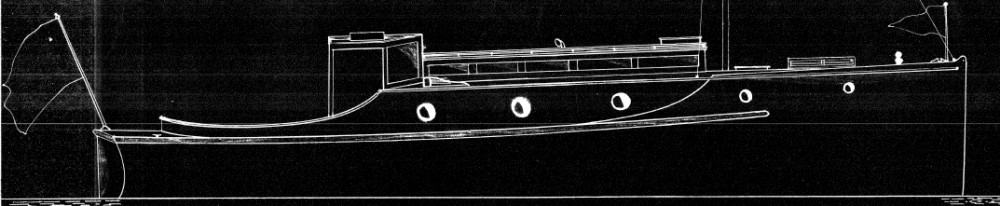
Walter Bailey designed her for 17 knots with a 100/150hp Sterling so she has the lines but is much lighter without the Yankee benzine-gobbler.
She now gets up on what passes for a plane earlier than before but we carried out no full power trials and didn’t get anywhere near “full chat” at Mahurangi, just hurried along to catch up with and photograph the lovely JESSIE LOGAN and WAIRIKI heading home on Sunday morning. I reckon she’ll nudge 20 knots when we summon up the courage.
On the other hand, she handled the nasty easterly jobble coming home from Bon Accord early on Monday morning well, ticking over at 1200 rpm and making 8 knots (plus flood tide).
When the Navy did a survey of launches available for patrol purposes in 1927 she had a 100hp Stearns, the “hot” engine of the time. The comment was “good seaboat”. We confirm that.
The Mills family of Devonport, who commissioned her from Bailey & Lowe in 1919, lived in Huia Street where I lived for many years, so there are multiple resonances for us.

ROMANCE II – WoW

This slideshow requires JavaScript.

ROMANCE II – WoW

Just received a photo of R2 on the trailer just prior to re-launching yesterday at Gulf Harbour. I have to say that Harold & Marco have nailed it in terms of restoring her back to almost the exact original configuration. Take a bow Mr & Mrs Kidd.

You can stop the slide show above to view individual photos in detail 😉


SterlingDolphin2

Mystery Launch + Romance II Relaunch

Mystery Launch

photo ex Peter Louglin ex papers past

Todays photo is from the NZ Herald 09-10-1928, appears to be a very manual process, note the tin of tallow on hand to grease the rails. Who can ID her?

One of the reasons I published this photo is that today a very similar motor boat, Pauline & Harold Kidd’s Bailey & Lowe – Romance II is re-launching after a refit at Marco Scuderi’s yard that has seen R2 returned to very close to her original configuration. Still a few last minute jobs to finish so unfortunately R2 will not be at Patio Bay this weekend. ww will feature R2 when complete.
View a gallery of the refit here http://www.mcnshipwrights.com/romance-ii.html

Joan

JOAN

Now this is what classic boating is all about – nice boat & nice people enjoying themselves in the spring weather 🙂

Joan was designed / built in 1919 by Bailey & Lowe so should get a tick from Mr Kidd. Even though Joan is a CYA vessel, I do not know much about her, so if anyone can shed some light – please do.

Photo taken by Greg Fenwick off Onetangi, Waiheke Island.

Whats the bet there wasn’t x12 life jackets on-board 😦

04-11-2024 Input ex Steven – My Great Grandfather was James Donald and the “Marion D” was named after his wife. I have just inherited his Hardy Bros “Sea Silex” 7″ reel and Tanekaha rod that he used when fishing with Zane Grey along with two photos, one holding the Rod and reel fighting a fish, the other with a swordfish in deep water cove, BOI.
My Great grandfather used to have a wool-mongers in Cox’s bay and would cruise the coast buying sheep from the farmers and then have them barged to Cox’s bay Auckland.
This saved the farmers from having to walk there sheep to Auckland.
Alex was his oldest Son, Trevor was the middle son and Raymond(my grandfather) was the youngest son. He also had a daughter but everyone called her “Girly”. So I am unsure of her name.
From what I was told The Donalds still owned the boat during WW2 as it was commandeered from the family by the Navy during the war.
Great to know she is still around, I had come to a dead end searching the “Marion D”. I will look out for a boat named “Joan”

Romance

ROMANCE
photos & details ex Paul Drake

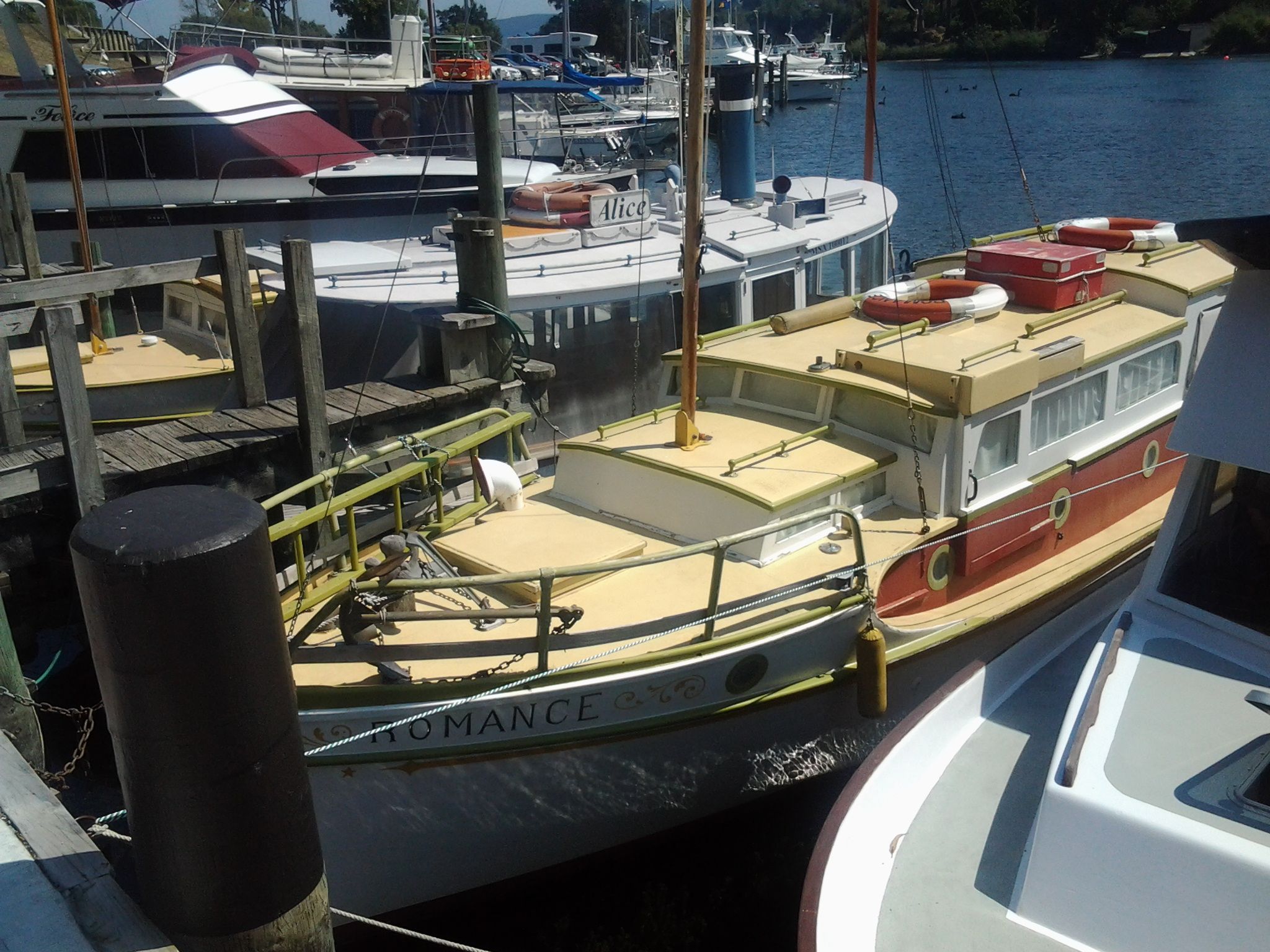
Romance 1 designed & built by Bailey and Lowe in 1914 has just celebrated her 100th birthday. Owner Paul Drake gifted the old girl a new coat of paint & installed an anchor winch – which he told me actually says more about the age of her owners than the age of the boat 🙂

The Drake family have been Romance’s custodians for the last 42 years & she has been kept at Taupo since 1931. She was built for W.C. Mills who replaced her with the larger and faster ROMANCE 2 in 1919, now owned by Pauline Kidd.

Romance had the distinction of appearing on both the front and back covers of The New Zealand Yachtsman magazine of May 19, 1917. See below photos of both covers taken by Paul from an original copy of this magazine he has.

The September 5, 1914 edition of the same magazine included the following: “The launch Romance was hauled up at Queen’s Parade at Devonport on Saturday afternoon last. She is a handsome little craft and is a welcome addition to our fleet of pleasure boats. Last Saturday it was delivered to Mr Mills, a 26 foot tuck stern launch. This boat is of the raised deck type, her engine room being forard and her cabin a roomy compartment aft. The cockpit is spacious and is fitted with the usual seats and lockers. Her motive power consists of a 6 HP 4 cycle engine. She has been named Romance”.

The Drake family saved Romance from the slab sided plywood cabin brigade when they rebuilt the cabin using there own ideas in 1976. They also re ribbed and re floored her, installing a wing motor (an ancient Feltham twin), and a magnificent Chrysler Ace. These engines continue to serve her well.

The above photos show Romance at Waiheke in 1914, as purchased in Taupo in 1972, and as she came off the slip a couple of weeks ago following her 100 year repaint.

More details & photo here https://waitematawoodys.com/2013/05/10/romance/

Ken Rickett photo below – Feb 2014

ROMANCE - TAUPO - FEB 2014


Kumi

KUMI

KUMI

I received an email a few weeks ago from someone that talked about the launch Kumi – problem was it was not from the owner & I had no idea who they were. They did talk as if they had an interest (past / present) in the boat. I even rang Harold Kidd & asked him if he knew of xxxx xxxxxx, the name drew a blank with Harold also.

So I call Kumi’s owner Haydon Afford & ask him if he knows someone called xxxx xxxxxx – the answer “thats me, I get sick of having to spell my name so for years I have used xxxx xxxxxx for the unimportant things in life e.g. ordering a pizza etc. xxxx even has his own email address…….. which is more than Haydon does, no mobile phone either 🙂

Hayden then realizes that on the email to me he did not say it was from him. I have re-printed the email below.

” Dear Alan. Quiet at work so found all these fantastic pictures on your extremely good website . if you wanted to include Kumi in the  Bailey and Lowe  chapter I wouldn’t mind. brief history?  Launched aug 1905 as ‘Eliza’  for Henry Adams as a lorry to take produce to and from his island Moturoa in the bay of islands. Raced in 1908 rudder cup ;failed to win . The annoyed  mr Adams challenged any body [mainly aimed at line honours winner James Reid with Seabird] to a race for 50 guineas to Russel wharf and back . Kumi beat Seabird more by good luck than boat speed , since in the rerun of the rudder cup it was very obvious that Seabird is a faster hull! Adams  had some bank trouble in 1913 and Eliza vanished  never to be seen again , but fortuitously at exactly that moment ‘Kumi’ appeared built by the same builder to the same design and launched on the same date as ‘Eliza’ .whew. She was sold to other people and in 1928 sold to Whangarei harbour board as a pilot boat and used as such till 1955 .She then went to Whangaroa harbour as a crayfish boat for mr Russ and did this till 1975. It was during this time  that an oyster barge made a mistake in berthing, crushing Kumi against the wharf and sinking her in apparently three minutes. In 1975 she went to a  Whangarei back yard till 1985 where she was modernised. Mr pont of Whangarei sold her to mr  Tercel and she came back to Auckland where her modernisation rapidly deteriorated through several owners until 1999 when  the present owners purchased her in spite of the surveyors comment of “not even any use as firewood, too rotten and wet”. The Affords took her back to their place and rebuilt her to close to 1905ish ; which was lucky because she ended up the same as her launching day photo in the maritime museum which Harold Kidd told us about after  her relaunch. Kumi has had several engines but mr Pont in Whangarei installed a 1963   six cylinder Ford  rated at 80 horse power  and this engine still gives perfect service .Kumi is a fun boat, fast enough [if not a line honours winner] but sea kindly and comfortable and ready for the next 100 years.”

A little more about Kumi – in the summer of 2012/13 Kumi completed a circumnavigation of New Zealand, I have covered this previously on ww but if you missed it, click the link below to read Haydon’s tale. Post the trip Haydon gave a talk to CYA members at the RNZYS, it was one of most entertaining evening I have been to. Haydon & Kumi’s vovage was acknowledged in 2013 with the presentation to Haydon of the ‘CYA Outstanding Achievement Award In Seamanship’ (photo above)

The story of Haydon Afford’s 3 month circumnavigation aboard Kumi his 1905 Bailey & Lowe launch

Recognition – Kumi also features in the CYA Classic Register 2014-15 edition – the link below takes you to the section.

http://classicyacht.org.nz/demosite/wp-content/uploads/Classicreg2014/flipbook.html#p=26