
Mystery Launch 19/09/2014
photo ex Dave Jackson via Adrienne
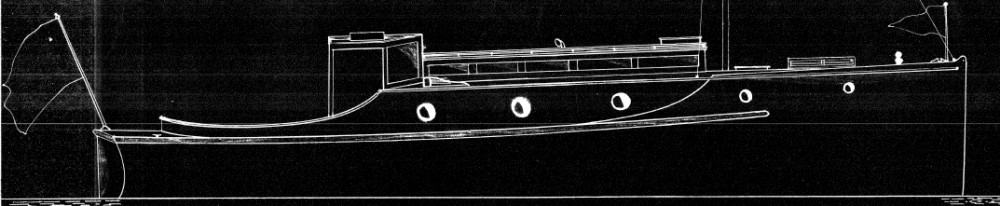
All I can tell you about the above launch / motor-sailer is that she is a Brin Wilson sedan. Now there can’t have been many sedans around with a stick, so lets see what we can uncover.

Mystery Launch 19/09/2014
photo ex Dave Jackson via Adrienne
All I can tell you about the above launch / motor-sailer is that she is a Brin Wilson sedan. Now there can’t have been many sedans around with a stick, so lets see what we can uncover.

Things I Miss
I was trolling the internet the other night & discovered that after 400 years (yes 400, its not a typo) the London yacht chandler – Arthur Beale Ltd now has a website, a bit lacking in features but I’m sure it will improve. http://www.arthurbeale.co.uk/
What did hit me was a photo of their shop window (above) & it reminded me of those wonderful windows that used to grace the front of our own Fosters in the city. Now the window contents might not have changed that often but I always looked & when I was a young lad working in the CBD it was a lunch time haunt. Then later when traveling overseas on business I used to hunt out the local yacht chandler outlets & I never found one that came close to Fosters for that total ‘salty’ offering. The crap I bought & in those days I didn’t even own a boat 🙂
I organised a few CYA evenings at Fosters (photos below) which included a guided tour of the building & stock rooms – totally amazing & so glad we did it as thats now gone. But time moves on & the new Westhaven store still stocks the same ‘stuff’.


A personal tale from Merv Stockley. pp: Don Ross on Don’s memories of Fosters. (added 21/09/2014
`Things I Miss’ really struck a cord with Don when you posted it the other day. He remembers Fosters from back in his youth and early yachting days. Don did his Trade at Stewart and Longbottom as a coppersmith and as the `boy’ was a regular at Fosters picking up supplies for
the tradesmen he worked with. Don relates what a wonderful place Fosters was in those days. Depending what you were after you could be taken upstairs to search for it or down into the basement. At that time Don owned a small keeler named `Elvine’ which he sailed around the Gulf. He particularly remembered the pre-WW2 foreman at Fosters, Hector Porter. Don remembers how good Hector was to him whenever he personally needed some fitting for his marine exploits. Unfortunately Hector went off to the War and never came back.
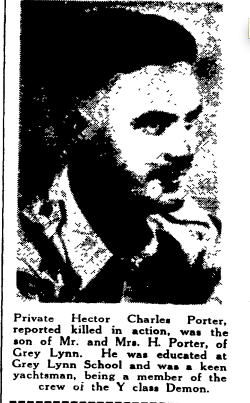
Your post got Don digging around in his special old memories collection and he came up with an Auckland Star newspaper cutting from the 8th August 1942 which announced Hector had been `killed in action’.
I searched in papers past and found this page of the paper.
Auckland Star, Volume LXXIII, Issue 186, 8 August 1942, Page 6.
Thanks to Woodies for your references to paper past. I have learned to search there.
Hopefully Don’s memories are of interest to some of you members. Maybe this should be added to the post `Whats Happening at Fosters’ too.
Thanks again Alan for your forum. It gives Don something new to think about each day as he remembers many of the boats you post.
Merv Stockley. pp: Don Ross.

WENNA
With ww I try to plan the posts a few days in advance, well yesterday Harold Kidd turned my schedule upside down when he sent in the above photo of Wenna. Earlier this week,
Harold was the recipient (on loan) of a photo album from Margaret Field of the O’Neill* family. One of the photos was the stunning one of Wenna above.
Wenna was recently purchased as Rangitira & renovated by Pam Gundy at the Whangateau Traditional Boat Yard (launch day photo below)
*Eric O’Neill arrived in NZ with his family just after WW1 and lived in Ring Terrace, just above St. Mary’s Bay & Wenna was built for him around 1925. Given his residence, most likely by a St. Mary’s Bay builder, the options being Collings & Bell, Leon Warne, Dick Lang (or Sam Ford who took over Lang’s yard in 1923 and used Ford’s moulds until 1924 when Lang returned).
Now two days ago I was sent a photo of Marua (below), by Dave Jackson via Adrienne, Dave’s father, (David Jackson Snr) was one of the owners of the Marua c.1955-56. Dave commented that Marua & Wenna were very similar in design, with Marua being built in 1915 for E. McKeown by Peter A. Smith who was an engine supplier and contracted out his hulls to St Mary’s Bay builders. Harold would pick Dick Lang as the builder of Marua’s hull, not Leon Warne who was still with Collings & Bell in 1915. It’s likely that Dick (or Sam Ford possibly) built Wenna too. Marua was a total loss as a result of the fire that destroyed the Baileys yard.
There’s always the possibility that Collings & Bell built both boats but Harold does not think they did much (if any) work for Peter A. Smith as they were more interested in selling their own brands of marine engines where the greater profit margin lay and weren’t short of their own orders.
All of the above aside – both Marua and Wenna are best described as typical St. Mary’s Bay – built launches of the period.
Note – when Pam’s partner George (Emtage) saw Margaret Field’s photo of Wenna, he starting looking for his chainsaw – he liked what Harold described as the slinky look – so do I.
Pam on the other hand is happy with Wennna’s tram-top, which according to Dave Jackson was built by Cyril Freeman of Ponsonby. He was working for Shipbuilders at the time, but this job was a ‘homer’. This was during the late 1940’s maybe even the early 1950’s.
MARUA

WENNA (Rangitira) 2014


07/11/14 – photo of Wenna ex Harld Kidd ex Bob Wiley


Jack Brooke Cruise Collection #2 – Ngatoa 1928- 29
Thanks to Robert Brooke for making these remarkable cruise drawings done by his father, Jack Brooke, available to ww followers. Jack produced a hand drawing on each cruise. Todays post is the second of several – enjoy.
The above drawing records the travels of Ngatoa during what I assume was their annual Christmas / New Year Cruise. They certainly clocked up some miles – with White Island to the South & Great Barrier to the North. From the drawing of White Island it would appear that she was very active at the time.
This one does not list the crew.


NGARO
Ngaro was designed /built in 1952 & launched in 1953 by Roy Lidgard (Lidgard Ship Yard) in Smelting House Bay Kawau Island. She is 14.78m LOA / 3.88m beam & draws 1.4m.. She is a solid old girl with double diagonal 1/2″ kauri & 1″ longitudinal planks & bronze riveted. Powered by twin Ford 120hp Lemman’s that were installed in 1965.
Her ‘newish’ owners returned Ngaro to the water last week at Gulf Harbour after a new coat of paint, top & bottom. They only had good things to say about Mike Vitali & his team at One10 Painters, the finished job looks very sharp.
While a few of us classic owners are a little gun shy of travel lifts, the boys at Gulf Harbour would be one of the best operators around, they used four slings on Ngaro. As further proof of their skill – the Tino Rawa Trust has recently hauled out half its classic fleet at Gulf Harbour.
Now back to Ngaro – The owners would like to know more about her past & view any photos that might be out there. So woodys what do you know?
The b/w photos (below) are the only early (possibly launch day) photos they have.
I have featured Ngaro before on ww – she is rather nice – click the link below to be wow’ed 🙂


Update 24-08-2018 Ngaro out again for some TLC at Gulf Harbour


500,000 VIEWS – A big day on waitematawoodys today – people have viewed waitematawoodys.com 1/2 million times.
In the last 18 months waitematawoodys.com has grown into a wonderful classic wooden boat community. You are all a big part of that with your comments, stories & photos sent in & I would like to thank you all for being helping make ww so special. One of the best buzzes is when we connect the dots between people & boats – ww has put a smile on many a face , young & old & I get very cool feedback & have meet some truly inspiring people. All this makes the time spent pulling together unique stories everyday worthwhile. I hope you have enjoyed the ride & hang-on-in-there for the next 500,000 views. Alan Houghton
Some facts:
Best Day: 4509 views – the Whangateau Traditional Boats Open Day feature. view here https://waitematawoodys.com/2014/05/05/whangateau-traditional-boat-regatta-yard-open-day-part-1/
Worst Day: 4 views – that was Day One & given so many of you missed Day One – I have re-posted the photo of Lady Gay & Waitangi taken by myself at the 2013 CYA Classic Yacht Regatta, below.
Some Stats:
1st Person to log-on & comment – Chris Leech (Castaway)
2nd – Steve Horsley (Ngatira)
3rd – Rick McCay (Luana)
4th – Baden Pascoe (John Dory)
5th – Russell Ward (Romany)
6th – John Wicks (Sirena)
7th – Colin Pawson (Marinus)
8th – Roger Guthrie
9th – Harold Kidd (Romance II)
10th – Peter Mence (Jenanne)
Most Prolific Followers:
# 1 A visitor from Hawkes Bay
# 2 Harold Kidd (harold531harold)
# 3 Nathan Herbert (Nath)
# 4 Ken Ricketts
# 5 Murray Deeble
# 6 Pam Cundy (whangateautraditionalboats)
# 7 Russell Ward (vintagesteamer)
Whose Reading ww:
Many NZ but there are followers all over the world – see yesterdays viewer countries below –

Why are we doing all this?
Well waitematawoodys.com was founded upon a desire to record the history of our classic wooden boats, the craftsman who built them & characters that owned & crewed on them. Archiving the information on these magnificent craft ensures they remain a part of our maritime history for future generations.
Along the way we hope to empower you to tell us the stories about the classic wooden boats you have rubbed up against in your life & your experiences around them, through photos & words.
Remember – at waitematawoodys, its all about wooden boats.


NEREIDES
Thought I’d drop something with a mast in to keep the sailors happy, saying that Nereides is more of a motor-sailer. Looking very sharp. Photo taken at Opua by Ken Ricketts.

THETIS (II) & Building Motor Boats at The Lane Motor Boat Company
thanks to current owner Paul Harris & indirectly Max Carter for photo & details
Thetis was built by the Lane Motor Boat Company in 1955. In a 2004 note to Chris McMullen, Max Carter describes the ‘process’ i.e. like all LMBC boats they came off a model. A solid 1/2 model was carved, usually 3/4″ to the foot – a convenient scale. All these Lane models were unfortunately most likely destroyed when the Panmure office (Riverview Road) & workshop burnt down.
In terms of design style – Max commented that American magazines like ‘Yachting’, ‘MotorBoat & Rudder were always lying around & inspiration for Thetis may have come from these & past models on display.
It worked like this (Max Carters words) – “a solid half model was built from a block of kauri & once the modeler was satisfied, the profile & deck line were penciled around onto the ‘plan’. After an assured waterline & the mould station intervals had been marked onto the model a saw kerf was made part way into the model. Pieces of stiff thin card were rough cut & inserted into the kerfs – a pencil run a around the section & the centre line, deck line & assumed waterline marked on. The card was then very carefully trimmed to the section outline & the section transferred to the ‘plan’.”
The only people at Lanes (at that time) that could calculate the volume off the ‘plan’ was Dick Hart & Max, they got the sections by triangulation. Max was taught how to do this & other basic calculations by Sandy Sands at Seacraft, were Max had been apprenticed.
The Thetis model was craved by Peter Parsons from a block of kauri during breaks. The ‘brains trust’ would pass comments like – ‘more flare’, ‘less tumble home’ etc & if Peter agreed he would scrape a little off a little with a piece of broken window glass & glass paper. They used to have an old mirror there & they would place the models on it to see the effect of both sides – moving it around to see it from all angles.
At the time Max worked for LMBC the yard consisted of an old tin shed, which was the office, lunch room, toilet & joinery shop all in one. There was no road down to the lower shop set into the riverbank, the only way to get there was by a narrow winding path or by water. Materials had to be slid down the path. Max recalls sliding the Grey Marine engines down the hill, knowing that if they got it wrong & they were damaged they would all be sacked. In 1955 everything was still in short supply & you needed an import licence, the Butlands seemed to have no trouble sourcing Thetis’s engines.
LMBC only had a table saw, a band saw, thicknesser & buzzer. The only portable tools being a disc grinder & a few electric drills. Most holes were drilled by hand. Hulls were built right side up & cleaned off by hand plane, blade scrapper & long board (a long & arduous job).
Thetis was built in the shed but they lofted it on plywood in the Anglican Church hall across the road. Like all Lane boats they built on shadow moulds so they could trim a bit off or pack the moulds.
Thetis was single skin, the rule being 1/32″ per foot for planking so it was probably 1 3/8″ thick. They would hold the planks to the moulds with temporary screws & place the steam bent spotted gum timber inside & drive the fastenings while hot (really hard work).
Launching were always an exciting time because no one knew the weight of the vessel & everyone had an opinion of where the hull would float & trim. Once launched they would measure the free board at the stem, stern & amidships & work out the weight.
Max recalls at the launching there was a big crowd gathered including a lot of ladies from the Navy League, Ray Pateman was to work the winch & the rest of the yard workers were to stay in the background to retrieve the cradle & any wayward blocks floating down the river. All workers were issued with white overalls for the day & given strict instructions on what to do & to behave. The bottle was broken & Thetis duly launched down the ways when Rays white overall got caught in the winch & ripped his clothes off – everyone thought that was a even greater event than the launching.
Note: at this time, the order of seniority at Lanes (Max’s memory) was Peter Parsons – foreman, Ray Pateman – leading hand, Dick Hart, Clarence Thorpe, Russell Philpot, Trevor Ford, Roy Deane, Bill Bailey, Max Carter, apprentices were Jimmy Emptage, Bob Ryan, Gary Linkhorn & Arthur Ellis.
An amusing tale from Max Carter – Lanes used to contract painters who came & went as the job progressed. One day one of the painters was limping & had his forearm in plaster. When questioned on what happened he replied he had been on a scaffold painting the outside of the city morgue when a guy in a white coat lent out of the window & asked “Do you want a hand?” & to his reply “Yes”, passed him a severed hand, with the result he stepped back off the scaffold & fell.
Also attached of interest, sent in by Scott Taylor, son of the broker – Mac Taylor – is the 1964 sale papers when Jack Butland sold Thetis to Dr. Jefcoate Harbutt for 13,350 pounds, a lot of money in those days. In chat with Harold Kidd it appears that on APYMBA records Jack Butland sold the boat to G Robertson, maybe they did not inform the APYMBA of the sale & Harbutt was missed out on the records?
As an aside – the present owner, Paul Harris, knew Dr Harbutt as he flew him & his family to the Harbutt farm at the bottom end of Waiheke in the 1960’s & Paul lived up the road from Mac Taylor in Devonport – its a small world we live in.
I hope I have assembled & retold these ‘tales’ accurately – if not I’m sure someone will pull me up & correct me 🙂

New photos ex Ken Ricketts 15/09/2014


26-04-2018 UPDATE
Ken Ricketts reports that having recently spoken with Thetis’s owner that the 2 in line, 6 cyl, 4-cycle, 120hp Gray Marine engines, installed in 1960 (still there today) are a very rare model & type. They were manufactured during WWII for the American forces & could possibly be the only 2 in NZ. The owner believes her original owner Jack Butland in the later 1950’s probably reconditioned, or war surplus imported them. Ken commented that until now, the only 6 cyl, in line, Gray Marine diesel engines he had heard of, were the 2-cycle, Gray Marine conversion of the 671 Detroit series.
Below are 2 photos of the manufacturers handbook.
Has anyone else ever head of them?


ESME
details & photos from Harold Kidd & Ken Ricketts
Esme was built by Joe Slattery for Henry Allen in 1921. He owned her in the 1920’s>1930’s. The photo above is from the early 1930’s after Allen raised her cabin top and put on a dodger. Hopefully one of the ww followers can ID some of the children on board.
More info here https://waitematawoodys.com/2013/09/29/esme/
Below is a raw photo essay in how our classics were ‘updated’ over a short period (approx. 10yrs). click to enlarge.
As Launched

1st Update

07-04-2017 Photo below ex Ken Ricketts


ROSEMARY II
In Mondays RNZYS post there was talk that the launch in the top right of photo 2 (above but small, click to enlarge) could be Rosemary II the 1946 Shipbuilders Supercraft – sister ship to Lady Eileen, Rakanoa & Mahara.
The great photo above of Rosemary II was sent to me by Nathan Herbert ex the National Library.
Whats says the collective brains trust? For whats its worth, I think not – not enough main cabin windows & no port holes between the aft cabin rectangular windows. I could be wrong, I often am 🙂
Todays post will have Russell Ward salivating 🙂
To read more on Rosemary II & see ‘recent’ photos check out this ww link
Russell Ward input
Arrrgh! I’ll go blind! Styleeee!
Yep Rosemary ll in her prime in this and the upper part of the pic of the aerial view of the trot of boats in Westhaven. Ken, I can see Rakanoa in the window/ports arrangement aft and in a lot of the details. When I used to row past Rosemary in Westhaven in the early-mid ’60s she did not have those fashion pieces aft of the wheelhouse and the brightwork was rather severely dark. She was always there and never opened up, just waiting -Just like Crossley and even less used.
Comparing the earlier pix with my Whangarei series of pictures you can see how much style her original layout had. Those aft fashion pieces just softened the profile of what is really quite a high wheelhouse that looks a bit bluff.
OK here is a thought for you style hounds. Compare Rosie’s styling in this pic with Ranui in her original guise -take that aft shed off her present appearance and voila -some similarity. Never say that the local people were out of touch with the latest trends.
Well, I always jokingly say that I spring out of bed in the early morning and feel rosie all over -if she will let me. Yes, Rosemary ll does it for me and I hope she is alive and well and, I hope, not now fitted with a frying bridge aft.
As the teenage son of the first owner,Noël Manthel I can probably fill in any queries about the Rosemary 11. The maiden cruise was to the Bay of Islands but spent its early years in wellington with some memorable crossing of Cook Straits. The twin American Redwing 90hp petrol motors needed to work hard to get to the cruising speed of 10 knots.Your photo could have been taken in the Marlborough Sounds.regards Neil Manthel

