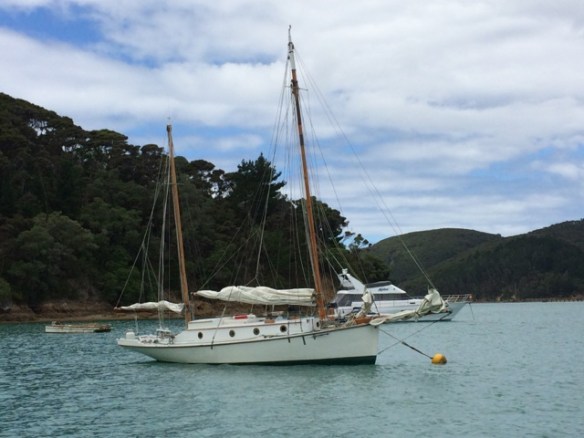
Tuirangi

Image

photo & details ex Ken Ricketts. edited by Alan H

Tuirangi’s original sail number was C35, but changed to F35 when the federation created the new “F” class, she remained F35 until the current system was created.

Built by A. (Bill) Couldrey & originally owned by Jack Allen, son of Henry Allen, (Tiromoana, the 1938 37′ Couldrey designed & built launch). Jack owned her from the late 1930’s until well into the 1970’s (even possibly the early 1980’s). Jack was a fitter & turner by trade, who was trained by Ken’s father, who said Jack was the best apprentice he ever had.

During WWII Jack was called up to join the war effort, in the Airforce, overseas, so Tuirangi along with a number of other yachts & launches, was pulled up on the sand at Judges Bay beach & covered with what was effectually a custom built hull fitting shed, of very strong timber & boarded up for about the next 5 or 6 years & she eventually sailed back on the world again in 1945.

Jack was a very traditional yachtie, of the highest order, adhering to all the best & oldest traditions of yacht racing. He refused for a great many years to even have an auxiliary engine, preferring to “row” the Tuirangi to her anchorage or moorings, when entering a crowded bay, or when there was no wind, (or both), with her dinghy. It was well into the 1950’s before Tuirangi had her first Ford 10 car engine conversion fitted.

When Jack married his wife Doreen, in the mid later 1940s, many thought he would soon replace Tuirangi with a launch & follow in his father Henry’s footsteps (Tiromoana). But no, not even when their children came along, did he falter in his love of sail.

It was only after the children arrived he actually fitted the engine, Ken recalls on many occasions seeing perhaps a dozen or more, pure white “pennants” flying from the stays & halliards in the late 1940’s & 50’s. Jack made one further concession to marriage & children when added the “dog house ” to the rear of the cabin top, to make for more comfortable family cruising.

While Jack passed away a year or 2 ago its hoped that Tuirangi maybe still alive & well – any more info on her past & current whereabouts would be appreciated.

Update from Neil Chalmers

Tuirangi is currently moored at Mahurangi . New photo shows her before Jack Allen fitted the doghouse.

And Neil – also pointed out the correct spelling of Tuirangi (now corrected). I used to think I was a shocker but Mr Ricketts is worse than me 🙂

Harold Kidd Update

Jack Allen had already ordered TUIRANGI from Bill Couldrey when war broke out in September 1939 with the intention that she would be launched before Christmas. However, she wasn’t finished and launched until after March 1940, understandably. Her first race appears to have been the Combined Clubs race to Matiatia in November 1940. Jack raced her consistently in the 4th Division with the Squadron for many years and did well with her.

Arethusa & Winsome

This slideshow requires JavaScript.

The Boats of H Pickmere

photos ex Dean Wright. details by Alan H

Arethusa was used extensively by Hereward Pickmere during WWII when he was employed by the Lands & Survey Dept. to survey Northland’s coastline. Arethusa started off life as a gaff rigged cutter (see b/w photo with a 30’ long boom), she was built in 1917 by Bob Brown at Sulphur Beach, Northcote. Carvel planked kauri – 33′ 4″ with a 11′ 7″ beam.  She was converted to a launch in approx. 1955 after being wrecked & salvaged post a grounding on Farewell Spit on a passage from New Plymouth to Nelson. You can view some wonderful old images of her & the Pickmere family cruises on Dean’s website:

http://deanwright.co.nz/arethusa-log-sub/123-pickmeres-my-arethusa.html

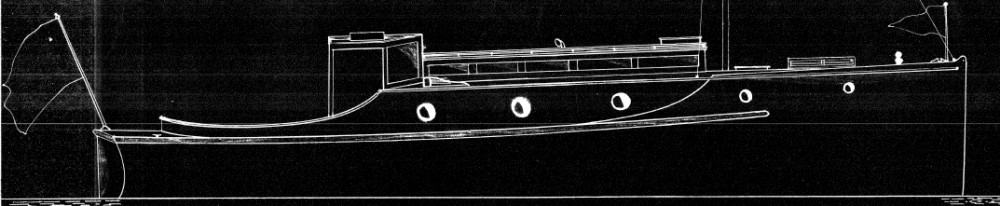
Arethusa was sold in 1943 & the Winsome acquired. She is described as a 34′ flush-decked launch built by Bailey & Lowe (that will please HDK) in 1918 with a draft of 2′ 7″ & had previously been owned by Hereward’s father since 1923.

Both boats still live in the Bay of Islands & you can view further details on Arethusa here: http://deanwright.co.nz/arethusa.html

photos – the 2 colour photos of Arethusa and Winsome together were taken by Dean earlier this year in the Bay. The b/w sketch below of Winsome is ‘borrowed’ from Pickmere’s Atlas of the Northland coast.

IMG_5524_2

Update 25-07-2018 ex Arethusa owner, Dean Wright. The cutting below show Arethusa leaving Auckland on-route to Suva.

37255718_1742165055904098_5453415551638437888_o

37277275_1742165029237434_5501911771134296064_o

A Woody Weekend

Woody Weekend on the Waitemata

The Waitemata Harbour was a pretty magical place this Labour weekend – we had an impressive collection of wooden classics visiting.

The classic 1929 motor yacht Nahlin, owned by industrial designer / inventor James Dyson is currently berthed alongside the CYA’s Heritage Landing. Nahlin has a very impressive history of ownership & was once ‘The Royal Yacht’ – details on her history & restoration at the link below.

http://www.glwatson.com/detail/Nahlin__Classic_Motor_Yacht/527/26.aspx

We also had the ‘Tall Ships’ berthed at Princess Wharf for the long weekend & their arrival & departure was very impressive.

At the other end of the scale the super yacht (ship) ‘A’ was anchored in the middle of the harbour, this boat divides people into to camps – love it or hate it – me I love it. One of the crew skills is the ability to abseil – thats how they clean the windows 🙂

And even my favorite woody made it off the marina for 3 days of spring boating.

Corsair

The Frostbite – Corsair

photos by Alan H 

At the recent Classic Yacht and Launch Exhibition  at the Viaduct, the 2013 event  showcased the acclaimed designers Jack Brooke & Bob Stewart. One of the outstanding boats on display was Paul Baragwanath’s exquisitely restored Frostbite ‘Corsair’, the attention to detail was just amazing, even featuring her original restored 1945 trailer. Corair was built by Jack Brooke in 1945 for Don Winston.

02-02-2018 Input from Paul Baragwanath

“She was built in 1946 for my grandfather, Don Winstone, and named after the planes he flew in WWII. The Frostbite class was designed in 1938 by Jack Brooke, and Corsair was built by him too. A few years back I tracked her down – derelict, but pretty much whole, in Nelson. We knew it was Corsair from the name let / inlaid into the middle thwart and the Corsair aeroplane profile in the for’d thwart. Teak in Kauri. Kauri hull. Oregon spars. Pohutukawa knees. Mahogany cappings. Teak and kauri floor grate. Australian hardwood rudder stock and kauri rudder. Kahikatea centre-board (from her time in the Waikato?). Mahogany mast supports. Brian Kidson who had owned did a good deal of work preparing and restoring the hull before she came north to Auckland for the woodwork to be completed by Jack’s son, master wooden boatbuilder Robert Brooke.

We restored the chrome hardware (Onehunga Electro Platers / Bumper Repairs – brilliant), re-created missing elements (Morris Sheet Metal and another engineer) including the lettering on the stern, restored the original 1946 mast, Frank Warnock created a traditional sail by hand, and I did the low-skill bits, and brought it all together. Ropes from Classic Marine in the UK. Other parts from Harken Fosters.

Robert designed a period road trailer with 1939 pressed steel Standard 10 wheels that I found on Trademe (Marlborough Sounds), and a friend who is a sculptor, David McCracken, made the trailer. I believe the Frostbite was NZ’s first specifically-designed trailer class – with it’s split / gunter rig – so a period trailer and launching trolley are part of it. It was the last class designed that you sit in, rather than on.

Robert’s lifetime of experience and eye resulted in what you can see – from the handmade wooden blocks, fine plank lines, floating thwarts, the traditional flick-bailer, right up to the pheasant feather pennant / wind vane atop the mast.

The colour is Eau de N’il – Water of the Nile – with a forest green waterline. My grandfather liked green – he also had a runabout named Amber (1950s 17 foot Greymarine engine) with a green waterline. Traditional white below the waterline. The interior is white house-paint up to the thwarts which sets off the varnish above that.

We don’t tend to race – wooden blocks, wooden grate, 1946 mast and rudder… but do sail off Narrowneck in Auckland, and Tutukaka, Ngunguru and Whangaumu Bay up north.

I put together a small book on the restoration – a few years ago now. The aim was to get her to A level condition – which we did, and she won the best restoration at the Lake Rotoiti (Nelson) classic boat show – and then to just enjoy her. She’s a delight to sail. Predictable, responsible and beautifully balanced. On the wind in a chop a for’d hand is useful for bailing!”


Turakina

TURAKINA

When I ask Peter Brookes to send me some photos from the re-launch on Thursday at Pier 21 of the C-Class Turakina (C77), I did not expect to receive all these wonder shots showing the major re-fit Peter has just completed on her. As we have come to expect from Mr Brookes she is simply stunning & another of our classics that now joins a very special group that should have a bronze plate that reads ‘Restored by Brookes Boatbuilders’.

Turakina was designed by Arnold ‘Bill’ Couldrey and built in 1949 Leo H Clark . She is double skin kauri – 30′ / 8′ / 5′. Turakina is a sister ship to Tuirangi (C35). Bill Couldrey was a protege of Arch Logan. These 2 vessels look like clones of Tawera and Gypsy.

Photos of the re-fit can be viewed here     www.classicsail.net

(Little Jim can be seen waiting patiently for her turn in the shed)

Woody Weekend

If you are at a loose end this weekend I would encourage you to attend the Classic Yacht & Launch Exhibition.

The Tino Rawa Trust is again hosting the Classic Yacht & Launch Exhibition at Karanga Plaza (next to the Viaduct Events Centre) this Friday 4th to Sunday 6th October, 10am – 4pm daily. The event is run alongside the 2013 Auckland Heritage Festival ‘Maritime Heritage On The Waterfront (Sept 28 – Oct 13) promotion.

There is an amazing collection of classic yachts & launches, classic dinghies, small yachts & picnic boats on display. Plus some wonderful Robert Brooke line drawings of our classic fleet & models on display. This years event focuses on the acclaimed designers Jack Brooke & Bob Stewart & will include a selection of their vessels. I have included above a few ‘quick snaps’ I took today as the vessels were starting to arrive.

Remember to check out the CYA’s permanent on-the-water display at the CYA Marina, Heritage Landing, Silo Park at the Wynyard Quarter.

Cheers Alan

Mystery Launch

Image

Mystery Launch

Mystery Launch

photo ex Ken Ricketts

Ok – can anyone ID the launch closest to the camera? The back one is almost certainly the Lady Una. And while you are at it what about the yacht?

Harold Kidd Update

I haven’t a clue about the launch, but the yacht is intriguing. She’s clearly an early 1890’s two and a half rater that’s been bobbed at the bow. The giveaways are the non-faired stem post and the cabin top/cockpit treatment. I’m not really up with what progressive “modernisations” each of these yachts suffered. A pity her underbody comes out so murky. However I would plump for GLORIANA (but I think she’s too fat) or a Bailey boat like DAISY. I would love a high-res image to play with the contrast and brightness and see if the hull below the waterline could be brought up.

Gloriana lines ex HDK

gloriana

Classic Yacht & Launch Exhibition – Tino Rawa Trust – Oct 4>6

Classic Yacht & Launch Exhibition – Tino Rawa Trust –  Oct 4>6  

Tino Rawa Trust is again hosting the CYA Classic Yacht & Launch Exhibition at Karanga Plaza (next to the Viaduct Events Centre) from Friday 4th to Sunday 6th October, 10am – 4pm daily. The event is run alongside the 2013 Auckland Heritage Festival ‘Maritime Heritage On The Waterfront (Sept 28 – Oct 13) promotion.

There will be an amazing collection of classic yachts & launches, classic dinghies, small yachts & picnic boats on display. This years event focuses on the acclaimed designers Jack Brooke & Bob Stewart & will include a selection of their vessels.

Remember to check out the CYA’s permanent on-the-water display at the CYA Marina, Heritage Landing, Silo Park at the Wynyard Quarter.

For details on all events click links below

http://www.yourwaterfront.co.nz

http://www.tinorawatrust.co.nz

http://www.classicyacht.org.nz

Why its called Team NZ

Why its called Team NZ

I like Dean Barker, a lot, but when we knock that 9th win off, there are a few boat builders & shore crew that we all owe a big thanks to. Very few high performance racing yachts would have survived either of the above oops.

What would you save?

Image

What would you save?

Some only save the important things 🙂

The above photo was taken immediately after a yachting accident on Sydney Harbour, you have to have a chuckle at the chap on the left who managed to ‘save’ a bottle of ‘something’.

Now a little quiz , why are the men positioned in the water the way they are?

Sorry for the non NZ photo but I’m having hard-drive issues so had to grab an image off my laptop.

Harold Kidd’s answer in the REPLYS section was right – they are hiding from the SHARKS

Comment from Robin Elliott

Saying it is all due to sharks is a bit extravagant and the Aussie skiffies still love to put the willies up any visitors with wild-eyed warnings of a possible chomping amputation during a capsize.

It really has less to do with sharks and more about sensible weight distribution while awaiting a tow. Those boats had NO buoyancy whatsoever other than the wooden hull and spars, and having 9-10 heavy crew all sitting on the capsized hull would just push it (and the sitting crew) further down under the water – making crew drowning a more likely possibility than shark attack. The spars were solid timber and also gave support to a crewman.
In that photo, the crewman in the very centre is out on the bowsprit while the others are spaced out on the mast and gaff, no doubt sitting on the sails as indicated. Sharks were (and still are) a consideration but there many more reported instances of shark attacks on swimmers on the ocean beaches (e.g Manly) than on capsized yachtsmen on the inner harbour.

While I tripped across the odd report of a curious shark, mooching about a nervous crew waiting for a tow, in actuality they were really quite rare (and I ploughed through over 100+ years of 18-footer racing reports, club minutes, records etc in NSW and QLD). The most alarming (but funny) occurrence was in February 1932 when Paddy Griffith’s Shamrock reported that a 3-foot grey nurse shark leaped aboard during the race. The forward hand beat it to a pulp with the spinnaker pole.

Can you imagine the adrenalin rush? Pity it wasn’t filmed.