Chris McMullen’s Herreshoff Steam Launch – Part 1

Chris McMullen’s  Herreshoff Steam Launch

I visited a rather special boat shed the other day, shed is a bit of an understatement – I have a shed, Chris McMullen’s one is more like an aircraft hanger.
The reason for the invite was to have a look at the 1933 Colin Wild built launch Wirihana out of the water, but what really made me accept the invite in a flash was the chance to view the 34′ Herreshoff steam launch that Chris has been creating for nearly 30 years.
I use the term creating because every piece of this boat (including the steam engine) has been crafted by Chris’s own hands. Its a little way off launch day but already its a piece of art.

Why would someone undertake a project of this magnitude ? Chris’s view is “the whole project is an engineering exercise and an interesting challenge to recreate what was done 100 plus years ago.  Further, traveling on a fast steam launch is a great experience and there is something about generating your own power from fire and water”.

Click any of the above photos to enlarge 😉

I’ll let Chris tell the story – read on

“I have been building this (lets say) machinery and boat on and off for would you believe 27 years!  I started the project in 1987 –88 the year I sold McMullen & Wing Ltd.  Unlike some of my steam friends in the USA and the UK who are single minded,this has not been my only interest, during the time I have owned or had the use of other boats and done many other things.
The long winded project, is an embarrassment for me being a professional boat builder. It must be explained that I am not a trained Engineers Pattern Maker,  Foundry Moulder, Fitter and Turner, Coppersmith or a Boilermaker. I have had to learn these skills. Believe me, the Herreshoff’s draftsmen certainly did not compromised his design to make it easy for manufacture.  The castings for the engine are complex and thin walled. Several foundry’s kindly allowed me to do my own sand moulding on their premises. It would never have been possible without their cooperation.  I have had four attempts at casting the crankshaft. The only good casting (currently installed in the Engine) is of material not up to spec.  This has been a major blow and I guess my knowing this has set back the job.
The 3 throw crank has been drawn in “Solid Works” with the idea of machining it from a solid 9 inch diameter bar of steel on a NC lathe and Mill. A huge job and still can not be completely finished on these remarkable machines. At this stage there is no way to change the design. Crazy, the original was cast and machined in steel over one hundred years ago!
I went on and built the 34’ x 6’ 3” x’ 1’10”hull exactly the Herreshoff way (with a mould for every White Oak steamed frame) The hull double planked carvel style and glued with epoxy rather than set in shellac (as was the original) The planking was two skins of 5/16 NZ Kauri. So thin it could not be edge set. On the bilge the planks were made from thicker stock as they had to be backed out (hollowed and rounded) Very easy to loose control of thickness doing this and I believe Herreshoff Manufacturing (some how) steamed the round into the planks. I have a steam box, experimented but could not make it form the planks. I could have built the same boat double diagonal in a fraction of the time but the design scantlings would have had to be changed. At the time I wanted an exact replica! To what end? Now, I am not sure. (See below Vapor)
Anyway, the hull is basically finished with the boiler engine and water tank installed ready for the plumbing.
For those interested the design is HMCO design # 263 it was built 1908 as the Starboard launch for the Beautiful Twin Screw Steam Yacht “Cassandra”  Cassandra was built for an American owner by Scott’s at Greenock. Scotland in 1908 .She was 238 f.t O.A.L and could travel at just over 15 knots. Her tender was designed and built in the USA would have been “State of the Art” at the time and most likely the fastest launch available.  It would seem to me there were excellent Steam Launch builders in the UK. Simpson Strickland and Liquid Fuel Engineering (Lifu) and others but the owner chose the Herreshoff design / build. I have a copy of a letter written by Francis Herreshoff (the designers son) stating these launches could do 14 knots. To many, that seems unlikely but I have been on two Steam launches on Lake Windermere that can do  13 knots, so lets say we do not know.  These launches are proportioned closer to a rowing eight than a normal hull. On design #263 The boiler pressure is 250 PSI  The propeller is four bladed 22 x 30 inch pitch. the Hull and machinery is light. The shaft is low angle and the weights well forward.  The speed and shape of “Vapor” a similar steam launch has been discussed at length on Wooden Boat Forum  I have never got involved in the discussion but I am very familiar with “Vapor” and know the owner. Ed Louchard a boat builder from Port Townsend has done a wonderful job of building a replacement hull.  Vapor is the only surviving Herreshoff Steam Launch. The hull had been re planked at some time but the machinery is all original. Regarding “Vapor”, when I started my project I thought there were no Herreshoff Steam Launches in existence. I tracked down” Vapor” and her friendly owner in California about 12 years ago. Now she has been rebuilt it sort of makes my replica surplus.  In some ways procrastination has helped as more information about these remarkable launches comes to light from all over the world. I have enjoyed the research but now I am looking forward to finishing my project but it does get harder as one gets older”

Part 2 – The building of a replica 1898 Nathanael Herreshoff triple expansion steam engine –  https://waitematawoodys.com/2014/07/11/chris-mcmullen-herreshoff-steam-launch-part-2-the-engine/

Update on Vapor on the WoodenBoat Forum 24/07/2014

Vapor photos & kind words about Chris McMullen

http://forum.woodenboat.com/showthread.php?179519-Herreshoff-Steam-Launch-In-Auckland-New-Zealand&p=4235461#post4235461

And more Vapor – 25/07/2014

http://forum.woodenboat.com/showthread.php?179519-Herreshoff-Steam-Launch-In-Auckland-New-Zealand&p=4236325#post4236325

Be Nice To Your Wooden Boat Builder

Be Nice To Your Wooden Boat Builder

Why? because in 2013 of the 97 apprentices that graduated from NZMarine ITO courses only 7% were in wooden boat building. That’s less than 7 wooden boat tradesman.

So who’s going to work on your classic when Geoff Bagnall, Greg Lee, Pam Cundy, George Emtage, Paul Tingey, Dave Jackson, Macro Scuderi & Peter Brookes hang up their tools?

Is This The Future?

Is This The Future?

ESC. KEY

Esc.Key is a new solar electric riverboat recently launched by Denman Marine Australia.

The initial design brief was for a river launch that was similar in concept to the early 20th century Noosa River putt-putt boats which had a hard top to keep the harsh Queensland sun at bay.

The boat is constructed from strip plank western red cedar on celery top pine structural timbers. Fit out is Tasmanian blackwood and Huon pine. Decks and sole are laid teak. The hard top is 25mm core cell foam/western red cedar and celery top pine. She has a beautiful birds eye Huon pine table aft that lowers to form a day bed for those lazy afternoons.

She is powered by a Mastervolt Drive Master ultra 3.5kw 48V AC motor which pushes her along at a nice cruise speed of 4.5kts with max speed 6.5kts. She has a 450Ah 48V AGM battery bank which is fed by 1000 watts of thin film, high output Solbianflex solar panels on the hard top. At full charge, the boat is energy neutral at 4kts.

The engine was small enough to have it completely below the sole and the set allows you to cruise along with no noise/fumes or the smell of diesel, definitely the way of the future.

DESIGN SPECS

LOA (feet): 23′

0″

Beam (feet): 8′

4″

Type/Rig/Power: electric powered river launch
Home Port: Noosa, Queensland , Australia
Designer Name: David Payne/Imagineocean Yacht Design/Denman Marine
Builder Name: Denman Marine
Launching Date: February 18, 2014


Ankle Deep Too

Ankle Deep Too

photos & story ex Chris Leech

Todays post is a quiz for the armchair historians out there. Now the above speed boat (hydroplane) is not a waitematawoody, built in fact in the USA in 1915 & competed in the 1915 Gold Cup Trophy for Count Casimir Mankowski, pictured above sitting on the bow. One week before the race she was holed & sank, recovered, repaired & raced. The 3 race series was one by the legend ‘Miss Detroit I’ who took out all 3 races.

Ankle Deep Too does have a connection to one of NZ’s outstanding designers who had a hand in building her.

Anyone willing to take a guess the designers name? Bert Woollacott

click photo to read the New York Times storey

Update from Jo & Rob Woollacott 08/06/2014

Coincidentally, I was cleaning our our shed today and found the original framed photo of this boat. Rob (Bert’s grandson) and I were chatting about it over lunch so I googled the boat name and came to this site. Rob had the designs stored at the museum for safe keeping.

The Whangateau Traditional Boat Yard

An insight into the Whangateau Traditional Boat Yard

There has been a lot of great photos posted this week from last Sundays regatta & reviewing them I wondered how many of the ww readers knew the background to Pam & George & the yard. So I asked Pam to tell us a little about themselves & the yard.  So read Pam’s reply below. Alan H

First I have to say thank you to everyone for the wonderful support we had on Sunday welcoming the Dreyer family, the new owners of MV Laughing Lady, our newest arrival at the yard. We attribute this support to a mix of Alan’s awesome website and Jane High’s enthusiasm for bringing everyone together. Special big thanks also to all those that brought boats along, to all the sailors, to the helpers who lent a hand with the rigging and the young pirate that made it such a fun time.
Way back
When George was a little boy he would build small Woollacott type model boats in the back shed. Then under his older brother Jim’s watchful eye he built a Cherub design and then a Zepher. He didn’t sail them on the tranquil Tamaki River but preferred to race them with other keen sailors out and about with the Kawau Yacht Club. Then he built thirty and forty foot trimarans and sailed away to the Solomon Islands… and beyond.
When I was a youngster Mum and Dad would bundle up my two older brothers and oldest sister (youngest sister was still just a twinkle) along with our short legged, black and white dog, Boy, and we would – with great excitement and anticipation, be taken night-time fishing. Under the cloak of darkness and the drone of the seagull outboard, we would motor the short distance from our bay in Chelsea, into the reflection of the city’s lights and towards the Auckland Harbour bridge.
Dad would anchor our little Mullety, Terina, between two of the huge concrete columns, under the far side of the harbour bridge. Under the light from the Tilly lamp hung in the rigging, the big kids were allowed to sit on the front deck, we would take up our make shift wooden fishing poles with string line and a small piece of torn white rag, sometimes with a ball of dough attached and dangle it into the water until one of the frenzied yellow tail below took a hold.
Then the four fishing poles would be flung simultaneously into the air. Boy dog barking, four kids squealing in delight, flashings of silver and yellow, fish catapulted through the air. Some would fall on the decks, some flung too far – falling back into the water on the other side of the boat.
There was much scrambling to untangle lines and re-launch them once again. All under the long dark shadows and echoes of the large concrete structure of the harbour bridge above. Slimy and stinky and into the bucket they went, where they could be retrieved later. Some fish were lucky and flipped back into the sea. This went on ’til we had exhausted ourselves, and Mum and Dad, or we splashed the vulnerable Tilly lamp breaking the lens. Plunged into semi-darkness we would have to go home.
I don’t remember walking up the track from the beach to home. I think Dad had probably carried me since I was the youngest at that time.
The here & now
As time ticks by, George and I are fast approaching ten years at the Whangateau Traditional Boat Yard. We have been quietly and diligently taking our turn at caring for the yard and maintaining it to its original state.  

           
Many of the photos featured by Alan are familiar to some already, but for the “newbies”, George and I, just the two of us, restore small wooden craft, up to thirty plus feet. Well that is between maintaining the slipway for the local fishing fleet and other recreational boats. I also take on paid boat building work. The money made from this is quickly dissolved back into the boat yard and the project boats we maintain and restore on site.
Many folk driving past the boatyard on the nearby road, see the wooden spars in the creek, they appear at our door in pure delight at what they have found. It is a “living maritime museum” some say or it takes them back to the smells of their grandfather’s sheds. The smells of linseed, oil based paints and freshly cut timber, linger in the old building.
For a long time I felt a need to protect the little yard, as most know it was at threat of being demolished. However the yard, boathouse, workshop and the wooden craft that have refuge here, have found their own way out there and all who stumble upon it endears the yard.
George’s wonderful fleet of restored planked Z’dys is indeed special and the other restored wooden craft are a hit with ever-popular Regattas. Many thanks go to Bud Nalder for donating a sewing machine and the materials and time for schooling and personally making sails for the small craft we have restored.
Russell Ward, the skipper of the steamboat SV Romany still has a berth here for Romany and sometimes the boat yard is graced by steam.
Visitors are welcome to the yard. We do ask that you mind your footing as you move about both in the shed and surrounds, as this is still a functioning, traditional boat yard.
I’m sorry there are not a lot of Laughing Lady photos but its a tight fit in the shed 🙂 but as work progresses I’ll send more to Alan.
Keep checking in here at waitematawoodys as we will be posting more news from the around the yard soon.”


Whangateau Traditional Boat Regatta & Yard Open Day – Part 2

Whangateau Traditional Boat Regatta & Yard Open Day – Part 2

Scroll down to previous post to view Part 1 (42 photos)

********* yesterday was an all time record for ww – the site was viewed 4,509 times *********

click photos to enlarge

Whangateau Traditional Boat Regatta & Yard Open Day – Part 1

Whangateau Traditional Boat Regatta & Yard Open Day

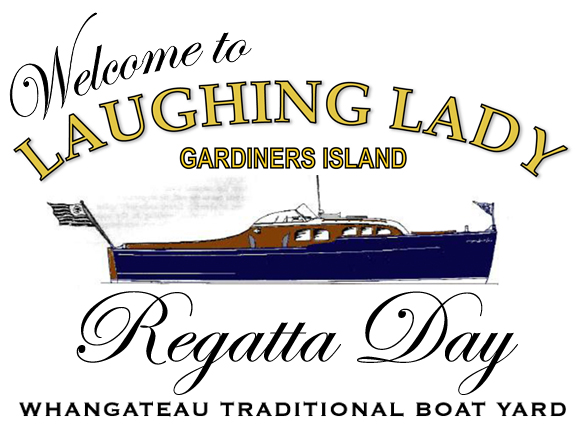
The Whangateau crew of Pam & George once again threw their yard open to lovers of classic wooden boats on Sunday (May 4th 2014). The regatta also served as a welcome to ‘Laughing Lady’ the new motorboat arrival from the USA that will be receiving some WTB love.
The autumn day was perfect – sun,wind & great boats. The food & people were pretty good as well 🙂
The regatta follows a well rehearsed format – boats out on the beach, sailors & crew arrive, boats rigged, wait for the tide (&wind), race begins/ends, lunch, prize giving. Now if that sounds like any old regatta – I can assure you Whangateau is not that. The fun & ‘games’ as people secure a boat, select sails & rudders etc & rig up is hilarious & the old salts on hand prove invaluable, in fact it wouldn’t happen with out them. No problem if something does not fit, its into the workshop & onto to the saw bench for some adjustments. Thanks to Jason Prew & Nathan Herbert for the ride aboard Otira, the 1902 Logan motorboat.
Your own Steve Horsley won the race (again) , chased / followed very closely by launch owner Shane Anderson, who had to draw on his past yachting days to keep Steve honest & win a waitematawoodys t-shirt.

A lot of the crew got into the spirit of the day & dressed as pirates.

I’m not going to attempt to caption all the photos, there are just too many – I post today a selection to give you a gander of what makes the people & the place so special.
Tomorrow I’ll post another selection – there is just too many for one day 😉

click photos to enlarge

Click the blue link below to read Jane High’s post regatta newsletter

Whangateau Article 2014

laughing lady regatta

Whangateau Traditional Boat Yard Open Day / Regatta

If you are out & about this Sunday & looking for a nice drive, the Whangateau Traditional Boat yard is throwing the doors open for people to view the newest arrival – Laughing Lady to the boat yard and New Zealand. The American and NZ flags will be flying & the theme for the day is red, white & blue or even just something nautical e.g. a boat hat.
And as is always the way – a selection of small craft will be out for inspection & visitors are welcome (encouraged) to bring their own craft.

For the newbies that have not been to one of the regattas before , its a very casual day where you make your own fun and are responsible for yourself i.e. if you are boating, bring and wear your own life jacket.

Bring a picnic lunch or have one of our sausages or bring your own sausages for the BBQ.

There will be a donation box for the sausages and the days events and for up-keep on the small craft on offer.

A course will be set to sail, motor or paddle around, out from the bay.This is open for all to join in

The boat yard is open to view Laughing Lady till 4.00pm

Please mind your footing around the yard, this is a traditional working boat yard.!

How do you get there?

Drive past Matakana aprox 9.1 km to 397 Leigh Road, Tramcar Bay & look for the one way bridge, park on the other side of the bridge please.

Launching of boats can be done from the reserve access by the boat yard, but be early to do this.

High tide is at 11.00 am – so 9.30 for setting up the boats – then as soon as the tide allows, hit the water & we shall signal you back for the start of the race 10.30-11.30 start of race.
Confused ? it will be all clear on the day 🙂


Is This Cutie A Seacraft?

Is This Cutie A Seacraft?

(click on the photos above to enlarge)

The crew at the Whangateau Traditional Boat yard would like some help ID’ing one of their boats. But before I go on, I have to say that this little motorboat has got my name all over it – perfect for Riverhead cruises, gunk-holing around Mahurangi & trailering to Lake Rotoiti.

The question for you all is :

Is the recent WTB purchase, a 12′ 6″ dinghy, a genuine Seacraft and if so, what year would she likely have been built? (there is no plaque on her).
She has a 3hp Normon marine engine, air cooled, which is believed to be her original motor.

Keith, the previous owner restored her and the motor & has her running superbly. He also has a couple more of the Normon motors running. He said she was painted green and cream and that he had striped the paint and carried out the varnishing.

Pam & George feel she has perhaps a little more sheer in her and perhaps not as broad and as flat a stern as the Seacraft boats they are familiar with & wondered if there was some variation in shape through the years?

Pam told me they had some lovely sea trials in her over the weekend & the boat is so user friendly she could manage her by herself.
They envision some tiki touring, sliping in the odd regatta along the way and shan’t be too deturbed if the pretty little thing is not a genuine Seacraft.

Boat Designer – Sonny Levi

Boat Designer – Sonny Levi

photos & details supplied by Ken Ricketts

Levi designed at least 3 launches for the NZ market (refer below)

Designer Bio (straight from his website)

Born in Karachi 85 years ago, Sonny Levi was at school in Cannes when the war broke out.
His father, an interior designer and manufacturer, and an enthusiastic motor yachtsman, moved into Government contract boatbuilding at a shipyard in Bombay. From this early age the young Renato (‘Sonny’ was bestowed by an ayah who could not manage the letter ‘r’) designed boats, inspired by the multitude of local craft in that seafront city.
He joined the RAF and trained in England, studied aircraft design and demobilisation and returned to Bombay, where by 1950 he was chief designer in his father’s busy drawing office. In 1960 he moved to Italy to work for Navaltecnica in Anzio. “I have been very fortunate to have clients who are prepared to take risks” he says today.

“I always tried to be as honest with them as I could when we discussed their projects. And occasionally something didn’t work. This is the problem with original design.”
But for every failure there were a great many ground-breaking successes, and it seems typical of the man to ascribe these to luck and pass on credit to his customers – even if they were signing the cheques.
But when you look at some of the projects he involved them in you begin to see what he means: so many of the designs were at the cutting edge of naval architecture, where success was by no means certain. Like an artist with wealthy patrons, whenever he had an idea for a new work he could usually find someone to pay for it.

Rich playboy powerboat racers would find themselves enthusiastically funding outlandish and dramatic experimental prototypes. Commercial boatyards would be talked into daring new engineering solution on the promise of more speed and efficiency. If Sonny Lei is a problem solver at heart, he is one who has never seemed inclined to solve the same problem twice.

The Levi Boats

#1 Resolute


Built in the mid/later 1950’s, originally 38 ft., she was lengthened somewhere along the way, probably in the 1990’s, to about 42 feet, originally with twin 4-53 GM Detroit Diesels, until a 2012, which were still going fine, but were replaced with 2 larger Yanmars. Resolute belonged to a friend of Ken Ricketts, Ray Bailey, for a period in the mid 70s & is now moored at Westpark Marina.

#2 Ikikai
Little is known about Ikikai, she was circa 40 feet & originally also had twin Detroits.

Both of these first 2 boats, were designs based on boats he designed & were built in numbers, for the Indian Police, as Police Boats, in their era.

#3 Bacardi


Launch date unknown but powered by twin 427 cubic inch ‘Interceptor’ GM V8 petrol engines, circa 400 hp each, these were replaced with 2 x GM Fuel Pincher 4 cycle V8 diesels circa 200 hp each. Barcardi was owned in the 1990’s by another of Ken Ricketts friends, Rick Brown.

All 3 boats were all built for Arthur Jenkinson, who was in the musical instrument business, in Auckland, by Percy Vos, & /or Shipbuilders.
Levi was very radical in his designs, for his day, virtually all his launches were designed as high speed, high performance boats, many of them having a reverse shear, & in the case of Ikikia & Resolute a slanting out tuck that v’ed to a central point in the middle.
Bacardi had a “cathedral” type bow, but she was very quick with those 2 “Interceptor” GM V8s.