


AVANTI – A Lot Of Boat From One Sheet Of Plywood
Now I know its not a NZ story and the boats made of plywood but when I read this story in the May 2021 issue of Small Boats Monthly it just made me smile – so today I share it with WW readers. Enjoy
Riley Hall was born and raised in Gig Harbor, Washington, a quiet town nestled around a narrow, mile-long inlet that shares the town’s name. The shoreline is bristling with piers and the water is dotted with boats at anchor. Surrounded by boats, it was only natural that Riley began building and working on them at a young age. He kept at it through high school and began restoring a 1940s-vintage canvas-covered cedar-strip rowing boat at home. For his senior-year project, he chose to work at the Gig Harbor BoatShop, documenting and disassembling hull #2 of the Ben Seaborn – designed Thunderbird.
After graduating, his interest in the restoration of old boats led him to move across the country to Rhode Island to study at Newport’s International Yacht Restoration School (IYRS). While enrolled there, he spent winter evenings and weekends restoring a 1963 Snipe. After graduating from IYRS in 2012 he got a job maintaining and restoring mostly classic racing yachts at Baltic Boatworks in nearby Bristol.
During the time he had been on his career path—restoring large yachts and working boats—Riley had been toying with the concept of small boats built from a single sheet of plywood. He designed and built his first one-sheet rowing skiff while home for Christmas in 2014. He had brought the paper patterns for the skiff with him to Rhode Island and shared them with Don Betts, a local boatbuilder who had built a 31’ six-oared Cornish gig, and the one-sheet skiff Don built led to two more, built with the help of a group of Sea Scouts.
After about six years at Baltic, Riley moved back to Gig Harbor in 2018 to take a job with Harbor History Museum. There, as a restoration/preservation specialist, he was put in charge of the volunteers restoring the 65′ purse seiner SHENANDOAH, which was built in Gig Harbor in 1925. The SHENANDOAH project kept Riley busy during his working hours but left him with some free time and a creative impulse to design and build something new.
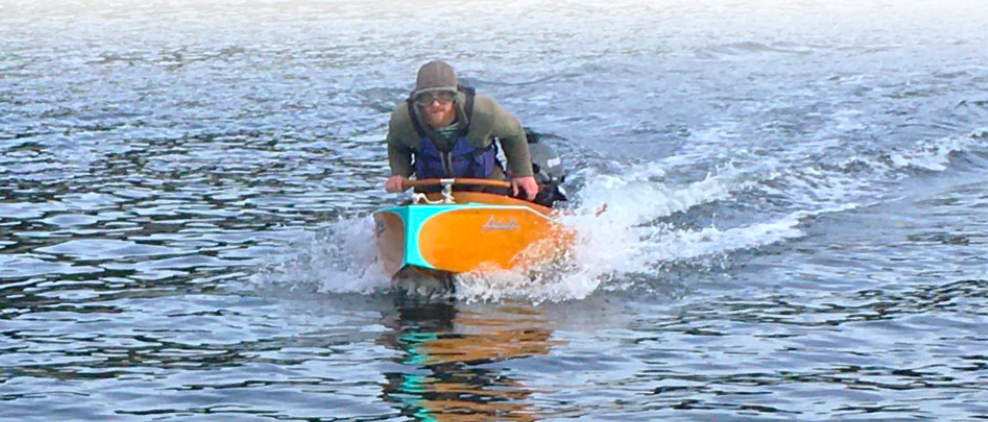
Working in the studio above his parents’ garage, he built three more one-sheet rowing skiffs, trying new iterations of the concept each time. The 2.5-hp four-stroke Yamaha outboard he had for his 16’ Calendar Island Yawl set him to wondering what kind of speed it could produce with a boat made of a single sheet of plywood.
Cocktail Class Racers naturally came to mind. Developed in 1939, they’re outboard-powered racing skiffs with a length of 8′ and a beam of 4′, just like a sheet of plywood, and limited to 6-hp motors—8 hp for racers who weigh over 200 lbs. They top out at 26 mph, far beyond the potential of Riley’s 2.5, so, with racing off the table, he was free to lavish attention on aesthetics and let visual elements from racing kayak, vintage bicycles, Beetle Cats, and ’50s nostalgia work their way into his design process.
He started with a wedge shape for the hull: a plumb stem to part waves and a flat run for planing. As he explored the shape with a model of stiff paper, the sides came together in a way that suggested a raised foredeck and stem with a reverse rake. The foredeck required a break in the sheer to sweep down to the stern, which, as Riley put it, “revealed a slightly strange shape, like little ears, between the side and foredeck standing out as rather odd and unconventional. I decided it was similar to what you see on racing kayaks, which look cool and go fast, so why not?”
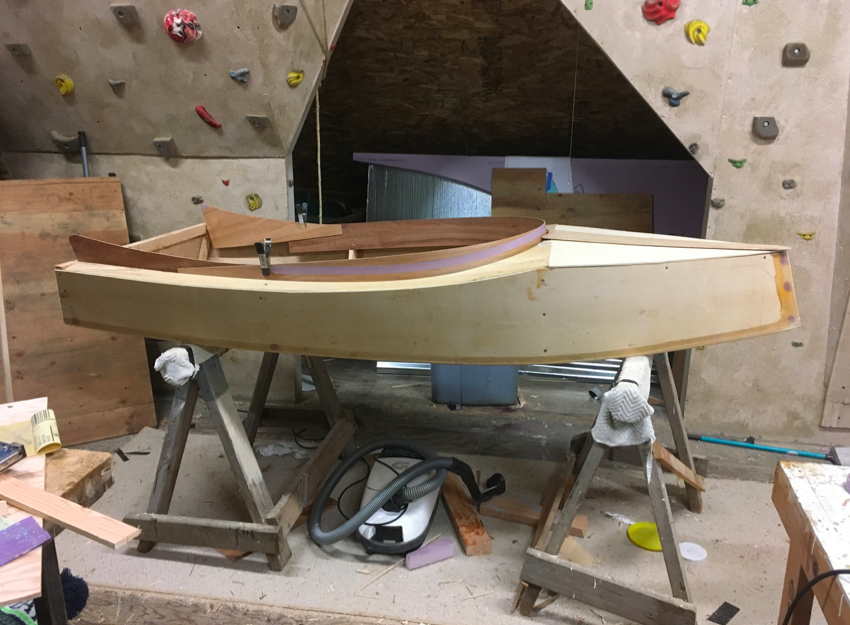
Riley started construction in a workshop space over his parents’ garage. With the shape established by the model, Riley could take the pieces apart from each other to “expand” their shapes and scale them up on onto a piece of plywood. After cutting the full-sized panels from plywood and fairing the panels, he temporarily assembled them with Gorilla tape, fine-tuned the shape, and used the plywood “skin” of the hull to take measurements for the boat’s two frames.
After Riley had installed the foredeck and a Beetle Cat–inspired coaming, he invited his father, Curtiss, an art teacher at the high school Riley graduated from, for a consult on aesthetics. As soon as he laid eyes on the boat, Curtiss said, “It looks like a Studebaker Avanti.” The iconic Avanti, a high-performance car with a distinctive “reverse rake” on the front end of its side panels, was Studebaker’s swan song, released in 1962 as the company was closing down.
Curtiss’s comparison set the boat’s name, AVANTI, Italian for forward, and pointed to an automotive aesthetic direction for the rest of the project. Riley had been looking to Herreshoff’s boats for a suitable shape for the aft ends of the coaming, but nothing looked quite right on AVANTI. While the Studebaker coupe didn’t have fins, it was produced in the final years of the fin craze, and the combination seemed to work for the boat.
For steering, Riley opted for handlebars instead of a wheel. Cocktail Class Racers require that the drivers lean far forward to keep their bows down and they’re forced to wrap their stomachs around the wheels. Riley found a bow fitting at a marine thrift store that could have easily been a classic-car hood ornament; the nameplate his dad made, replicating the one Studebaker put on the Avanti, was the finishing touch.

Discover more from waitematawoodys.com #1 for classic wooden boat stories, info, advice & news - updated daily - 15+ million views
Subscribe to get the latest posts sent to your email.
 waitematawoodys.com #1 for classic wooden boat stories, info, advice & news - updated daily - 15+ million views