



ALDEN KETCH – Sailing Sunday
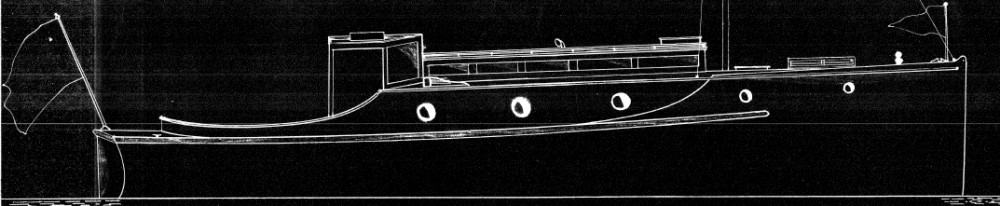
We do not see a lot of John Alden designed classic’s in NZ which given they are almost always very pretty vessels, isn’t good.
This one was design #550 & was built in 1939 by Arnold France in Lyttleton & has been lovingly restored by her current owner.
She is 39.35′ & built with full length 1 1/4″ oregon on hardwood frames. Her when the sails aren’t up a 2012 Nissan TD27 88hp diesel pushes her along.
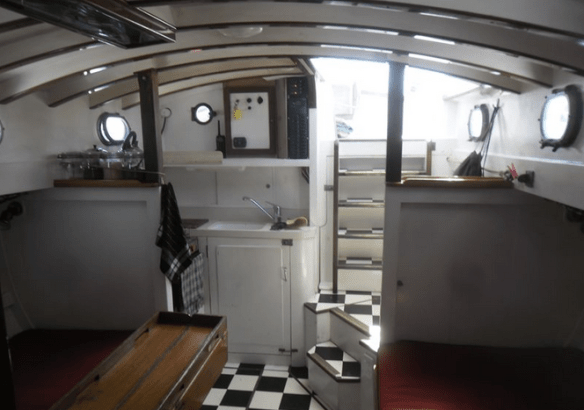
She was re-rigged in Her refurbishment included being rewired, new switches / breaker panels, batteries, instruments, electric toilet and holding tank, new plumbing throughout. Plus new squabs and many other extras, complete hull paint before Christmas.
She is for sale on trademe – a very smart classic & a lot of boat for the asking price of $65k ono
02-04-2017 Updates from Robin Elliott
She is Windswift and was registered as A-8 with Banks Peninsular Cruising Club, She was a 3 year building project by Arnold France.
France probably started building her in 1939 but she wasn’t launched until October 1941. He and his wife and son lived aboard for 3 years during the War.
Seems to have grown a little over the years. Reported as 35-feet when launched, Arnold France gave dims of “33ft 8in x 10ft 6in x 4ft 8in” in 1949, In December 1956 she was advertised for sale as being 34-feet. She was on Trade Me in 2008 as 41-feet, and now as 39.35ft. Tricky things these Alden ketches.
Here’s a little bit more, courtesy of Papers Past
https://paperspast.natlib.govt.nz/newspapers/CHP19411030.2.63?query=arnold%20france
https://paperspast.natlib.govt.nz/newspapers/LWM19460509.2.22?query=arnold%20france
Discover more from waitematawoodys.com #1 for classic wooden boat stories, info, advice & news - updated daily - 15+ million views
Subscribe to get the latest posts sent to your email.
 waitematawoodys.com #1 for classic wooden boat stories, info, advice & news - updated daily - 15+ million views
En français chapeau les gars veut dire chapeau bas en vieux français (qui n est plus jamais utilisé de nos jours) ça veut dire : devant vous j enleve mon chapeau ou ma casquette … Respect a bientôt Harold .Robin .Luana
LikeLike
Sur cette terre de New Zeeland je suis fier j ai plusieurs amis Harold … Luanna .. Robbins thanks m’y safer …Harold my friend peut tu me recommander au New Zeeland Maritime Muséum . god blessé you m’y friends
LikeLike
Thanks Robin you are my Sauveur. SAFER …god blessé you
LikeLike
Sacre Bleu! Le bateaux de la cément et gravelle sandwich. Zut! Alors
LikeLike
ie hats off to you maritime blokes!
LikeLike
Cher Thierry,
Il semble que la plupart des dessins du mort R.L. Stewart soient tenus par New Zealand Maritime Museum
http://www.maritimemuseum.co.nz. Est-ce je puis vous en aider?
Harold
LikeLike
Difficult to determine how many ferro Stewarts are out there.. The construction method would have been entered on the original registrations papers but after that they are just a ‘matangi’ when reported in any newspapers.
Here are the only ones i know of so far;
Matangi design
Marire sail no 853 built by Morley Sutherland registered 1964
Rehia sail no.1632 finished off by John Gladden in 1966 but not registered until 1973
Camelot design
Plieades Sail no. 195 – probably Morley Sutherland, registered 1968
Swanhlde I Bernie Skinner’s boat that he built in 1968 and took around the world.
There were also these unknown Stewart designs
Corail Sail no. 1258 built by Ferro Craft registered 1971
Innisfree Sail no. 948 a 55-footer built by Ferro Cement Ltd registered 1970
I forget the company name that Morley Sutherland operated under but his success with Marire got him going full time. In his employ at the time was Laurie Davidson.
There were loads of Hartleys, Woollacotts, and H28’s built in ferro too, both amateur and professional.
Then of course there was Whangarei’s Ev Sayer who built a lot of of ferro hulls during the 1970’s including the wonderfully named Floating Footpath.
LikeLike
Bob Stewart (or his family) left his drawings to the Auckland Engineering School. I recall going through them up at the University in the early 1990’s. However, I seem to recall that they have since been transferred that waterfront black hole that is disguised as a Maritime Museum.
LikeLike
Effectivement il s agit du matangui ferro auriez vous quelques plans dessin ou photos ? En tout cas chapeau les gars marins et merci d avance cordialement th
.
LikeLike
Je crois que le nom de Matangui me parle avez vous des renseignements sur ce type de Bateau en ferro ? Il s agit d une construction en France .. cordialement th
LikeLike
Nathan that was Swanhilde subject of a book about sailing round the world on concrete by Gwen Skinner. I believe that Brian Donovan or Ferro Craft may have built a few Camelots in GRP (gravel rocks and pebbles) in the late 60’s early 70’s
🙂
LikeLike
Murray, what was the one tied to the Westhaven fuel pontoon for some time, a while back? Run down paint but an attractive shape.
LikeLike
Thanks Nathan, that’s helpful.
Who’s the expert on Bob Stewart’s yacht designs?
The ferro ones are a bit too recent for me.
LikeLike
There’s the odd ferro Matangi/Camelot floating around, one quite nice aft cabin verson I think is ferro?
LikeLike
Well, he came straight back with hard questions, wanting to know specifically about any amateur-built 12-13m ferro-cement Bob Stewart yachts of the late-70s and where to contact Bob.
Bad news for the last query, but can any WW follower help with the first?
LikeLike
Flash bugger 🙂
LikeLiked by 1 person
Bien sur. Mon adresse email est harold@kblaw.co.nz. Veuillez m’ecrire?
LikeLike
Connaissez vous un architecte naval neo zelandais nommé RL bob Stewart qui fabrique des voiliers en ferrociment dans les années 1979 ? merci amicalement th
LikeLike
Hang on, you don’t count the bowsprit or the rudder in giving loa. Just stem to stern, the fixed parts of the hull. That dimension plus lwl, beam and draft give an accurate idea of the size and bulk of the boat. The full length including bowsprit is relevant only for marina etc purposes.
LikeLike
https://paperspast.natlib.govt.nz/newspapers/CHP19411030.2.75.3?query=windswift
LikeLike
Here’s a little bit more, courtesy of Papers Past
https://paperspast.natlib.govt.nz/newspapers/CHP19411030.2.63?query=arnold%20france
https://paperspast.natlib.govt.nz/newspapers/LWM19460509.2.22?query=arnold%20france
LikeLike
She is a “Great Circle”, 33’8″ Auxilliary Cruising Ketch on the plan, has 5′ bowsprit so 39′ ish overall, maybe 41′ total because of transom hung rudder. Is also quite beamy and a big boat for her size, has lovely little ship feel. Arnold France was a casting pattern maker so she is superbly built, he was involved in the development of marine jet propulsion with Bill Hamilton and apparently sold “Windswift to set up “Francecraft” which made early production fibreglass jetboats. She was also one of only 2 finishers in the ill fated Wellington-Lyttleton race in 1951 which his wife Ruth wrote a book about, the black and white photo is of the start. She was sold shortly after to Frank Nightingall who was a renowned conscientious objector during WWII and a photographer for the Wanganui Times, he lived aboard her for 35 years before she ended up in a shed in Evans Bay in Wellington for 10 years or so. She has had a couple of refits and a family Pacific cruise since, my late wife and I lived aboard for 4 of years of the 8 we have had her. Interesting what you say about launch date but know she was blockaded into Lyttleton Harbour until after the war.
LikeLike
She is Windswift and was registered as A-8 with Banks Peninsular Cruising Club, She was a 3 year building project by Arnold France.
France probably started building her in 1939 but she wasn’t launched until October 1941. He and his wife and son lived aboard for 3 years during the War.
Seems to have grown a little over the years. Reported as 35-feet when launched, Arnold France gave dims of “33ft 8in x 10ft 6in x 4ft 8in” in 1949, In December 1956 she was advertised for sale as being 34-feet.
She was on Trade Me in 2008 as 41-feet, and now as 39.35ft. Tricky things these Alden ketches.
LikeLike