
C & B JUNIOR
photo & details ex Barry Davis
The above stunning photo of C & B Junior was one of two photos that Barry Davis ‘found’ when poking around the Collings & Bell boat sheds after the yard closed down as a result of the reclaiming of the area for the Auckland Harbour Bridge. Barry ‘found’ this photo on the floor in the then very derelict older of the two C & B boat sheds just shortly before it was finally pulled down in 1961, a good two years after the business had closed. Barry has had the photo & one other (Dorothy – a previous ww post) filed away for decades & how thanks to ww they can be viewed. Junior was built by C & B in 1913. And while a wee thing at 20′ x 5’6″ x 3′ she is in my eye perfectly proportioned, not an easy task in a boat this size.
Given the inscription on the photo, she may have been built for W.H.M. Davis, or perhaps that was the photographer?
So woodys what became of C & B Junior?
ps photo below (ex Harold Kidd) of the Collings & Bell yard, with the 36′ Carrie-Fin on the slip. Carrie-Fin was later shipped (on Makura) to Tahiti for a wealthy American sport fisherman, Eastham Guild.

Update from Harold Kidd
She was built by Collings & Bell for themselves as an advertisement for their skills, one of several such launches they built as demonstrators. Her actual name was C & B JUNIOR. Davis was the photographer. She was launched in April 1913, a few days before this image was taken. Her dimensions were as stated . She had a 10hp 2 stroke Eagle engine. Alf Bell had most of the running of her, entering quite a few launch races with her.
She was a trend-setter with her dodger, something quite new at the time, and obviously immensely practical.
Collings & Bell sold her to J Harris of Grey St., Onehunga in early 1914. He renamed her CYNTHIA. In late 1914 he fitted a 9-12hp 4 cylinder 4 stroke Aristocrat engine. In 1917 he sold her to D. Herd and she “disappears” shortly after, probably a name change.
Collings rarely published his lines because he thought of himself as an innovator, especially with his hard chine “concave-convex” planing hulls.
It seems that when the St. Mary’s Bay yard closed a lot of material was left lying around. Barry liberated the two lovely images of C & B JUNIOR and DOROTHY, but hundreds of Charles Collings’ own glass plate negatives were either shied into the bay by apprentices or left lying around, mostly cracked or broken. I have a number of these, all much the worse for wear but hugely interesting.
An earlier launch of the same dimensions was exhibited at the Auckland Winter Show in 1910 with a smaller dodger. That one was was really the trailblazer and was one of several of their launches called just C & B.
Terribly minor point; for whatever reason, when C & B JUNIOR was sold to Harris, Collings & Bell fitted a 6hp 2 stroke Perfection engine in place of the Eagle. They were agents for Perfections and I suspect that the Eagle may not have proved satisfactory. The Perfection was built in Detroit by Caille and one of the better American marine two-strokes (of which there were a great number).
Discover more from waitematawoodys.com #1 for classic wooden boat stories, info, advice & news - updated daily - 16+ million views
Subscribe to get the latest posts sent to your email.


Now that’s a good looking little ship, even if designed for a leprechaun to drive–I guess you could install a hatch. There is a lot of fun to be had in these small craft as we have discovered and fishing with a bit of shelter from the weather is wonderful. Two skins of ply over laminated frames she couldn’t be too expensive to build….
LikeLike
Perhaps if you show me your stern and I’ll show you mine Paul.:-/
LikeLike
Ok well you guys should know.
Don’t forget she’s carried caring all that top hamper.
The offer was for Don to replicate a very pretty hull that was very much like junior I still maintain his trip to come and see her worth while. It’s neither here nor there to me she’s pretty as…
LikeLike
Concerning KATHLEEN M, ex AK444,ex P3, to my mind there is nothing to suggest that she is a Collings and Bell. To me the transom shape is not C & B, which I think is quite distinctive on their smaller launches of that era, as typified by our SIR FRANCIS. Very clean at the stern – that is, very little of the transom is immersed, resulting in – well, I don’t know how else to say it – a very clean stern!
LikeLike
Perhaps I should give all my meager findings to Al so he can create her own post.
Paul Drake told me she was Kathleen M AK 444 in 1971 when she was operating as a long liner from the viaduct.
LikeLike
PS I was hoping you would actually.
LikeLike
Oh Hello Harold, I thought we might bump into each other here. 🙂
You’ll have to excuse me I have sika on the go at the mo. Bit sticky. I shall check the writings I have this evening.
LikeLike
Is there anything that really confirms, or even suggests, a 1918 Collings & Bell provenance for Kathleen M? An original name, an owner, a photograph in a chronological context?
LikeLike
Kathleen M is believed to be a Collings and Bell.
21’6″
1918
The side profile doesn’t really show how full she is but in the real she is as much of dumpling as Junior. Some similarities seen anyhow.
LikeLike
I doubt it. Collings rarely published his lines because he thought of himself as an innovator, especially with his hard chine “concave-convex” planing hulls.
It seems that when the St. Mary’s Bay yard closed a lot of material was left lying around. Barry liberated the two lovely images of C & B JUNIOR and DOROTHY, but hundreds of Charles Collings’ own glass plate negatives were either shied into the bay by apprentices or left lying around, mostly cracked or broken. I have a number of these, all much the worse for wear but hugely interesting.
An earlier launch of the same dimensions was exhibited at the Auckland Winter Show in 1910 with a smaller dodger. That one was was really the trailblazer and was one of several of their launches called just C & B.
LikeLike
She’s very much like our Kathleen M. 24ft. If you would like to scale her down.
I agree she would be be a fun new build and being so small, affordable.
photo added. AH

LikeLike
Terribly minor point; for whatever reason, when C & B JUNIOR was sold to Harris, Collings & Bell fitted a 6hp 2 stroke Perfection engine in place of the Eagle. They were agents for Perfections and I suspect that the Eagle may not have proved satisfactory. The Perfection was built in Detroit by Caille and one of the better American marine two-strokes (of which there were a great number).
LikeLike
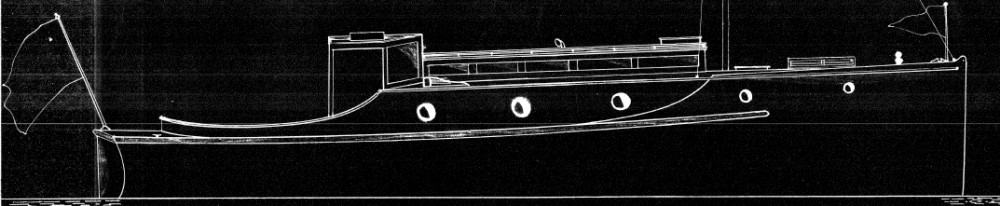
Harold, do the original plans, line drawings or half models from C&B still exist?
Junior could be a fun build?
LikeLike
She was built by Collings & Bell for themselves as an advertisement for their skills, one of several such launches they built as demonstrators. Her actual name was C & B JUNIOR. Davis was the photographer. She was launched in April 1913, a few days before this image was taken. Her dimensions were as stated . She had a 10hp 2 stroke Eagle engine. Alf Bell had most of the running of her, entering quite a few launch races with her.
She was a trend-setter with her dodger, something quite new at the time, and obviously immensely practical.
Collings & Bell sold her to J Harris of Grey St., Onehunga in early 1914. He renamed her CYNTHIA. In late 1914 he fitted a 9-12hp 4 cylinder 4 stroke Aristocrat engine. In 1917 he sold her to D. Herd and she “disappears” shortly after, probably a name change.
LikeLike
Junior looks really great and it appears to scoot along.
It might be ‘perfectly proportioned’ but it appears to lack headroom under that dodger.
I like the steering setup with the vertical tiller handle, presumably attached to the wheel by cable.
LikeLike