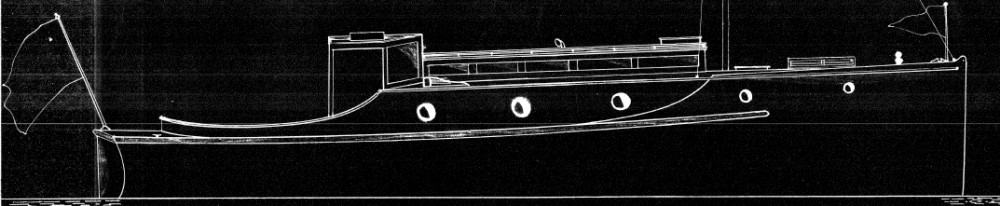
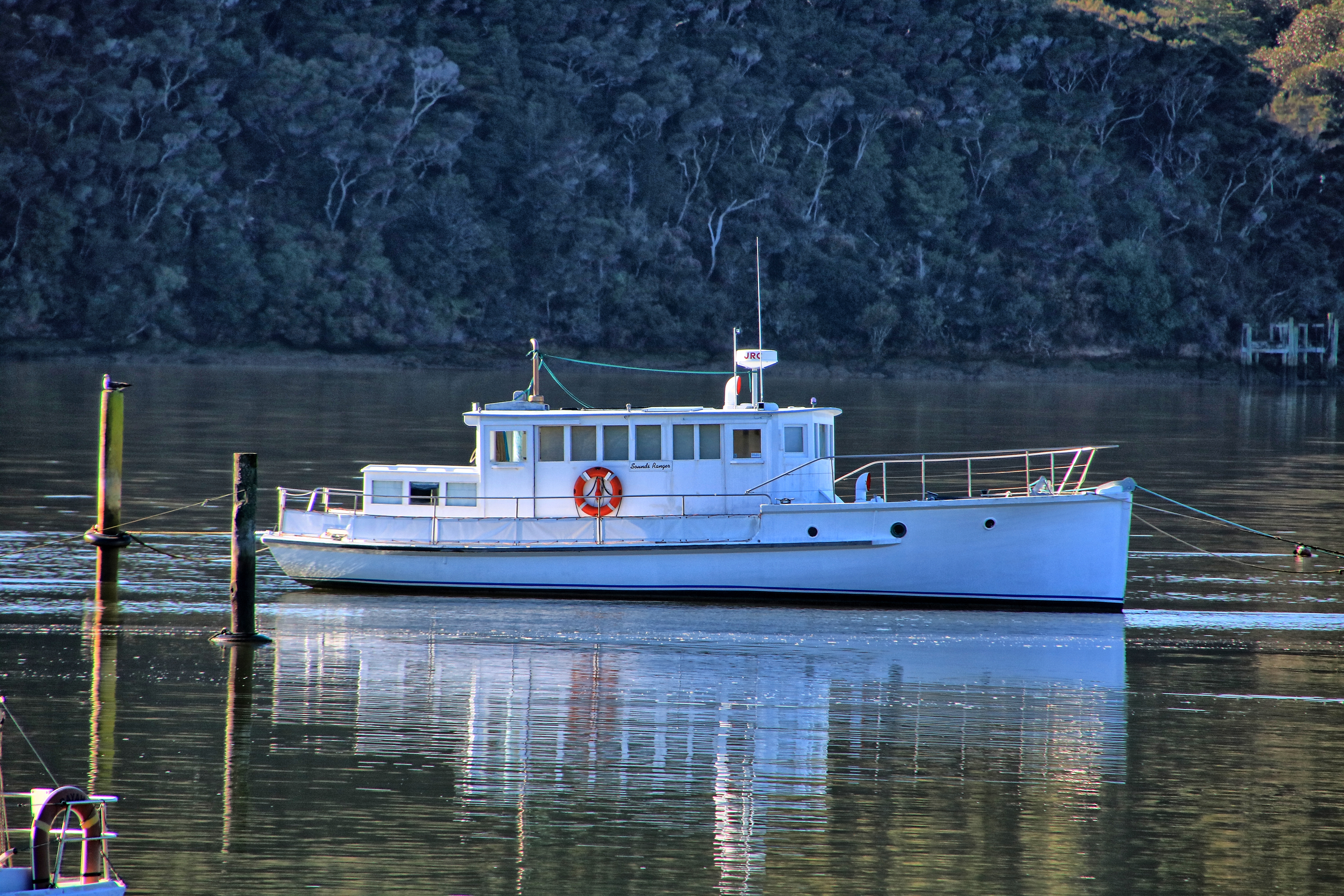
Sounds Ranger
The above photo of Sounds Ranger was emailed to me by Frits Schouten & was taken by Frits in the Bay of Islands, sorry but that all I know.
I suspect the name & style are a hint to her past
What do we know about her & her past?
Update 10-02-2022 – Photos below of Sound Ranger on the slip at Dargaville. ex Dave Stanaway

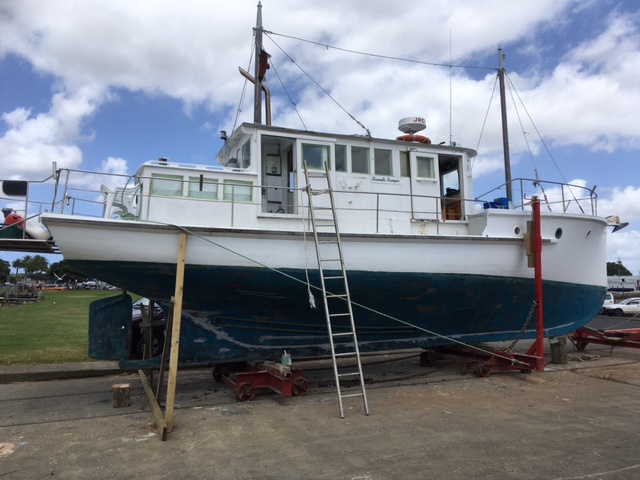
29-05-2024 UPDATE ex NORM JUDD
The following description by Kerry Johnson of the “Sounds Ranger.” is from the unpublished NZ NATIONAL PARKS AND RESERVES RANGERS’ ARCHIVE – a collection of written and taped memoirs of Lands and Survey rangers between 1952 and 1987. Kerry was Chief Ranger of the Marlborough Sounds Maritime Park from the 1968 to the 80s.
“Reading my note to Norm Judd, Havelock based ranger, re starting the Sounds Ranger brought back memories about those early days when I took over, among other things, the care and operation of the vessel. I wasn’t impressed with its overall condition. There was need to bring the launch up to Marine Department standards as soon as possible.
The problems included batteries not set up properly to provide backup if one set went flat, the stern tube the tail shaft went through contained a heavy oil for lubrication but would not function properly and no matter how much advice and effort I could muster this thick oil would ooze into the bilge. A few months down the track while cleaning the accumulation of grime from a circulating pump it literally fell apart. Thank goodness the boat was safely in her berth in Picton then!
Many improvements were eventually made but there was one incident that occurred one night when I think I was away. Late one rough, wet evening my wife received a call from the Harbour Board patrol to say the Sounds Ranger’s engine was chugging away in her berth with no sign of anyone on board and the doors securely locked! Now there has to be a logical explanation as to how this happened but I was never able to clearly identify the cause and that’s probably why the battery leads had been removed as mentioned in my note to Norm.
I’m not superstitious and while I learned later the same thing had happened once before, you can’t help thinking that there must have been some free spirit lurking about that stormy night and was about to take the “old girl” for a cruise in the gloom! “Stranger things have happened at sea.”
Thank you Norm for holding on to a note many (including myself) would have discarded long ago. As a friend commented recently when talking about recording family history, “even the milking cow’s name is important”.
Here’s the note
“Now a few directions in case you should be asked to take out the Sounds Ranger.
Batteries have been disconnected – under seat on starboard side, crescent spanner in tool box near batteries.
Before starting engine remove bucket from top of funnel – open hatch to engine room, light switch is on a beam just inside the hatch opening, that is if you stand on the engine room floor looking forward, the switch is on your right hand side on the back of the beam that forms the front section of the hatch opening. Move under the exhaust pipe along to the front port side of the motor. If you look around the actual front of the engine you will see a small wheel with finger grips around the outside (about 3” or 4” diam.)
This is the wheel that engages the bilge pump by simply screwing or rotating the wheel clockwise or in towards the engine. It should be in this position now, so to disengage the pump, just screw the wheel very slowly out. Do not on any account force the wheel too far out, or for that matter too hard in, otherwise it will stick hard. The pump has to be primed before it will start, this done on the starboard side of the engine. There is another light there with the switch by the light bulb, you will find an old kettle with water in it. You will see towards the front, a tap with an opening for the water to be poured in on the top. With the engine at low idling speed, turn the wing tap to vertical – pour water in slowly. I hold my thumb near the hole and when the pump looks like starting I block the hole with my thumb then turn the wing tap to horizontal.
To start the engine use the starter button on a beam in front of the light on the Port side of the motor, but you should only have to use this one when the engine is cold. It also pays to use the overload button on the fuel pump (when the machine is cold only) the button is on the front of the fuel pump.”
(Here there was a small diagram that showed the location of the overload button on the fuel pump.)
“Button should be pushed up, at the same time pull back the rack. Push the starter button until the engine starts.
Be sure to turn both lights out, on leaving the engine room.
To stop the motor just pull a string that hangs on a nail beside the top of the steps that lead into the forward cabin. Normal starting can be done by using the starter button by the compass. (This for some reason has given trouble in which case I have used the engine room button.)
Push throttle lever up to 1100RPM after about 20 minutes. I doubt whether it will be necessary for you to use the boat, and if you do, I don’t think the bilge will have to be pumped out. There is a hand pump in the engine room, the valve is on the side is off. If you have to use this rather that the pump on the motor please be sure to turn the wheel mentioned earlier to off position.
Remember that the motor is only 60 HP and will not pull up as quickly as the PR (Pelorus Ranger – Havelock based vessel) in other words take her quietly and don’t get into shallow water or you will get into trouble.
Hope this makes sense?”
“P.S. Key to door lock is under bucket by gas cylinder rear of wheelhouse.”
(All of this made sense but just being up with the detail didn’t necessarily mean I was any less concerned with the implementation! – Norm. My recollection is that SR drew about 6 feet and was 45 feet at the waterline.)
Discover more from waitematawoodys.com #1 for classic wooden boat stories, info, advice & news - updated daily - 15+ million views
Subscribe to get the latest posts sent to your email.
 waitematawoodys.com #1 for classic wooden boat stories, info, advice & news - updated daily - 15+ million views
Pingback: SOUND RANGER – A FIRST-RATE READ | waitematawoodys.com #1 for classic wooden boat stories, info, advice & news – updated daily
New photos added. Alan H
LikeLike
Just saw her last weekend at Pahi, northern Kaipara harbour. A beautiful boat. Googled the name which brought me here… great site, thank you
LikeLike
Re Enterprise, I was deckboy aboard the Enterprise, in 1956. Brian Pickering was the captain. We serviced the Stephens and Brothers Islands’ lighthouses every fortnight. Cargo was carried out to these stations, which consisted of 44 gallon drums of diesel, 100wt sacks of coal, stores, lighthouse keepers and their families. Also building materials, and other maintenance people too, to service Lister diesel engines, which ran the generators for the lighthouses.
The Brothers Island lighthouse was single men only, and I recall we brought out from time to time, cargoes of ingredients for homebrew, for the Dickens brothers. One of them told me his ambition was to drink himself to death before he was 40, or so he said. I recall one instance in Picton, at Oxleys Hotel, at 8am in the morning, dragging one of the brothers out, totally inebriated, and on arrival at the Brothers, I remember rolling him into the net under the cargo crane like a sack of potatoes.
Between the Island lighthouse trips, we maintained unmanned shore lights, and ferried in and out batteries for recharging, empty and full acetylene bottles, and carried out general maintenance painting etc.
The batteries and acetylene gas bottles were all taken ashore by a wooden clinker-built dinghy, rowing only, no outboards. Some of the landings were quite tricky, in surf and swell, although we had extra crew at these times, as the batteries were very heavy and so were the acetylene bottles.
One cargo we took out was about six 44gal drums of highly toxic acid, for dumping in deep water off the Brothers. We were somewhat nervous about it.
The Enterprise, as I recall being told, was built for Thomas Dalton McManaway circa 1932 by E. R. Lane in Picton as a line-fishing boat. It was powered by a 40hp 4JP Lister diesel. This had gearbox problems around 1950, and the engine was replaced by a 5LW Gardener, 60hp at 1200 rpm. The service speed of the Enterprise was 8knts at 1080rpm and burnt 1.5 gal/hr. Very economic. The Enterprise was very fine forward, and very good in a head sea, made good time, but was scary in a big running sea, reputedly had 5 tons of ballast, easy motion but it could certainly roll.
Davey Jones.
LikeLike
Heya, my family owned her from approx 1986 to early-mid 90’s. She was, as the name suggests, the ranger’s boat in the Marlborough sounds. They serviced lighthouses etc. I think she went to Auckland when we sold her, recently a friend spotted her for sale in Whangamata 🙂
LikeLike
Hi people, we have been fortunate enough to look after Sounds Ranger for the last 10 years. We have just sold to a lovely family who are basing her in Tauranga. She was built by Ernie Lanes as a deep sea hapuka fishing boat but put into service as the light house tender for cook strait without ever fishing. Originally Enterprise but re named Sounds Ranger when she became the Rangers boat in the Sounds. Sold to a private owner whose name escapes me who now lives in Waihi, he kept her in the sounds also for some years. Sold to a family who based her in the Kaipera for a few years then my wife and I purchased her 10 years ago. We kept her in Wellington for 4 years, Napier for 5 years and Whangamata for 1 year. She spent just 5 months in the bay before sale to the new owners. A lovely kindly sea boat, the photo was taken when we had the masts off for maintenance since reinstated and what a difference they make to her motion at sea! Powered by a Gardner 5lw she maintains 7 to 7.5 knots mostly on about 4.5 litres an hour. Cheers Tim Whelan.
LikeLike
Oh, and I forgot to add that her skipper during her lighthouse tender days was Brian Pickering
LikeLike
Hi Brad- can you added the details / history you are aware of here ? Cheers Alan
LikeLike
Hi there, my granddad owner her for a while and it was keep at pahi. I do know bit about the history off her.
LikeLike
Originally “Enterprise”, by Ernie Lane. I think she may have originally fished for a living, but is best remembered as the lighthouse tender in the Cook Strait area. After a new boat was designed and built for that job by Roger Carey, she became the ranger’s boat for the new Sounds National Park, with the name change to “Sounds Ranger”.
Some time later she was fishing on the Kaipara with – I believe – a temporary name change to “Kaipara Ranger”. Must have been interesting, given that she’s pretty deep draughted in the typical Ernie Lane manner for her original home waters.
LikeLike