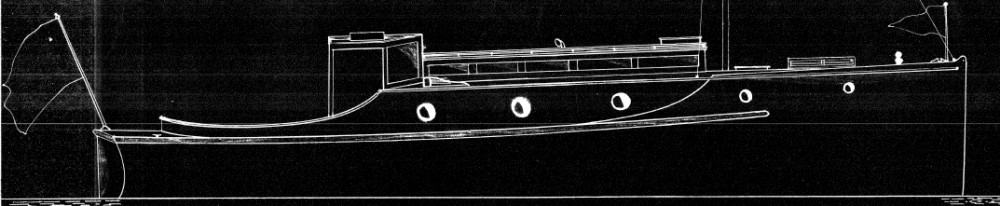


CURLEW
photos ex Thomas Gross, details ex Harold Kidd
Curlew was built by Bailey & Lowe at Auckland for Percy Dufaur and launched in February 1912. Percy Dufaur was a law clerk working for the legal firm Dufaur Fawcett (now Cairns Slane). He owned many yachts in his time but was very fond of the concept of a small, seaworthy cruising boat.
Curlew had a 4hp Auckland-built Kapai auxiliary from new and was a centre boarder. Dufaur sold her to W. Abbott in 1914 and he sold her to H E Chamberlin of Ponui Island in 1918.
In 1919 A T Jamieson of Northcote bought her. He had admired Curlew and had had Bailey & Lowe build him a very similar yacht called Kereru in 1916 although she was a keel yacht. Jamieson kept her for 2 years, selling her to George Lepper of Northcote who used her to transport NZ Herald newspapers to Northcote for distribution every morning, 6 days a week.
W. Keen owned her in 1946 and D J Best 1946 to 1951 when boat builder Dave Jackson bought her (hopefully Dave J can tell us more about her recent history).
K Darrach owned her in 1973 and Bert Knight of Ngunguru owned her in 1989.
From 1946 her registration number was O15.
These days Curlew is owned by Thomas Gross & moored at Bucklands Beach.
ADVICE NEEDED 🙂
Thomas has a question for the woody boaters out there – he is after some guidance on how to re-build Curlew’s rudder that broke in 2 pieces. He has the pieces stored on the boat to bring home and use as form for the new one, but was wondering where to start, e.g. he has read that he should use different sheets of plywood and put them in different directions etc, but was wondering if the ww followers know of more information on this or what other options to rebuild the rudder.
Update – 19-09-2015
Whangateau Traditional Boay yard have been helping Thomas with the repairs – Pam’s words “Lots of good wood still so George decided to make some simple repairs.
New rods with thread and nut to draw it all up tight again”


And for the yachties – todays bonus is a link to Day 4 + Ladies Race photos from the British Classic Week. Enjoy
Discover more from waitematawoodys.com #1 for classic wooden boat stories, info, advice & news - updated daily - 15+ million views
Subscribe to get the latest posts sent to your email.
 waitematawoodys.com #1 for classic wooden boat stories, info, advice & news - updated daily - 15+ million views
Repair photos added to main post. AH
LikeLike
Dave J. said Baileys took the centre case out and fixed the keel to her.
LikeLike
Thx Pam , we like projects on ww 🙂
LikeLike
Thomas poped in with the rudder yesterday.
George has already dismantled it, investigating the good still in the existing and has set it aside to dry. I shall take some photos as the repairs move ahead for you Alan.
LikeLike
Thanks the email- do keep in touch.
LikeLike
I think I’d start with a new stock and maybe use the old fin if it proves ok. The time it would take to scarph new timber onto the bottom and setup the gudgeon you’re better off with new stock. Make sure you use proper metal for the gudgeon bolts. Probably copper is best peined over. Otherwise you risk electrolysis..
Setting up a third pintle is a good idea but not easy. Any warpage and the middle gudgeon will bind…
Good luck!
LikeLike
Some photos of the broken rudder
https://goo.gl/photos/S8rwVBYgAp1S9LFk7
https://goo.gl/photos/hLWzBFYqKP1piH5Q6
LikeLike
Hi Thomas, I just read about your rudder problem. I am assuming that it is built all in timber and it is made up of several boards bolted together lengthwise. If it is broken across the lengthwise boards you will have to build a new one. It also might mean you need an additional rudder fitting half way up the length of your blade as it may not be supported well enough. If it is broken lengthwise you may be able to repair it by using new bolts and gluing the cracked boards together. I hope this helps. Let me know if you need some more advice. Herbert
LikeLike
1912 Wow and L Francis designed the H in the 40’s -he must have had spies down here, look at those lines.
LikeLike
I second Pam @ Whangateau. I can’t imagine Bailey’s using plywood for their rudders back then. Without seeing the parts it’s hard to give advice, but a rudder was typically made up of vertical boards with bronze or copper drifts bored through from the stock to the trailing edge.
LikeLike
Thanks a lot, really appreciate any help with this. I will get the pieces tomorrow and take pictures. I believe it got damaged from a bigger crack in the middle of the rudder which I repaired but must’ve broken again and water started to make the wood rod. Fixing the current one is an option now that you say it 🙂 More tomorrow, thanks again!
LikeLike
The engine is now a 1980s toyota 2L diesel
LikeLike
She is a cute wee boat and has survived well. The Kapai engine was made in Auckland by Arthur and Dormer Engineers, Nelson St 1904 -1914. Castings were by T T Masefield -one of the biggest in the pioneering days. (My cousin married one of the Masefield descendants). The engine would have been quite a burdensome single cylinder four stroke. Not many survived sadly. John Guard had one in Nelson at last count. Info from Stationary Engines Made in NZ by Robinson.
LikeLike
Thomas it would be nice to see some photos of the rudder to see where or why it broke. It would also be nice to see it go back together with some new timber and bolts than to play around with a plywood repair. We would be happy to help you with this. I’m sure Dave J would be happy to make suggestions also. whangateautraditionalboats@gmail.com
LikeLike