Who Can ID This Yacht
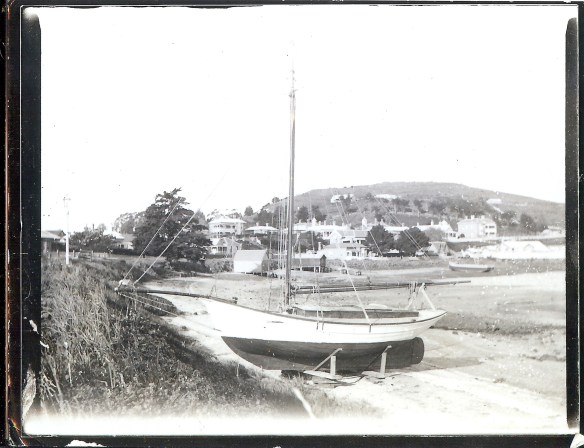
We are over due for a little bit of yachting – now this one will have the crusty old salts scratching their heads. The image is a contact print off a glass plate that was sent to me by Keith Ottaway. The original was taken by his wife’s great grandfather, Richard George Collins.
The location is obviously Devonport & as a starting point, RGC started ‘taking’ photos c.1895
Harold Kidd Update
A most unusual hull-form for Auckland, unlikely to have been built by any of the mainstream builders like Logan or Bailey. She’s a Devonport boat, hauled up alongside the wharf at the foot of Church Street.
My wild guess is that she’s the 4 tonner WANDERER, built in Devonport by Tom Le Huquet in October 1891, soon after he set up in business there. If so she was built as a cruiser for J.C. Webster but was a total loss when she broke away from her moorings under North Head in a hard NE blow in May 1893. She came up on the rocks at St Mary’s Point and was badly damaged. From the sound of it she was beyond economical repair.
Jack Webster immediately ordered another yacht from Robert Logan, the 38ft cutter NGARU, which also had a sad fate when she was wrecked on the south end of Rangipuke Island at Christmas 1900 when owned by C.B. Stone.
The hull-form of the yacht in the image is almost French smack and quite reminiscent of the oyster and crabbing boats Le Huquet had been building in Jersey,. particularly the treatment of the stern. But there were all sorts of hulls being built at the time and I am likely to be totally wrong.
Follow up update 05/05/14
If I’m right, and she does have the ancestry I think, then you can see how this form of hull would work well in an environment where the tides average 40ft and all boats dry out on legs. The extended, flat forefoot, the protected and vertical rudder, plus the great deal of sheer to cope with the short steep seas in the very shallow waters around the Normandy/Brittany coast with strong winds and 10+ knot tides on occasion where much passage making is done by sling-shotting the tides.
Discover more from waitematawoodys.com #1 for classic wooden boat stories, info, advice & news - updated daily - 15+ million views
Subscribe to get the latest posts sent to your email.
 waitematawoodys.com #1 for classic wooden boat stories, info, advice & news - updated daily - 15+ million views
If I’m right, and she does have the ancestry I think, then you can see how this form of hull would work well in an environment where the tides average 40ft and all boats dry out on legs. The extended, flat forefoot, the protected and vertical rudder, plus the great deal of sheer to cope with the short steep seas in the very shallow waters around the Normandy/Brittany coast with strong winds and 10+ knot tides on occasion where much passage making is done by sling-shotting the tides.
LikeLike
OOPs. Different Collins. Richard George Collins had a wife and several children back home in Pollen Street, Grey Lynn in 1893.
LikeLike
A most unusual hull-form for Auckland, unlikely to have been built by any of the mainstream builders like Logan or Bailey. She’s a Devonport boat, hauled up alongside the wharf at the foot of Church Street.
My wild guess is that she’s the 4 tonner WANDERER, built in Devonport by Tom Le Huquet in October 1891, soon after he set up in business there. If so she was built as a cruiser for J.C. Webster but was a total loss when she broke away from her moorings under North Head in a hard NE blow in May 1893. She came up on the rocks at St Mary’s Point and was badly damaged. From the sound of it she was beyond economical repair.
Jack Webster immediately ordered another yacht from Robert Logan, the 38ft cutter NGARU, which also had a sad fate when she was wrecked on the south end of Rangipuke Island at Christmas 1900 when owned by C.B. Stone.
The hull-form of the yacht in the image is almost French smack and quite reminiscent of the oyster and crabbing boats Le Huquet had been building in Jersey,. particularly the treatment of the stern. But there were all sorts of hulls being built at the time and I am likely to be totally wrong.
LikeLike