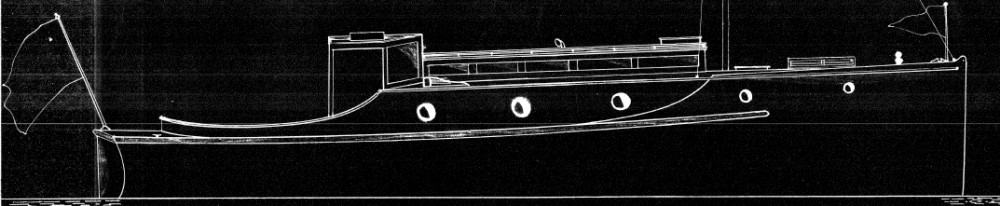

Belle Isle > Belle IIe
An update on Belle Isle (now renamed Belle IIe) as you will see in the above photo she has entered a new stage in her life. Better has a Beehive restoration i.e. a box of matches > fire & I’m told the owners wee son loves her – thats good enough for me 🙂
To view older photos & details on her click this link https://waitematawoodys.com/2013/07/04/belle-isle/
And Jason Prew – b4 you comment – no I don’t have the room in my backyard for Raindance 🙂
Discover more from waitematawoodys.com #1 for classic wooden boat stories, info, advice & news - updated daily - 16+ million views
Subscribe to get the latest posts sent to your email.


I use to see this from my grand father’s Mason Clipper on Lake Waikaremoana as we headed out each weekend. Was owned by davey46@gmail.com and then sold, and bought back one was a sons & a close family friend who lovingly spent tens of thousands fixing her, only to have poor corking replaced and the she semi sank. She was sold to a man in Kinloch who used her has a kids playground. I spotted her again by chance in 2024 her at Mi Camp near Taurangi. https://maps.app.goo.gl/Cv9qDV6F6V7NDUqHA?g_st=ic
LikeLike
Wicked!!!
That’s the daintiest Clydesdale I have ever seen.
LikeLike
Here you Harold

LikeLike
I’ve sent Alan a pic of Major Lane’s SLIM JIM of 1905 which illustrates the point. 16 knots out of 15 hp (mind you, they were Clydesdales).
LikeLike
Thanks Harold.
I followed through on google readying up on Turbinia- steam turbines, the cavitation tunnel,
Steam powered torpedo boats The Froude number- resistance of a partially submerged object moveing through water, speed- length ratio.
I’m learning more from what I read in these personal accounts than sat in a classroom.
LikeLike
Only in passing eg RAIONA, RONOMOR etc But the fashion stemmed from the type of stern used by steam-turbine powered torpedo boats, although the first one, Parsons’ TURBINIA of 1894, had a funny stern, a sort of reverse stern but with a counter on top. The idea was to ensure an efficient disposal of the wake to reduce drag. Planing hulls were several years in the future so that the goal in designing torpedo boats was to extract something like 35 knots out of a displacement hull of relatively short length ie very much more than its Froude number.
With recreational launches, the low power available from early marine engines meant that all the tricks of the trade had to be used to reduce drag. Usually these included an ultra narrow beam and a variety of torpedo-boat-like sterns designed to reduce wake. These characteristics were OK in sheltered waters but the much bigger hull produced by a transom stern of the mullet boat type proved to be much more seaworthy and faster when power outputs climbed exponentially after about 1908 and people didn’t give a hoot about their wakes any more.
That extra dose of power also spelled the stone end of the counter stern in launches as, although it too gave a clean wake, it just buried itself in the water under increased power.
In my counter-sterned “settler’s launch” GREENBANK, you could actually drop the stern below the surface of the surrounding water by opening the taps on its whopping Universal Six engine.
LikeLike
Radical styleIng Harold.
Other than Belle-Isle has there been any other discussion on similar torpedo sterned launchs, that I may have missed in the past?
LikeLike
Fashion
LikeLike
Why a torpedo stern, who influenced us with this?
Pam
LikeLike
ahahaha
LikeLike
rude rude rude. 😛
LikeLike